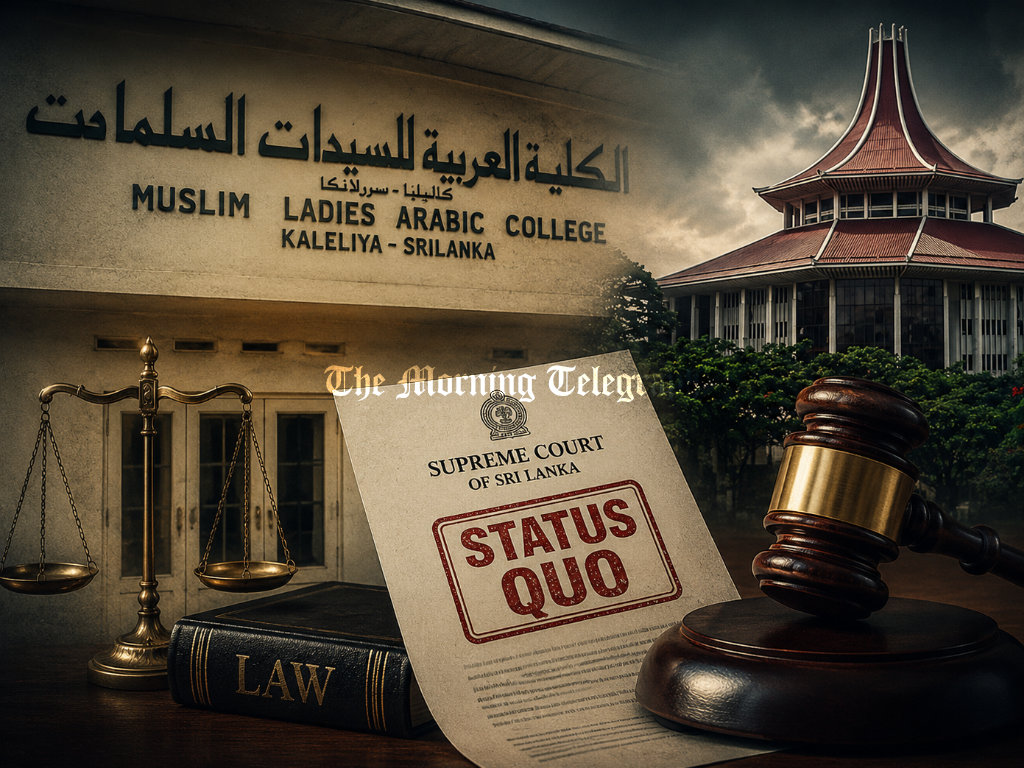
Kaleliya College faces a legal crisis as questions grow over Waqf Board action despite a Supreme Court status quo order.
The Kaleliya College Waqf dispute has pushed a respected Muslim women’s education institution into a serious legal and governance crisis, raising fresh questions over whether the Waqf Board’s conduct can stand while a Supreme Court order remains in force.
Kaleliya Muslim Ladies Arabic College, known for its distinctive role in uplifting Muslim women’s education in Sri Lanka, is now at the centre of a legal battle over whether the institution is private property or property subject to “Waqf,” meaning a public religious trust. That dispute has now reached the highest court in the country.
However, after the Supreme Court issued a “Status Quo” order regarding the matter, attempts by certain groups to bring fresh cases before the Waqf Tribunal against the college management, contrary to that order, have created a serious legal concern.
This article places before the authorities the legal foundation of the entire process and the alleged illegality of filing new cases while the current status quo remains active.

Legal Standing of an Institution Created by Parliament
Kaleliya Muslim Ladies Arabic College is not merely an ordinary registered body. It is an independent institution with legal personality granted through a special Act of Incorporation passed by the Parliament of Sri Lanka.
Legal Status: When an institution is incorporated through an Act of Parliament, its governance, assets and management must be handled according to the provisions of that Act. Its Board of Management has full legal authority to purchase, hold and manage property. Such an institution cannot be automatically converted into an ordinary “Waqf” property.
Supreme Court Status Quo Order and Its Effect
The Board of Management of the college has filed an appeal before the Supreme Court against a decision by the Waqf Board declaring the property a Waqf property. In that case, the Supreme Court has issued a “Status Quo” order protecting the rights of the current administration.
Legal Interpretation: When the Supreme Court issues a “Status Quo” order, it means that until the final judgment is delivered, no party has the right to alter the property or governance structure of the institution. While this binding order remains in effect, neither the Waqf Board nor any other external institution has legal space to interfere with the powers of the current Board of Management or implement fresh decisions.
Why Fresh Waqf Tribunal Cases Raise Legal Questions
While the Supreme Court order remains active, attempts by certain groups to initiate another case before the Waqf Tribunal against the current management are being described as completely illegal. Two key legal principles apply to this situation.
A. Contempt of Court
When an interim order issued by the Supreme Court, the highest court in the country, is in force, seeking relief or taking action from a lower tribunal on the same subject matter directly violates that Supreme Court order. Such conduct may amount to contempt of court under Sri Lankan law and the Constitution.
B. Res Judicata and Sub Judice Principles
Sub Judice: If a matter is already pending before the highest court of the country, parallel proceedings on the same issue cannot be filed or heard before another lower court or tribunal.
Prevention of Legal Multiplicity: The law does not permit the same parties to pursue the same objective, based on the same facts, in multiple courts or tribunals at the same time.
Rule of Law Must Prevail
Attempts to destabilise an educational institution such as Kaleliya Muslim Ladies Arabic College for private agendas are both illegal and unethical.
The Department of Muslim Religious and Cultural Affairs, the Waqf Board and the Waqf Tribunal must fully respect the “Status Quo” order issued by the Supreme Court, the country’s highest judicial authority.
At a time when a Supreme Court ruling is still pending, any legal process pursued against the college’s Board of Management outside that framework amounts to disrespecting the court and, under proper legal examination, is null and void.