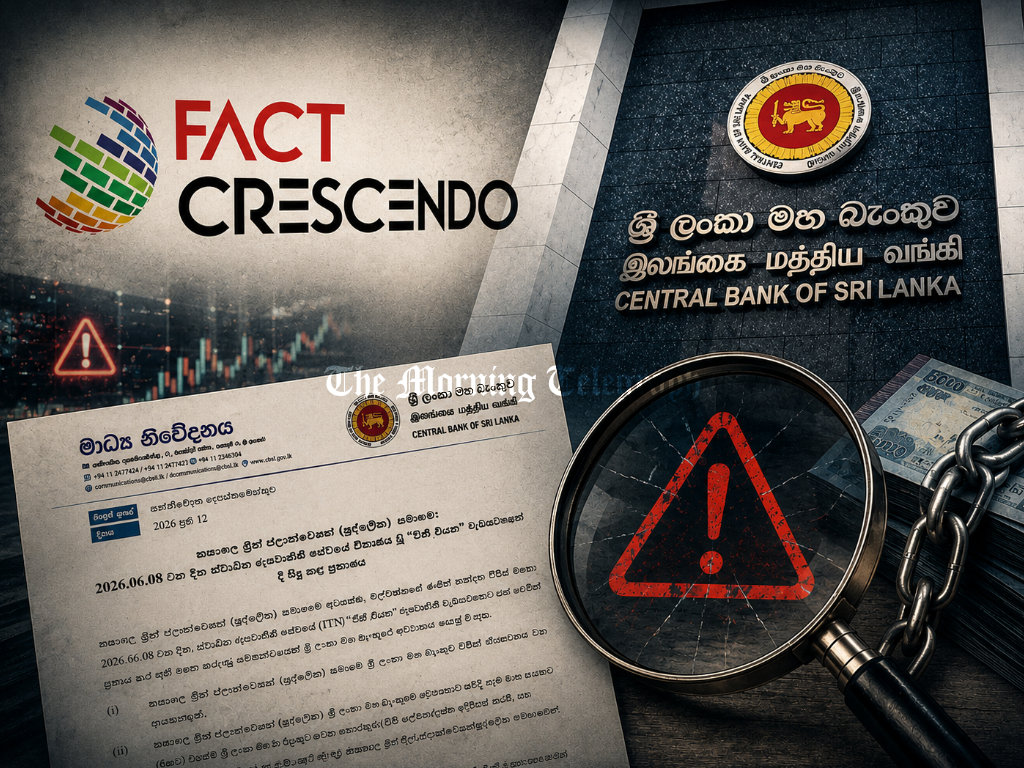
FactCrescendo faces scrutiny after its intervention appeared to soften the Central Bank warning issued against Kasagala Green Plantation.
The FactCrescendo intervention following the Central Bank’s official warning against Kasagala Green Plantation Private Company has triggered a serious debate over public trust, financial regulation and the role of private fact-checking organisations in matters involving state law.
The Central Bank of Sri Lanka holds the absolute authority to protect the stability of the national financial system and ensure consumer safety. When an institution accepts public deposits or creates a financial risk, the Central Bank has the responsibility to issue early warnings to protect the public.
However, after the Central Bank issued a strong warning in June 2026 against Kasagala Green Plantation Private Company (KGPL), the fact-checking organisation “FactCrescendo” intervened through media channels in a manner that critics say subtly weakened the force of state law. The move has now created a serious socio-political and legal controversy.
This article examines what right a third-party organisation such as FactCrescendo has to dilute an official warning issued by the state financial regulator and, in effect, allow a suspicious company to regain consumer confidence.

How the Central Bank Warning Began
The controversy began after a statement made by a director of Kasagala Green Plantation Company during a television programme on June 8, 2026. He claimed that the company was regulated by the Central Bank of Sri Lanka and that it provided financial data to the Central Bank.
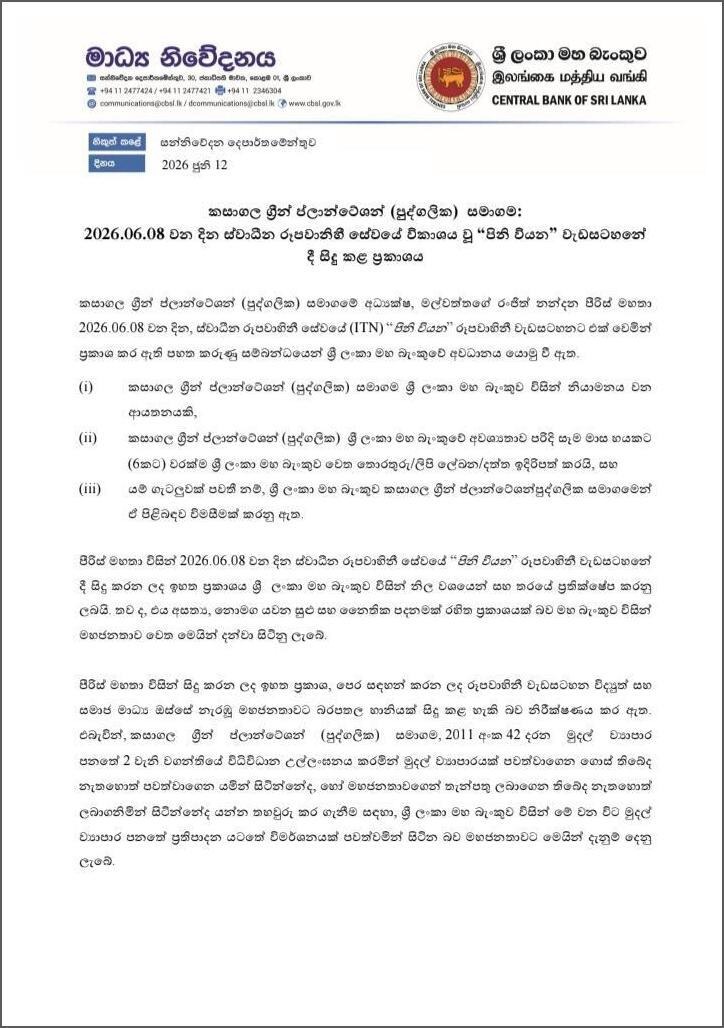
To prevent the public from being misled by that false claim, the Central Bank issued a special notice on June 12, 2026. The bank clearly stated that the company was not regulated by it and that a thorough investigation had been launched to determine whether Kasagala was carrying out unauthorised financial activities in violation of Section 2 of the Finance Business Act.
FactCrescendo’s Role and the Advertising Question
Amid that strong regulatory position, FactCrescendo published an article presented as a clarification regarding the Kasagala company and the Central Bank’s notice. Although the organisation claims to stand for “truth,” critics argue that its intervention effectively normalised a warning issued by the Central Bank to protect the public.
More seriously, FactCrescendo republished on its page the video containing the false statement made by the Kasagala representative during the television programme. Re-promoting a video linked to an institution that had already been warned by the Central Bank is viewed by critics as an act against the public interest. It is also being described as a serious distortion of a decision taken by Sri Lanka’s premier financial institution.
Legal and Structural Contradictions
The clash between the Central Bank’s strong regulatory stance and FactCrescendo’s media intervention is visible in several key areas.
Financial Legality:
While the Central Bank had launched an investigation into suspicions that Kasagala was accepting deposits without authorisation, FactCrescendo highlighted the company’s registration certificates and awards, creating the impression that it was a legitimate agricultural business.
Investment Security:
Although the Central Bank warned about the legal insecurity of collecting money without regulation, the FactCrescendo article indirectly reassured investors by referring to security linked to land and plantation asset deeds.
Public Risk:
While the Central Bank warned that the public could face serious financial harm, FactCrescendo’s emphasis that the matter was merely an “investigation” appeared to reduce possible consumer concern about the company.
Bribery Allegations and Proposed Legal Action
Although FactCrescendo claims to stand for the public’s right to know, serious suspicions have now arisen over whether the organisation served the private interests of a suspicious company. A wider discussion has emerged in society about whether FactCrescendo received any bribe or financial benefit from the company concerned.
It has also been reported that parties who provided relevant information are preparing to file complaints with the Commission to Investigate Allegations of Bribery or Corruption regarding FactCrescendo’s conduct.
Stakeholders have further stated that a representation has already been made to the Central Bank of Sri Lanka, requesting strict action against fact-checking organisations that distort official statements by the state regulator and act as a shield for institutions suspected of fraud.
Critical View
What is clearly visible is the suspicion that Kasagala may have used FactCrescendo to repair the major reputational damage caused by the Central Bank notice.
From a legal perspective, so-called fact-checking organisations that mislead the public by undermining state law for narrow financial or other benefits can be as dangerous as unauthorised financial companies themselves. The critical view is that such fraudulent verification organisations, like Kasagala, must also be brought under strict regulation without delay.