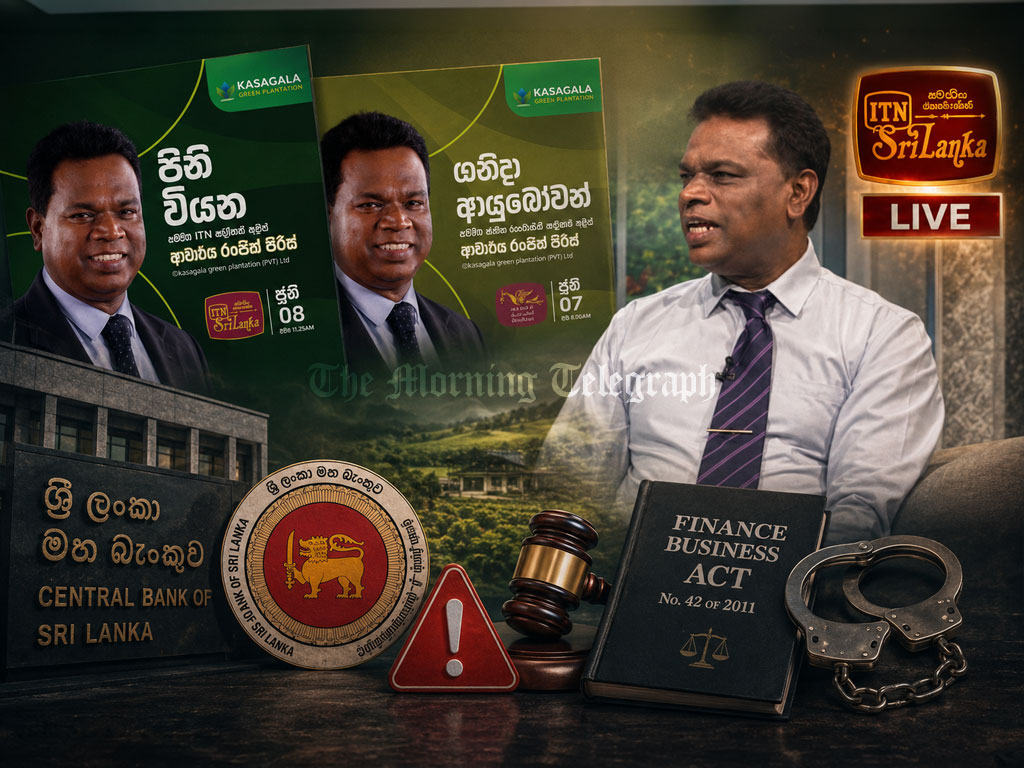
Central Bank warning raises questions over Kasagala Green Plantation’s ITN interview and penalties for promoting unapproved schemes.
Central Bank warning has placed fresh scrutiny on suspicious investment promotions after concerns were raised over media interviews and advertisements linked to unapproved deposit and plantation schemes.
According to the Sunday Times newspaper, the Central Bank of Sri Lanka has issued a strong warning over the promotion of suspicious investment and deposit schemes through media platforms, especially those operating without approval from the banking regulator.

The Central Bank has firmly cautioned media institutions not to publish, broadcast, or promote any unregistered or unregulated deposit-taking ventures or suspicious plantation investment schemes. It warned that those who ignore this directive may face legal penalties.
In a notice issued last week, the banking regulator stated that publishing or promoting such projects through the media is an offence punishable under Central Bank regulations.
Failure to comply with these laws could, upon conviction before the High Court, result in a prison sentence not exceeding five years, a fine not exceeding Rs. 5 million, or both. The person concerned may also be ordered to settle obligations owed to depositors and other creditors under court supervision.
The warning followed the appearance of Kasagala Green Plantation (Private) Company Director Malwaththa Ranjith Nandana Peris on an Independent Television Network program on Monday, June 8, where he promoted the company’s plantation investment options.
During the interview, Peris reportedly claimed that the company was a regulated institution under the Central Bank. That claim is false. The Central Bank has previously warned the public about suspicious plantation investment schemes.
The Central Bank says an investigation is now underway into the activities of this company under the provisions of the Finance Business Act No. 42 of 2011.
The inquiry seeks to determine whether the company has engaged in, or is currently engaged in, financial business contrary to Section 2 of the Finance Business Act, or whether it has accepted, or is accepting, deposits from the public.
Meanwhile, on Friday, the Central Bank sent a letter to the chairpersons of all media institutions, stating that despite awareness programs conducted by the regulator, unauthorized institutions continue to operate. It also warned that citizens remain at risk of falling victim to such unauthorized entities.
“Media institutions and journalists must understand the provisions of the Finance Business Act (FBA), especially regarding commercial advertisements and interviews relevant to their duties. The Central Bank has observed that some media institutions have broadcast or published content promoting businesses that appear to be taking deposits. Before publishing any advertisement soliciting deposits, media institutions must verify whether the relevant advertisers are authorized institutions under the Finance Business Act,” the letter stated.
The Central Bank further pointed out that media institutions are legally bound to ensure that deposit-related advertisements comply with the law before they are promoted to the public.
The letter also drew attention to Section 49, read together with Section 56(4) of the Finance Business Act, emphasizing that media outlets must take responsibility before giving publicity to businesses that appear to solicit public deposits.