By Roshan Jayasinghe
Some of life’s greatest lessons arrive without invitation. They are not found in books, classrooms or speeches, but in ordinary moments that most of us would simply pass by. During a recent motorcycle ride along California’s breathtaking Big Sur coastline, one such moment unfolded before me through the actions of a small squirrel. What began as a light-hearted encounter became a quiet reflection on one of the oldest questions humanity continues to ask itself.
One of the greatest pleasures of riding a motorcycle has very little to do with the motorcycle itself. It is the freedom to stop whenever something captures your attention. A magnificent ocean view, a winding mountain road, a conversation with a stranger, or simply a place where nature asks you to slow down for a few minutes. Those moments have become just as meaningful to me as the destination.

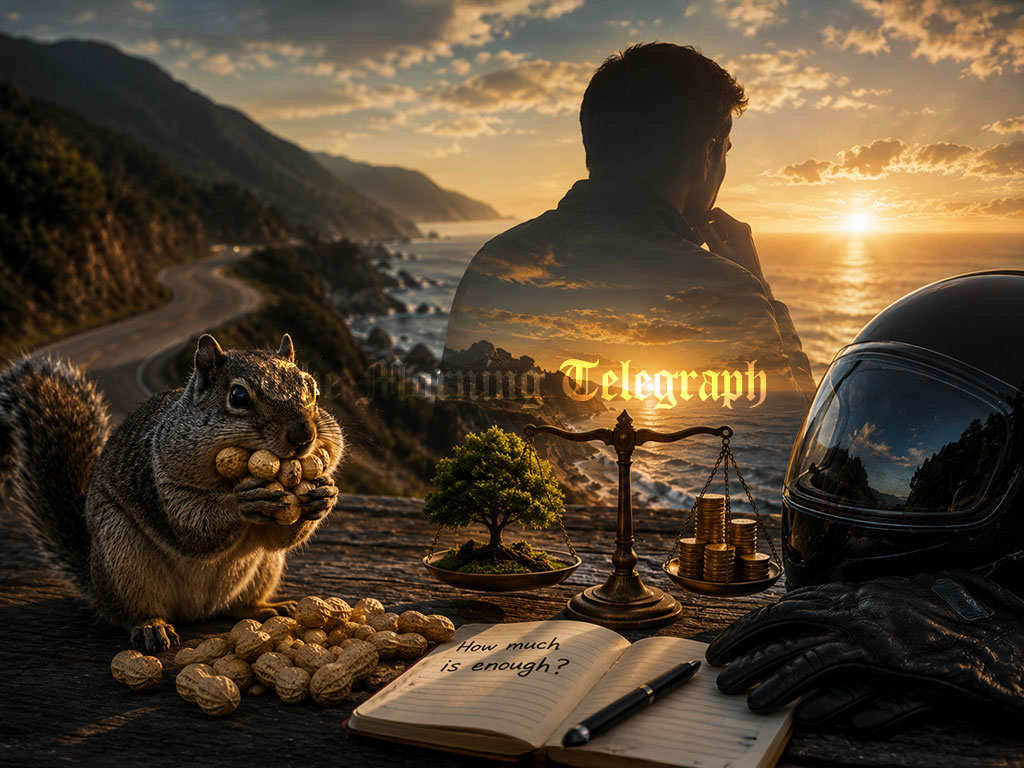
During my recent ride through Big Sur, a fellow rider and I stopped to admire the scenery. Before long, a small squirrel wandered towards us with complete confidence, as though visitors had become a familiar part of its world. We offered it a few peanuts. It quickly picked one up, then another, and then another. Within moments its tiny mouth was completely full, yet it continued trying to gather more.
Watching this little creature made us smile. Then, almost without warning, my thoughts travelled somewhere entirely different.
My first reaction was to think how similar this seemed to human behaviour. We too often want one more of almost everything. One more possession. One more achievement. One more promotion. One more dollar. One more acre of land. One more victory. It appeared, at first glance, that this tiny squirrel and humanity were not so different after all.
The longer I watched, the more I realised that I had been asking the wrong question.
The squirrel was not making a moral decision. It was not comparing itself to another squirrel. It was not building wealth, chasing status or measuring success. It was simply responding to instincts that have allowed its species to survive for countless generations. Gathering food today may very well determine whether it survives tomorrow. There was nothing selfish about what it was doing. It was simply being what nature had created it to be.
My attention slowly shifted away from the squirrel and back towards myself.
Human beings are different.
We too carry instincts, desires and ambitions, but we also possess something extraordinary. We have the ability to pause before acting. We can question our own desires. We can examine our motives. We can decide whether another possession will genuinely improve our lives or simply satisfy a passing impulse. We have the rare ability to recognise when enough has already arrived.
That ability may be one of the greatest gifts entrusted to humanity.
As I continued my ride, I began thinking about how much of modern life encourages accumulation. We often build larger than we need, buy more than we use, consume more than we appreciate and waste more than we realise. Entire economies celebrate continual growth, while our own hearts quietly search for contentment. The irony is difficult to ignore. We have achieved remarkable advances in science, medicine and technology, yet many of us still struggle with one of the simplest questions life can ask.
How much is enough?
This is not a question about ambition. There is nothing wrong with working hard, preparing for the future or creating a better life for those we love. Progress has always been one of humanity’s greatest strengths. The question is whether progress eventually reaches a place where wisdom asks us to stop measuring life only by what we accumulate and begin measuring it by what we understand, what we share and how we live.
Nature has an extraordinary way of reminding us of truths we often overlook. It asks for nothing except our willingness to observe. A tree grows only as much as it needs to remain healthy. Rivers never compete with one another. The ocean never attempts to become the mountain. Every living thing follows its own purpose within the balance of life.
Human beings alone possess the remarkable freedom to choose whether our desires remain servants of our lives or become their masters.
As I rode away from Big Sur, the image of that tiny squirrel stayed with me far longer than I expected. It reminded me that some of life’s deepest lessons do not arrive through great discoveries or complicated philosophies. They often reveal themselves through ordinary moments that quietly ask us to pay attention.
I found myself asking a question that has remained with me ever since.
When we already have enough to live with dignity, enough to care for those we love and enough to appreciate the beauty that surrounds us, what is it that continues to convince us we need more?
The answer to that question may reveal less about the squirrel and far more about ourselves.
Author’s Note
These reflections are not intended as judgments of others but as observations of humanity, beginning with myself. Every article I write begins with an ordinary moment from everyday life. My hope is simply to look a little more closely at the world around us and, through those observations, better understand ourselves. If this story encourages even one reader to pause for a moment and reflect on what “enough” means in their own life, then that small squirrel has already taught us more than it could ever have imagined.
About the Author
Roshan Jayasinghe is a writer and observer of human systems. His work explores the gap between man made constructs and lived humanity, with a focus on how economics, trade and everyday choices intersect with questions of fairness, responsibility and inner alignment. Through essays for publications in The Morning Telegraph, he aims to remind readers that they are not passengers in a fixed machine, but active custodians of a shared world.