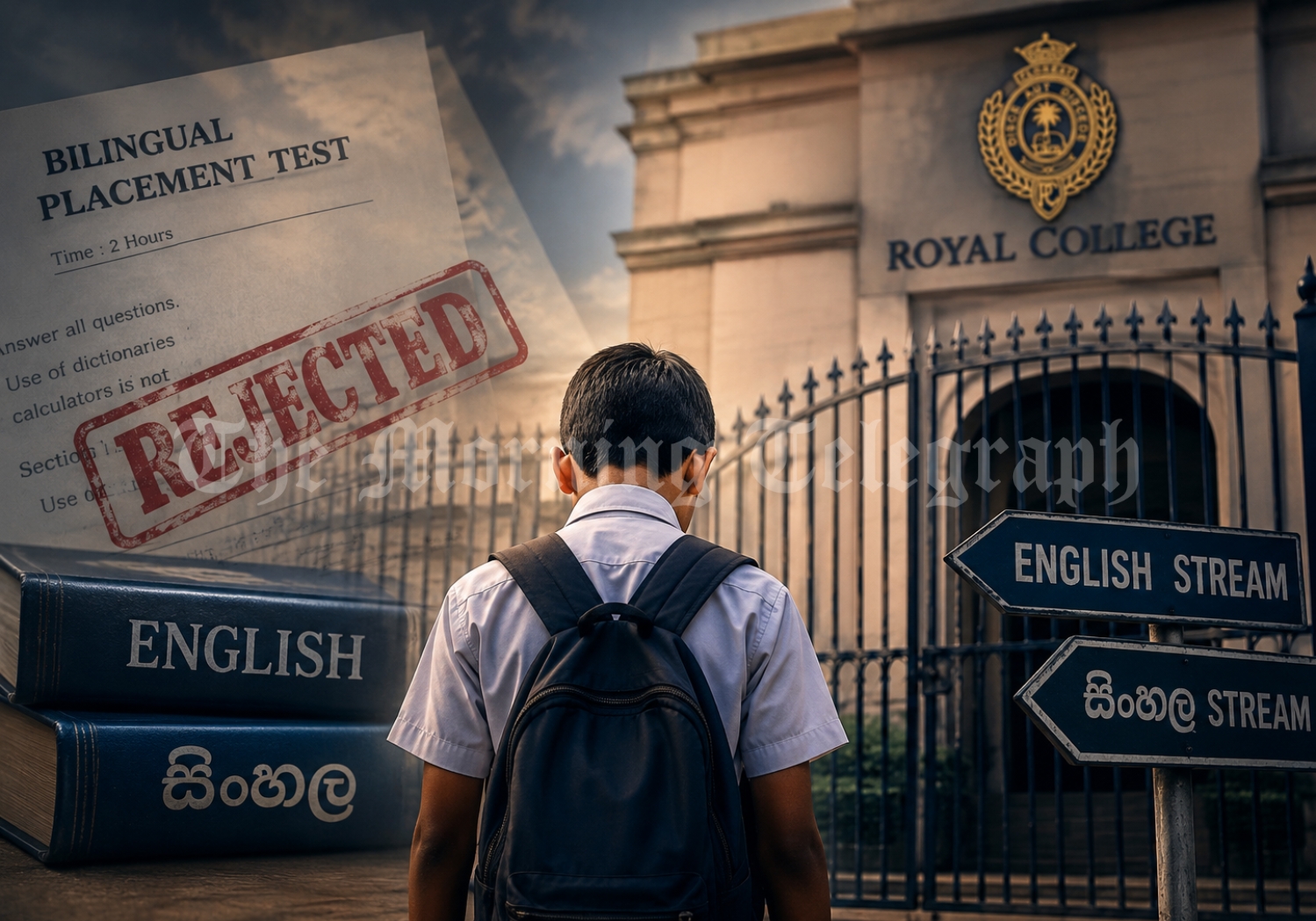
The Royal College bilingual test has triggered anger among parents, who say bright Scholarship students face unfair gatekeeping.
Behind Royal College’s gates, they allege, sits a disturbing system of exclusion, corruption and shattered dreams. Critics call it an administrative racket disguised as an “academic placement test”. They say it blocks deserving children from English-medium education while favouring families with influence, access or money.
Imagine an 11-year-old from a rural village. He excels at the Grade 5 Scholarship examination and enters a premier public school. He leaves his parents, friends and village to study in Colombo.
His dream is simple. He wants to continue learning in English, as he had already been doing in the bilingual stream at his village school. But when he reaches Royal College, that dream collapses.
The school requires him to sit for a secretive bilingual placement test. Parents say there is no clear syllabus, no past papers and no transparent marking process. They also allege that the paper tests advanced areas children have never studied.
Then comes rejection. The child hears that “there is no space” or that his English level is not sufficient. He cannot return to his village school. Instead, he must abandon English-medium education and move back into the Sinhala stream.
Royal College Bilingual Test Under Scrutiny
Is this really about resources? Parents and campaigners reject that claim.
They point to a previous inquiry before the Human Rights Commission, which they say exposed the system as compromised. According to their account, the process did not function as a fair academic assessment. Instead, it became a broken channel for financial and personal advantage.
The first allegation concerns backdoor access. Parents claim brilliant and fluent children failed the test while students with weak English fluency somehow scored high marks. They allege that examination papers reached a selected few in advance.
The second allegation concerns unauthorized approvals. Parents say some students who scored extremely low marks still entered the bilingual stream, bypassing the same system used to reject others.
If these claims are correct, the test does not protect academic standards. It protects privilege and punishes children without access to the right networks.
Parents Say Results Exposed The Truth
Determined parents challenged the process before the Human Rights Commission and the Attorney General’s Department. Their campaign later led to a reversal under former Principal Mr. R.M.M. Rathnayake.
The school admitted the rejected children in Grade 7. It also allowed students who preferred the bilingual stream to enter it. According to parents, this happened without creating any shortage of teachers, classrooms or resources.
That outcome challenged the school’s earlier claim that some children “could not cope” with English. Parents say the children caught up after missing a full year of English-medium instruction.
One unfairly rejected student later received Commendable Reports for three consecutive years in Grades 7, 8 and 9. That student maintained a strict average above 75 percent across every subject.
For parents, this evidence destroys the credibility of the placement test. They say it does not measure ability. Instead, it measures privilege, access and compliance.
When Ananda Can, Why Not Royal?
The central question remains unavoidable. If national schools such as Ananda College can provide bilingual education based on student and parental preference, why can’t Royal College do the same?
Parents also point to regional schools in the Polonnaruwa district. They say those schools provide bilingual opportunities without secretive barriers.
So what does Royal College lack that a school in Polonnaruwa appears to manage? Parents argue that the issue is not money, buildings or capacity. Royal College has infrastructure and prestige. They say the missing element is integrity.
They also allege that the current administration reintroduced the test after Mr. Rathnayake retired. In their view, it reopened a restrictive gateway that should have stayed closed. They believe it creates space for under-the-table deals at the cost of children’s futures.
Parents frame the matter as a direct violation of the fundamental right to education. They want the Ministry of Education to intervene, abolish the disputed placement test and mandate open enrollment for the Grade 6 bilingual intake.
Children should not become commodities in an administrative system. They should not lose English-medium education because hidden gatekeepers control access. Royal College must explain why it cannot offer bilingual education openly. The Ministry must answer too.