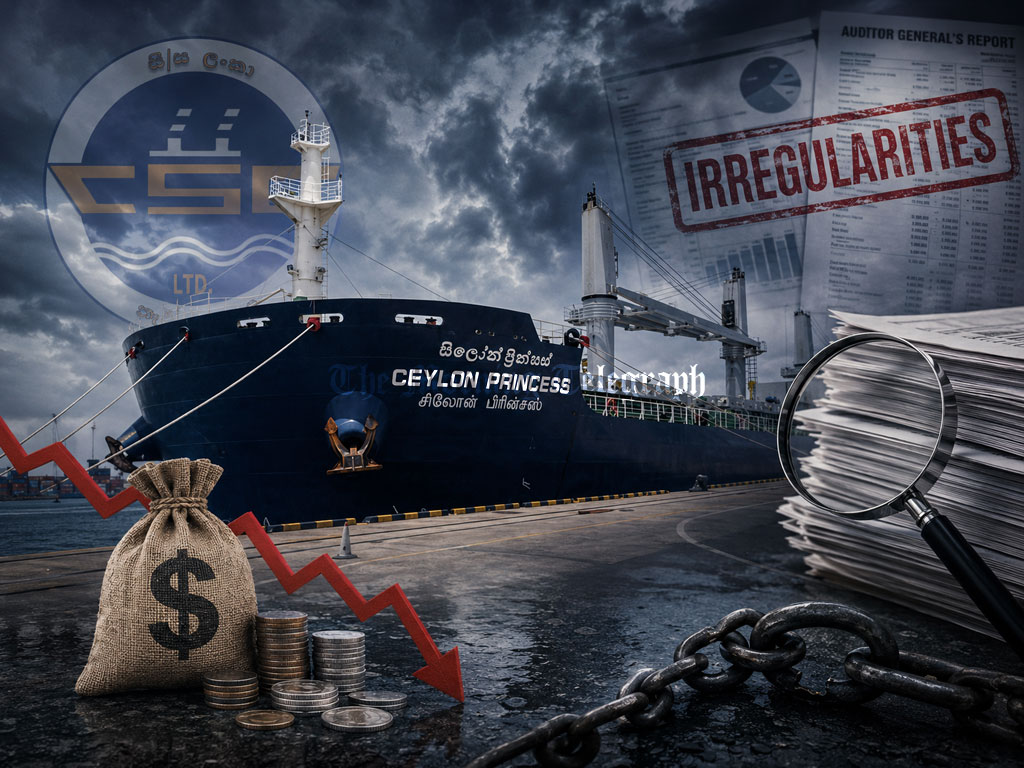
Ceylon Shipping Corporation irregularities exposed at COPE include poor investments, unpaid vessel debt, financial losses and weak oversight.
Serious Ceylon Shipping Corporation irregularities have come under scrutiny after the Committee on Public Enterprises, known as COPE, uncovered major financial and operational concerns.
The Committee heard that Ceylon Shipping Corporation Limited had invested Rs. 630 million in six subsidiary and associated companies. However, the annual return from those investments amounted to a dividend of just Rs. 400,000.
The COPE Committee, chaired by Parliamentarian Dr. Nishantha Samaraweera, recently met at Parliament to examine the state-owned corporation.
The Committee reviewed the Auditor General’s reports for 2021, 2022 and 2023. It also examined the Corporation’s current performance and raised several serious concerns about its operations.

Ceylon Shipping Corporation Irregularities Under Scrutiny
COPE found that the Corporation’s Corporate Plan for the 2024 to 2027 period was not practical.
The Committee observed that officials had not prepared the plan as a meaningful guide for the institution’s operations. Instead, it appeared to have been prepared merely to meet administrative requirements.
COPE also raised concerns about the Corporation’s weakened decision-making process. Several key executive positions, including the post of General Manager, have remained filled on an acting basis for extended periods.
The Committee also examined the US$70 million loan obtained in 2016 to purchase two vessels. Of that amount, US$47 million still remains to be repaid.
Delays in paying loan instalments have also forced the Corporation to undertake debt restructuring.
Meanwhile, rising vessel fuel costs and failures in properly maintaining operational systems have created further problems. According to the Committee’s findings, these weaknesses caused the Corporation to lose opportunities to earn greater revenue from the international market.
COPE also heard that authorities had not conducted a formal investigation into the disappearance of 1,852 litres of lubricating oil from the vessel Ceylon Breeze.
Furthermore, a school uniform fabric distribution project resulted in a loss of Rs. 1.4 million. The institution has also failed to recover another Rs. 6.3 million.
Shipping Agreement Failed to Meet Revenue Targets
The Committee also examined the agreement with Singapore’s Wallem Shipping company for the commercial management of vessels.
The arrangement has operated since 2016. However, COPE emphasized that it had failed to achieve the expected revenue targets.
The Committee identified another serious weakness in the agreement. Although the company had failed to meet its targets, the contract contained no penalty clauses to address such failures.
Officials told the Committee that the agreement is scheduled to end in September 2026.
They said authorities have prepared a new plan and a Cabinet paper to change the Corporation’s commercial operating model after the agreement ends.
Under the proposed system, the Corporation would move away from intermediary companies. Instead, it would conduct commercial operations through six government-registered direct brokers.
Officials expect the new system to save commission fees while helping the Corporation establish direct relationships within the international market.
COPE Calls for Restructuring and Formal Investigations
Following its examination, the Committee ordered a complete restructuring of the Ceylon Shipping Corporation.
COPE also directed the institution to immediately reduce unnecessary expenditure as concerns continue over financial management, debt and operational weaknesses.
Finally, the Committee recommended formal investigations into the alleged frauds and irregularities uncovered during its examination.
COPE recommended that authorities conduct these investigations through either the Criminal Investigation Department or the Commission to Investigate Allegations of Bribery or Corruption.
The findings have placed renewed attention on the management of the state-owned shipping company. The proposed restructuring, change in its commercial operating model and recommended investigations will now determine how authorities address the financial and operational weaknesses identified by the parliamentary committee.