Patali Champika court case testimony faces scrutiny over medical records, political links and alleged contradictions exposed by the defence.
The Patali Champika court case has taken a dramatic turn after defence lawyers challenged the prosecution’s main witness over his medical history, political links and alleged contradictions.
The case relates to a traffic accident in Rajagiriya in 2016. Former Minister Patali Champika Ranawaka and two other defendants face proceedings before Colombo High Court Judge Rashmi Singappuli.
The court heard the matter on June 25, 2026, and July 8, 2026.
During those hearings, the defence described prosecution witness Harsha Bandara Thilakasiri as a “political puppet.” It alleged that he had presented false and contradictory testimony.
Deputy Solicitor General Yohan Abeywickrama appeared for the prosecution. According to the account of the proceedings, he informed court that the witness had committed the offence of concealing evidence.
President’s Counsel Sarath Jayamanna and President’s Counsel Maithree Gunaratne conducted the cross-examination for the defence. Their questioning focused on the witness’s statements, timeline and personal background.

Medical Evidence Raised in Patali Champika Court Case
Harsha Bandara told court that he had been abducted and forcibly sent for medical treatment.
However, the defence produced documents relating to his previous medical care. It argued that those records contradicted his account.
According to the defence, the witness had previously attempted suicide while suffering from a severe psychotic condition. It said he had received medical treatment following that incident.
The court also heard about a formal report prepared by a medical board.
The board reportedly included specialist doctors Jayan Mendis, Nilanthi de Silva and Nishantha Gunasekara. The article states that two members were university deans.
According to the documents presented in court, the medical board concluded that the witness suffered from a mental illness.
A statement attributed to specialist doctor Jayan Mendis also indicated that the witness had received treatment from him for the condition over a period of time.
These matters emerged as the defence sought to question the witness’s reliability. However, they remain part of arguments and evidence presented during an ongoing trial.
Defence Alleges Political Influence Behind Testimony
The defence also questioned why the witness surfaced publicly in 2019, three years after the accident.
By that point, the second defendant had already pleaded guilty and paid a fine in 2017.
The witness later held media discussions and lodged complaints with the police and the Colombo Crimes Division. These developments reportedly occurred soon after Gotabaya Rajapaksa came to power.
The defence argued that a political hand influenced those actions.
It also referred to the known political dispute between Patali Champika Ranawaka and Udaya Prabhath Gammampila.
During his testimony, the witness reportedly said: “At that time, only Gammampila helped me. He gave legal advice and told me to speak to the media. I held the media discussion at Gammampila’s office.”
The defence further alleged that the witness acted out of resentment. It claimed that Ranawaka had declined to assist the witness’s girlfriend, a Korean woman identified as “Lee,” with her business affairs.
These claims were presented by defence counsel and have not been established as judicial findings.
Chef Claim and Walking-Track Timeline Challenged
Sarath Jayamanna compared statements the witness had given police with his testimony in court.
During the questioning, the witness reportedly laughed while responding to some of the contradictions raised by counsel.
The defence challenged his earlier claim that he had served as the minister’s private secretary. Under cross-examination, he acknowledged working as Head Chef at Waters Edge Hotel.
Counsel also questioned his account of visiting the Boralesgamuwa walking track.
The witness said he went there because it had a lake and because a heart condition required him to walk slowly.
The defence asked why he travelled several miles when a lakeside walking track stood beside Waters Edge Hotel. The witness reportedly answered that there was no lake near Waters Edge.
Defence counsel described that response as a fundamental falsehood.
The timeline also came under scrutiny.
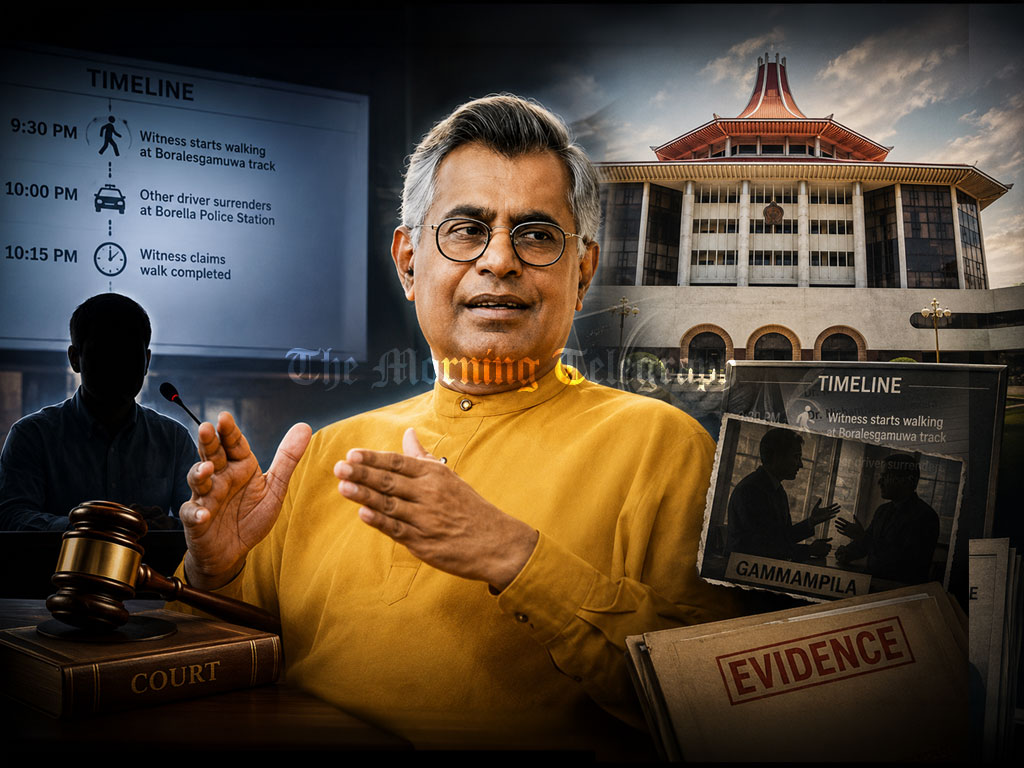
The witness said walking one-and-a-half rounds of a three-kilometre track slowly would take 45 minutes. Therefore, a walk beginning at 9.30 p.m. would end after 10.15 p.m.
However, Thusitha Kumara had reportedly surrendered at Borella Police Station by 10 p.m.
Based on that timing, the defence argued that the witness’s version of events had been fabricated.
Questions Over Authority and Allegedly Concealed Evidence
The defence also asked what authority a hotel chef had to issue instructions to driver Thusitha Kumara.
At the time, Kumara was reportedly travelling with the minister’s two young daughters.
Counsel asked how the witness could order him to leave the children on the road and immediately report to Borella Police Station. According to the account, the witness did not answer.
Jayamanna then told him: “You created evidence in this case, so you should be the 4th defendant here.”
The witness reportedly gave no response.
The hearing also addressed a statement that driver Alwis had given police at the time of the accident. The defence alleged that investigators deliberately excluded his true statement from the case.
Meanwhile, the prosecution sought permission to record online testimony from another witness living in Germany. The defence strongly objected to that request.
Judge Rashmi Singappuli postponed the Patali Champika court case until September 1, 2026. The court also issued notices directing other witnesses to appear that day.
The defendants are former Minister Patali Champika Ranawaka, Dilum Thusitha Kumara and former Welikada Police Officer-in-Charge Sudath Asmadal.
The proceedings remain ongoing, and the court has yet to make final findings on the disputed testimony, medical evidence or allegations raised during cross-examination.