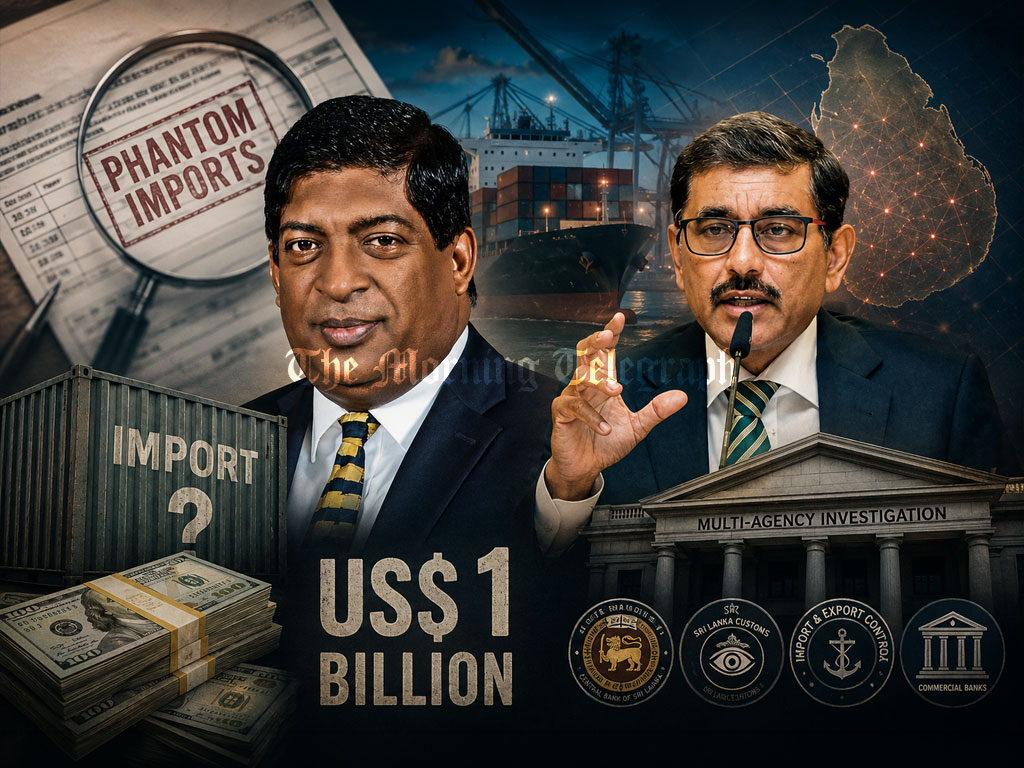
US$1 billion phantom imports allegations face a proposed multi-agency probe backed by Central Bank Governor Nandalal Weerasinghe.
The US$1 billion phantom imports allegation should face a coordinated multi-agency investigation, Central Bank Governor Dr. Nandalal Weerasinghe has said.
He backed a proposal by Member of Parliament Ravi Karunanayake for a detailed inquiry into claims that nearly US$1 billion in fake or “phantom” imports may have occurred.
Dr. Weerasinghe said only a joint investigation involving every relevant authority could establish how the transactions happened. Such a probe should also identify regulatory gaps and recommend corrective action.

US$1 Billion Phantom Imports Probe Gains Support
The Central Bank Governor made the remarks during a recent appearance before the Parliamentary Committee on Public Finance (CoPF).
He accepted Karunanayake’s proposal for a special discussion on the issue and said the Central Bank could contribute its views.
“I saw through the media that MP Ravi Karunanayake has requested a meeting. I think it would be good to have that detailed discussion with the authorities. We can also participate and share our views and proposals on how it happened, what leads to such situations, and what the gaps in the laws are,” he said.
Dr. Weerasinghe said the investigation should involve the Central Bank of Sri Lanka, Sri Lanka Customs and the Department of Import and Export Control.
He added that commercial banks and other relevant institutions should also participate.
The Governor informed CoPF that President Anura Kumara Dissanayake had already discussed the transactions with Customs, foreign exchange authorities and other institutions.
Following those discussions, the Department of Import and Export Control issued a series of instructions to address the issue.
However, Dr. Weerasinghe stressed that the Central Bank does not hold information gathered by law enforcement authorities regarding the specific allegations.
“We do not have information on that. This is a very broad investigation. I don’t think we can comment on that transaction at this moment without proper information,” he told the committee.
Data Gaps May Explain Part of the Discrepancy
Dr. Weerasinghe explained that Sri Lanka’s foreign exchange framework permits advance payments for imports.
He said time gaps between foreign exchange regulations and Customs procedures could create apparent inconsistencies. Some transactions may legally appear in Central Bank payment records before entering Customs data.
Central Bank officials said time lags, advance payments and documentation requirements could account for a significant share of the reported value.
Therefore, officials warned that data inconsistencies should not automatically be treated as proof of US$1 billion phantom imports.
Preliminary analysis indicates that approximately 40% of the questioned US$1 billion may relate to genuine imports.
That finding supports the Governor’s position that authorities should conduct a comprehensive investigation before reaching any final conclusion.