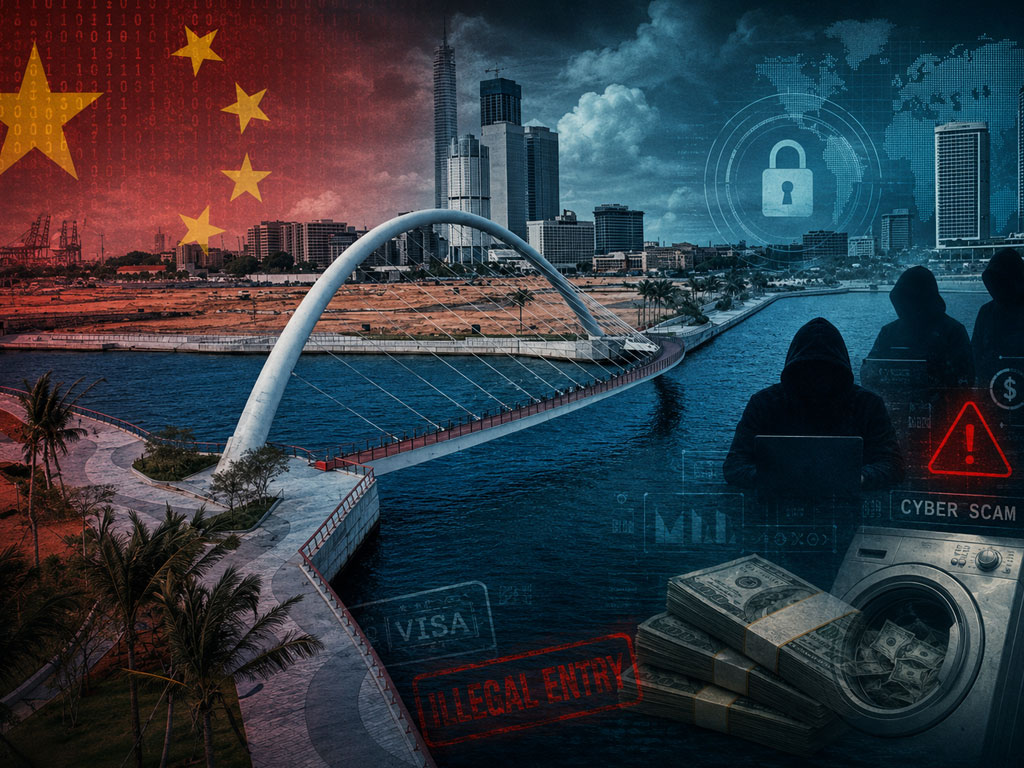
Colombo Port City security concerns are growing amid warnings over cybercrime, organised criminal networks and weak regulatory oversight.
Colombo Port City security has come under growing scrutiny amid concerns that relaxed regulations could expose Sri Lanka’s Chinese-funded economic zone to cybercrime, money laundering and organised criminal activity.
China has developed overseas Special Economic Zones as part of its Belt and Road Initiative. Critics have long warned that extensive legal exemptions and weak enforcement could allow some zones to become enclaves for foreign criminal networks.
Similar concerns surrounded Colombo Port City from its early stages.
The United States and other critics warned successive Sri Lankan governments that the project’s special legal and regulatory framework could create vulnerabilities involving financial crime and illicit transactions.
The Rajapaksa administration launched the project, while the Sirisena-Wickremesinghe government initially opposed aspects of it. The present administration has also continued with the development.
Colombo Port City now operates under the Colombo Port City Economic Commission Act No. 11 of 2021. The Commission acts as the principal authority overseeing businesses and operations within the Special Economic Zone.
Get Breaking News First
on WhatsApp

Cambodia Shows How Special Zones Can Be Exploited
When China supported the development of the Sihanoukville Special Economic Zone in Cambodia, opposition politicians warned that the area could become a base for transnational crime.
The Cambodian government dismissed those concerns and promoted the development as a major source of investment and prosperity.
However, Sihanoukville later became associated with online scam centres, money laundering, human trafficking and organised crime.
United Nations agencies have documented the growth of cyber-scam compounds across Cambodia, Myanmar and Laos. Many operations use trafficked workers who face threats, confinement and violence while being forced to carry out online fraud.
Chinese-supported economic zones in Myanmar and Laos have also faced allegations involving gambling, narcotics trafficking and cybercrime.
The Golden Triangle Special Economic Zone in Laos and criminal compounds operating in Myanmar have become prominent examples of how weakly regulated areas can attract transnational syndicates.
These developments do not prove that Colombo Port City will follow the same path. However, they demonstrate why strong regulation, financial monitoring and law enforcement remain essential.
Colombo Port City Security Questions Intensify
Sri Lanka has already recorded an alarming increase in organised cybercrime involving foreign nationals.
Recent enforcement operations have led to the detention and deportation of hundreds of foreign nationals, many of them Chinese, over suspected involvement in cyber-scam activities.
Public reporting indicated that authorities had detained or deported nearly 700 foreign nationals during recent operations, although the source article places the broader number at around 1,000.
Concerns intensified after a violent incident involving Chinese nationals at Colombo Port City.
Investigators are reportedly examining whether the confrontation and subsequent killing had links to a wider cyber-fraud network or organised Chinese criminal groups. These connections remain under investigation and have not reached a final legal determination.
The incident has renewed questions about visa monitoring, financial surveillance and law-enforcement access inside the zone.
Sri Lankan authorities must ensure that commercial incentives and foreign investment never override national security.
Colombo Port City may still become a valuable regional business hub. Its official regulatory framework promises centralised supervision, investment facilitation and oversight under Sri Lankan law.
However, confidence will depend on transparent investigations, strong anti-money-laundering controls and equal enforcement against every criminal network.
Without firm action, Colombo Port City security concerns could undermine the very investment and international credibility the project was designed to attract.