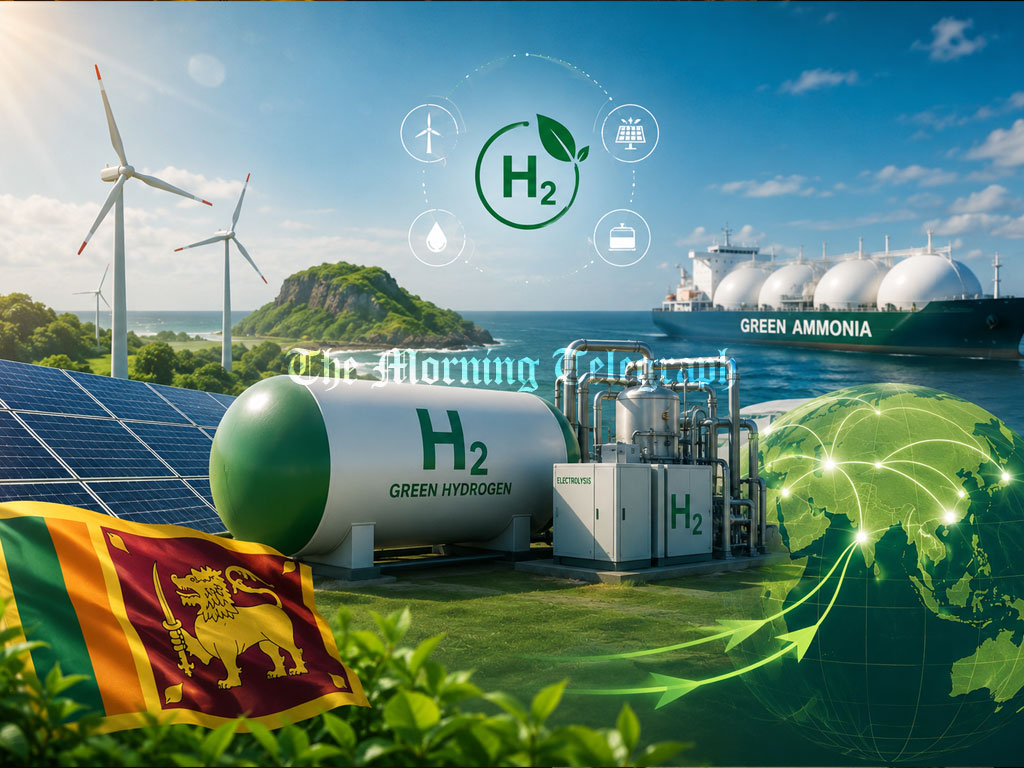
Sri Lanka green hydrogen plans move toward investment, but financing, infrastructure, safety rules and renewable capacity remain major challenges.
Sri Lanka’s Sri Lanka green hydrogen ambition is moving from policy documents toward investment promotion, but major challenges remain before the country can become a regional producer and exporter.
The government has now taken a significant step by inviting potential investors to express interest in green hydrogen and ammonia projects.
The Board of Investment (BOI) launched a Request for Information (RFI) process for prospective investors. The submission period ended on June 5, 2026.
Officials describe the move as the beginning of Sri Lanka’s commercial hydrogen programme. However, turning that ambition into an export industry will require major investment, infrastructure and regulatory development.
Green hydrogen uses renewable electricity to split water into hydrogen and oxygen through electrolysis. Unlike conventional hydrogen produced using fossil fuels, the process generates virtually no carbon emissions.
As a result, green hydrogen has become increasingly attractive to industries seeking to cut emissions and meet climate targets.

Sri Lanka Green Hydrogen Plan Targets Renewable Potential
Sri Lanka hopes to use its expanding solar and wind energy resources to build the new industry.
Under the proposed model, excess renewable electricity generated during off-peak periods could power hydrogen production. Producers could then store the hydrogen to strengthen domestic energy security.
Alternatively, companies could convert it into green ammonia and methanol for export. Potential markets include countries pursuing net-zero emissions targets and cleaner industrial energy systems.
The initiative forms part of the government’s wider renewable energy strategy. Sri Lanka aims to increase renewable electricity generation to 70 percent by 2030 while reducing dependence on imported fossil fuels.
Budget 2026 also identified the development of green hydrogen hubs as a national priority. The government sees potential for generating export revenue while improving the country’s long-term energy security.
The National Policy on Renewable Hydrogen in Sri Lanka supports these ambitions.
The Ministry of Energy prepared the policy together with the Sri Lanka Sustainable Energy Authority (SLSEA) and the United Nations Development Programme (UNDP).
The policy sets out a regulatory framework covering hydrogen production, storage, transportation and exports. It also seeks to encourage investment in emerging technologies linked to the industry.
From Hydrogen Roadmap to Investor Search
Sri Lanka introduced its National Hydrogen Roadmap in 2023. However, officials acknowledge that the earlier phase largely concentrated on strategy and long-term planning.
Since May 2026, the government has shifted its focus toward regulatory reforms and attracting investors with the capacity to finance large-scale projects.
One of the most important remaining tasks is the development of safety standards.
Since August 2025, the SLSEA has been drafting regulations covering health, operational safety and hydrogen infrastructure.
Authorities aim to complete the regulatory framework before construction begins on the country’s first commercial hydrogen facilities.
Meanwhile, research partnerships are building the technical foundation needed for future industry development.
An agreement signed with Greenstat Hydrogen in March 2025 supports Green Mobility pilot projects. It also provides for a Centre of Excellence for Hydrogen at the University of Peradeniya.
The initiative aims to develop technical expertise and strengthen Sri Lanka’s hydrogen research capacity.
Massive Investment Challenge Ahead
Despite growing momentum, the Sri Lanka green hydrogen vision faces major practical hurdles.
Analysts point to the need for massive renewable electricity expansion, specialised infrastructure and billions of dollars in investment.
The scale of the government’s long-term ambition is substantial. Current plans envision installing 30 gigawatts of electrolyser capacity by 2048 to support Sri Lanka’s carbon neutrality goals.
Achieving that target will require much more than policy announcements. Sri Lanka will need sustained investor confidence, reliable regulation and enough renewable energy generation to support hydrogen production at scale.
The country must also develop infrastructure capable of producing, storing, transporting and potentially exporting green hydrogen and its derivatives.
Whether the ambition becomes a commercial reality will ultimately depend on policy consistency and successful execution.
Sri Lanka has begun the transition from planning toward implementation. However, the real test lies ahead: converting the island’s renewable energy potential into a competitive green hydrogen export industry.