Judicial retirement age changes face opposition as G.L. Peiris warns of political interference, blocked promotions and damage to public trust.
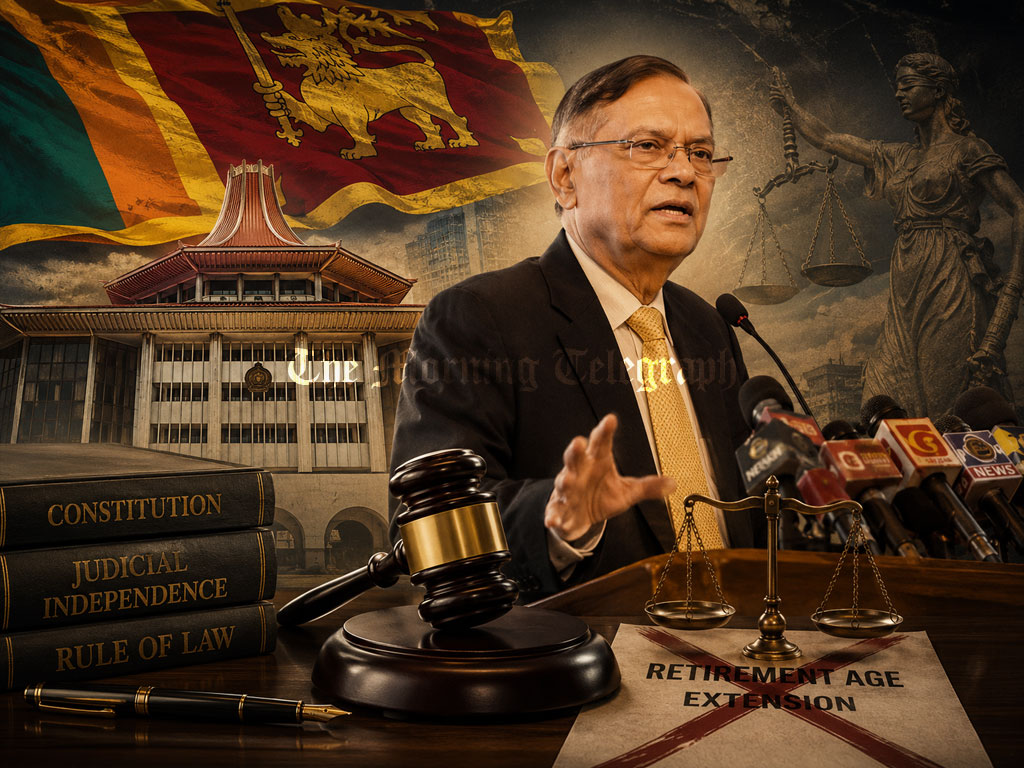
The proposed judicial retirement age extension could destroy Sri Lanka’s democratic culture and institutional system, Professor G.L. Peiris has warned.
The proposal seeks to amend Article 107(5) of the Constitution. It would increase the retirement age of Supreme Court judges from 65 to 67.
It would also raise the retirement age of Court of Appeal judges from 63 to 65.
Professor Peiris made the remarks yesterday (09) at a scholarly forum held at the Amari Hotel auditorium in Colpetty.
The combined opposition organised the event under the title, “Let’s Defeat Political Ploys That Undermine Judicial Independence.”
Numerous President’s Counsels, opposition political leaders and civil society representatives attended the discussion.

Judicial Retirement Age Plan Questioned
Speakers at the forum argued that the proposed extension would not benefit the country or strengthen the judicial system.
Instead, they alleged that the amendment serves a narrow political agenda.
Three Supreme Court judges have already retired this year. If Parliament passes the amendment next month, it will not apply to those who have already left office.
Speakers said this selective effect raises questions about whether the government designed the amendment to benefit a small number of serving judges.
They also stressed that no recognised section of the legal community had demanded such a change.
Neither the Bar Association of Sri Lanka, serving judges nor civil society had requested an extension, according to speakers at the forum.
Professor Peiris acknowledged that countries maintain different retirement ages for judges. However, he argued that such laws should apply equally rather than favouring selected individuals.
He warned that using constitutional amendments for personal or political purposes could weaken confidence in the judiciary.
Lower-Court Promotions Could Be Blocked
The forum also focused on the effect the extension could have on judges serving in lower courts.
Speakers warned that keeping senior judges in office for another two years would delay the entire judicial promotion process.
Hundreds of judges working in Magistrate’s Courts, District Courts and High Courts could lose promotion opportunities during that period.
Many judicial officers and lawyers spend more than 25 years building their careers. Their professional ambition is often to progress gradually into the higher judiciary.
However, fewer vacancies at the top could prevent qualified judges from reaching those positions.
Some may eventually retire while remaining in their existing posts, despite having the experience required for promotion.
The forum heard that this situation had already created deep frustration throughout the judicial service.
Speakers argued that the proposed judicial retirement age change could therefore affect far more than the judges currently serving in the superior courts.
Maithri Gunaratne Questions Eight Vacancies
President’s Counsel Maithri Gunaratne, Chairman of the Association of Independent Lawyers, presented figures highlighting the institutional crisis.
He said the Supreme Court and Court of Appeal currently have eight vacancies.
According to Gunaratne, the Supreme Court alone is short of four judges. Each Supreme Court bench requires at least three judges to hear a case.
He said the shortage had disrupted hearings and placed additional pressure on the court system.
Traditionally, authorities fill higher-court vacancies by appointing judges from the Court of Appeal, officers from the Attorney General’s Department or senior members of the legal profession.
Gunaratne noted that many recent appointments had come from the Court of Appeal.
However, he alleged that the government was avoiding proper appointments and promotions. Instead, he claimed, it was attempting to change the Constitution for a narrow political objective.
He argued that filling the existing vacancies would improve court operations and open promotion opportunities across the judicial system.
Legal Figures Call for United Opposition
Former Bar Association President and President’s Counsel Jeffrey Alagaratnam also addressed the gathering.
He urged political parties, lawyers, judges and civil society groups to unite against any attempt to bring the judiciary under political influence.
Speakers warned that manipulating appointments, vacancies or retirement rules could turn the courts into a political instrument.
They also stressed that judicial independence depends on transparent and consistent rules that apply equally to every judge.
The forum’s central argument was that constitutional reform must address a genuine national or institutional need.
It should not serve the interests of selected individuals or temporarily reshape the composition of the higher courts.
Professor Peiris warned that weakening judicial independence would damage more than one institution. It could undermine public confidence in the Constitution, the courts and Sri Lanka’s wider democratic system.