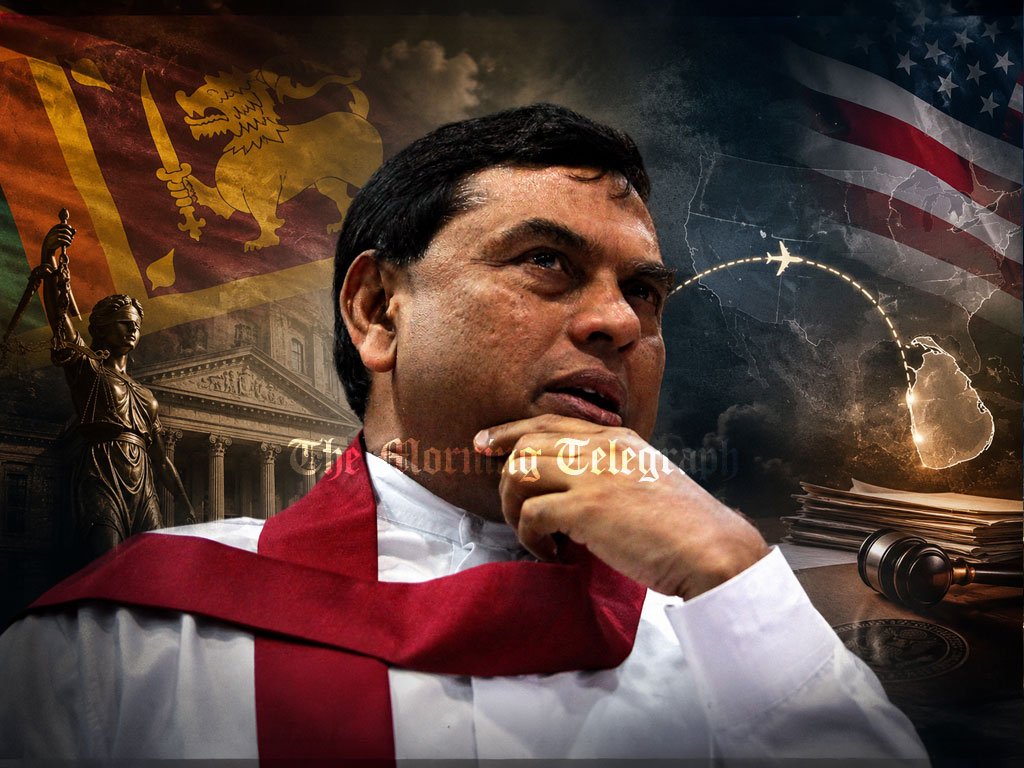
The Basil Rajapaksa extradition effort has moved into legal and diplomatic channels as Sri Lanka seeks his return from the United States.
The Basil Rajapaksa extradition effort has entered legal and diplomatic channels as Sri Lanka seeks the former finance minister’s return from the United States.
Multiple government sources familiar with the matter said Colombo had initiated steps to secure Rajapaksa’s return for criminal proceedings in Sri Lanka.
The developing case could become an important test of the extradition relationship between Sri Lanka and the United States.
Officials at the Ministry of Justice, Ministry of Foreign Affairs and Presidential Secretariat separately confirmed that communications had taken place regarding Rajapaksa.
They spoke on condition of anonymity because of the legal and diplomatic sensitivity surrounding the process. They were also not authorised to discuss the exchanges publicly.
According to the sources, Sri Lankan authorities contacted the United States as investigators and prosecutors sought to advance proceedings linked to alleged financial misconduct.
Rajapaksa is believed to be in the United States.

The government’s position is that he should return to Sri Lanka and face the country’s judicial process, the sources said.
They stressed that Colombo was pursuing the effort through legal and diplomatic mechanisms. They rejected the suggestion that it involved a political arrangement between the two governments.
Rajapaksa served as finance minister and remains one of the most influential members of the powerful Rajapaksa political family.
He has faced several investigations and court proceedings in Sri Lanka. However, he must be presumed innocent unless a competent court convicts him.
Arrest Order Adds Momentum to Basil Rajapaksa Extradition
Legal pressure intensified in May when the Colombo Fort Magistrate’s Court ordered the Criminal Investigation Department to arrest Rajapaksa and several others.
The case concerns the alleged misuse of Rs. 7.8 million belonging to the Sri Lanka Tourism Promotion Bureau.
Investigators allege that the money supported political campaigning during the 2014 Uva Provincial Council election.
According to local court reporting, the CID informed the court that the suspects would be named under the Public Property Act.
The CID acted following instructions from the Attorney General.
Government sources said the arrest warrants and active proceedings gave Sri Lankan authorities a basis to explore formal measures for securing Rajapaksa’s return.
However, extradition would not follow automatically from a letter sent by Colombo.
A political request from the Sri Lankan government would also not, by itself, compel Washington to place Rajapaksa on a flight to Sri Lanka.
Instead, both governments would need to follow the treaty and the relevant legal procedures.
Treaty Signed in 1999 Provides Legal Framework
The legal foundation is the extradition treaty between Sri Lanka and the United States.
The two governments signed the treaty in Washington on September 30, 1999.
President Bill Clinton formally transmitted it to the US Senate in 2000.
The agreement created a bilateral framework for surrendering fugitives wanted for prosecution, sentencing or the enforcement of a sentence.
The treaty applies the principle of dual criminality.
In simple terms, authorities must show that the underlying conduct amounts to a crime in both countries.
The alleged offence must also meet the treaty’s punishment threshold.
Sri Lanka and the United States do not need to use identical legal names for the offence.
They also do not need to place the conduct within the same criminal-law category.
The treaty and its official US analysis state that differences in legal terminology do not automatically block extradition.
That provision may prove especially important in a case involving allegations about public money or other financial offences.
Sri Lankan authorities would need to explain the alleged conduct and present supporting evidence.
They would also have to satisfy both the treaty requirements and United States extradition law.
Merely notifying Washington that a Sri Lankan court issued an arrest warrant would not be enough.
US Citizenship Would Not Automatically Block Surrender
The treaty also removes nationality as an automatic barrier to extradition.
Therefore, Rajapaksa’s status as a United States citizen would not, on its own, make him immune from a valid request.
The legal assessment would instead focus on whether Sri Lanka had submitted a proper demand covering extraditable conduct.
American authorities would also consider whether the request met every required procedural and evidentiary standard.
Foreign extradition requests to the United States generally move through diplomatic channels.
The US Department of State first reviews whether an applicable treaty is in force.
It also considers whether the alleged offences qualify for extradition and whether officials properly certified the supporting material.
If the request is in proper order, the State Department forwards it to the US Department of Justice’s Office of International Affairs.
That office plays a central role in cases involving fugitives located in the United States.
US Authorities Would Examine Evidence and Probable Cause
The Justice Department’s guidance explains how the Office of International Affairs handles a formal foreign demand.
Officials first examine whether the documentation is complete and in the correct form.
They then assess whether the material could establish probable cause.
That requires evidence supporting the claim that a crime occurred and that the person sought committed it.
If a request conforms with US requirements, authorities can send it to federal prosecutors.
Those prosecutors would generally operate in the district where the person is believed to be located.
The next stage could involve seeking an arrest warrant and placing the matter before a federal court.
Sri Lanka would therefore need to prepare a detailed legal package.
That dossier would need to identify Rajapaksa and explain each alleged offence.
It would also have to describe the relevant Sri Lankan laws and include court records, warrants and supporting evidence.
Weak, incomplete or improperly certified documents could delay or undermine the request.
The Basil Rajapaksa extradition effort therefore depends heavily on the quality and precision of the material Colombo provides.
US Court Would Not Conduct Sri Lankan Criminal Trial
A United States court would not conduct Rajapaksa’s Sri Lankan criminal trial.
It would also not determine whether he was ultimately guilty or innocent of the allegations.
Instead, the US extradition process would decide whether the treaty and American legal requirements had been satisfied.
The judicial and executive stages are separate.
A judge would examine whether the evidence and legal documentation supported extradition under the treaty.
Even after the judicial stage, the executive branch of the US government would retain a role in the final surrender process.
If authorities eventually approved extradition, officials could transfer Rajapaksa into Sri Lankan custody.
He could then be brought to Colombo to face the proceedings covered by the approved request.
However, the principle of speciality may restrict how Sri Lanka prosecutes him after surrender.
That principle generally prevents a requesting country from obtaining someone for specific offences and then prosecuting unrelated matters outside the authorised terms.
Sri Lankan authorities would therefore need to decide carefully which cases and allegations to include in any completed dossier.
Sri Lanka’s Extradition Law Also Applies
Sri Lanka’s domestic framework rests mainly on the Extradition Law, No. 8 of 1977, as subsequently amended.
The legislation governs the extradition of fugitive persons to and from foreign countries.
It also regulates the treatment of people accused or convicted of Sri Lankan offences who return from overseas.
The Rajapaksa matter is consequently more complicated than an ordinary domestic arrest warrant.
Investigators and prosecutors must convert a Sri Lankan criminal case into a treaty-compliant international request.
Justice officials and diplomats must then ensure that the demand can survive scrutiny within the American legal system.
Government sources said Colombo understood the complexity.
They added that several state institutions had become involved.
The Ministry of Justice has a central role because of the legal framework and documentation.
The Ministry of Foreign Affairs handles diplomatic communication with the United States.
Sources also said the Presidential Secretariat was aware of the effort and the government’s handling of the matter.
Status of Formal Extradition Dossier Remains Unclear
The precise status of any completed dossier sent to Washington remains uncertain.
Sources confirmed that communications seeking American cooperation had taken place.
However, they declined to disclose the contents of the correspondence.
They also did not confirm whether Sri Lanka had transmitted every document required for a final treaty request.
That distinction is crucial.
Preliminary letters, requests for assistance and informal diplomatic communications do not necessarily amount to a completed extradition demand.
A formal request must satisfy the treaty’s procedural, evidentiary and certification requirements.
The United States Department of Justice describes its Office of International Affairs as the country’s main mechanism for international extraditions.
The office also coordinates the lawful return of fugitives sought for prosecution in the United States or abroad.
Until Sri Lanka completes and submits a legally sufficient request, the process may remain at a preparatory or consultative stage.
A Major Test for Colombo and Washington
For Colombo, the case could test whether Sri Lanka can use an extradition treaty signed more than 25 years ago against a former political figure of considerable influence.
The government would need to show that its request rests on evidence, court proceedings and extraditable conduct.
Political declarations or public pressure would not replace the legal standards required by the United States.
For Washington, any completed request would have to move through the treaty and the US legal system.
Rajapaksa’s political prominence would not remove those procedural safeguards.
The final outcome may depend less on statements made in Colombo and more on the admissibility, strength and accuracy of Sri Lanka’s legal case.
American authorities could scrutinise whether the evidence establishes probable cause and whether the alleged conduct qualifies under the treaty.
They could also assess certification, documentation and any legal arguments raised by Rajapaksa’s representatives.
The process could therefore take time and involve several judicial and executive decisions.
Still, the government’s move marks a significant escalation.
According to officials across the relevant state institutions, Colombo is attempting to move beyond domestic warrants.
The Basil Rajapaksa extradition initiative now places the case within the much more complex field of international criminal cooperation.
Whether Sri Lanka succeeds will depend on its ability to submit a precise, complete and treaty-compliant request capable of withstanding examination in the United States.
SOURCE:- SRI LANKA GUARDIAN