Colombo Port City investment, jobs, land leases and commission salaries face parliamentary scrutiny after questions from Shanakiyan Rasamanickam.
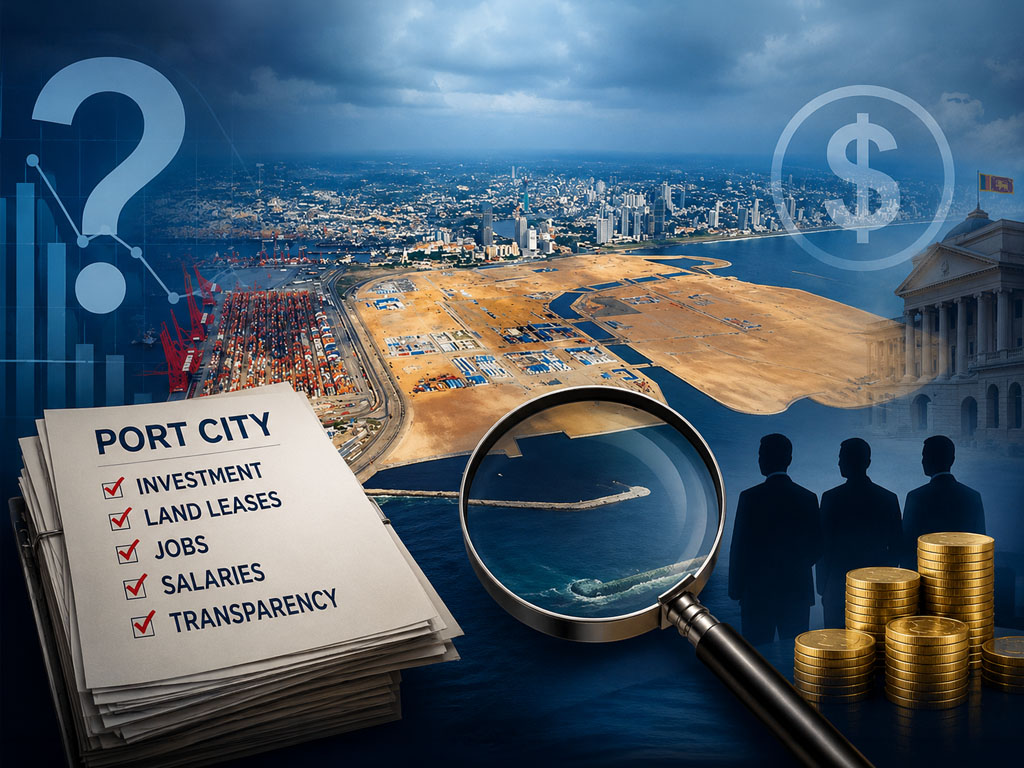
Colombo Port City investment has come under renewed parliamentary scrutiny as questions grow over promised foreign capital, job creation, land leases and the salaries of commission officials.
The project exists outside several conventional economic and administrative structures used elsewhere in Sri Lanka. Parliament established its governing framework through the Colombo Port City Economic Commission Act, No. 11 of 2021.
The law created a special economic zone with its own administrative and regulatory arrangements. As a result, the Port City Commission operates differently from traditional state and semi-state bodies.
Management Services Circulars and several conventional regulations governing public institutions do not apply to the Commission’s administration.

The President-appointed Commission holds authority to determine salaries, wages and service conditions for its staff, including the Director General.
Sri Lanka has previously created institutions with independent administrative powers. However, critics now question Port City’s financial transparency and its so-called “dollar paradise” structure during a severe economic crisis.
Public servants in senior positions continue to work within restricted salary scales. Meanwhile, questions have emerged about the higher remuneration reportedly paid to Port City Commission officials.
Parliament has also begun asking whether the billions of dollars in foreign investment originally promised have actually reached the country.
Colombo Port City Investment Questioned in Parliament
MP Shanakiyan Rasamanickam raised these concerns directly in Parliament on the 10th.
He called on the government to disclose the actual investment attracted by the project, the financial position of participating companies and payments made to Commission officials.
Rasamanickam submitted a special questionnaire under parliamentary standing orders to the Minister of Finance, Planning and Economic Development.
He said the project initially promised US$15 billion in investment and 80,000 jobs.
However, he noted that Sri Lankan youth continue leaving the country in record numbers because of limited employment opportunities.
The MP also focused on land allocation inside the special economic zone.
Port City contains 178 hectares, or approximately 440 acres, of marketable land.
According to Rasamanickam, authorities allocated 116 acres through a 99-year lease to CHEC Port City Colombo Private Limited.
The company is a subsidiary of a Chinese state-owned enterprise. He claimed it generates income by transferring or commercialising rights over those lands.
Rasamanickam then presented five areas requiring answers from the government.
Five Questions Over Land, Revenue and Foreign Investment
His first question concerned the present status of the 116 leased acres.
He asked how much land CHEC had subleased or assigned to third parties.
The MP also requested a report listing the investors, their countries of origin and their lease periods.
He further asked what percentage of the relevant land Sri Lankan companies currently hold.
His second set of questions focused on revenue.
Rasamanickam asked how much income the Sri Lankan government had earned from Port City since the project began.
He also asked the government to compare that figure with the revenue earned by CHEC Port City Colombo.
The third issue concerned foreign direct investment.
The MP requested the actual US dollar value of foreign investment received by Port City over the past five years.
He asked how that figure compared with foreign investment secured through the Board of Investment of Sri Lanka.
His fourth question addressed employment.
Rasamanickam asked how many people currently work within Port City.
He requested separate figures for Sri Lankan employees, workers under 35 and foreign nationals.
The fifth question concerned administrative spending.
He asked for the total salaries, allowances and capital expenditure of both the BOI and the Colombo Port City Economic Commission during the past five years.
Claims of a “Chinese Colony” Return to Debate
Rasamanickam recalled the controversy surrounding the Port City Economic Commission Act when Parliament introduced it in April 2021.
He said the current President and several others opposed the legislation at the time.
Critics warned that the special zone could develop into what they described as a “Chinese colony.”
Rasamanickam also said Wasantha Samarasinghe challenged the legislation in court during that period.
The MP compared Port City salaries with those offered for other important state positions.
He said some public institutions struggle to recruit qualified officers for monthly salaries of about Rs.60,000.
However, he claimed certain Port City Commission officials receive between Rs.100,000 and Rs.120,000 each month.
Rasamanickam questioned what measurable benefit those officials had delivered to Sri Lanka.
He also claimed that some receive more than the Director General of the BOI.
The MP then used a sarcastic comparison to criticise the project’s visible public activity.
He said the main activity currently seen at Port City involved MP Namal Rajapaksa visiting in the morning and riding buggies across the sand dunes.
Through that remark, Rasamanickam argued that ordinary Sri Lankans had yet to experience meaningful benefits from the development.
MP Calls for COPF or COPE Investigation
Rasamanickam urged the government to summon the Colombo Port City Economic Commission before a parliamentary oversight committee.
He proposed either the Committee on Public Finance or the Committee on Public Enterprises.
The MP said a detailed investigation should examine investment, land transactions, salaries, administrative spending and possible wastage of public funds.
His intervention has increased pressure on the government to provide verified figures rather than relying on projections announced during the project’s early stages.
The debate now centres on whether Port City has delivered genuine foreign investment, sustainable employment and revenue for Sri Lanka.
It also raises broader questions about accountability inside a special economic zone operating under exceptional administrative powers.
A minister responding on behalf of the government did not immediately provide the requested figures.
Instead, the minister said officials would prepare detailed information addressing the timely and important questions raised.
The government requested additional time before presenting its answers.
Until those figures reach Parliament, questions over Colombo Port City investment, public revenue, employment and Commission expenditure will remain unresolved.