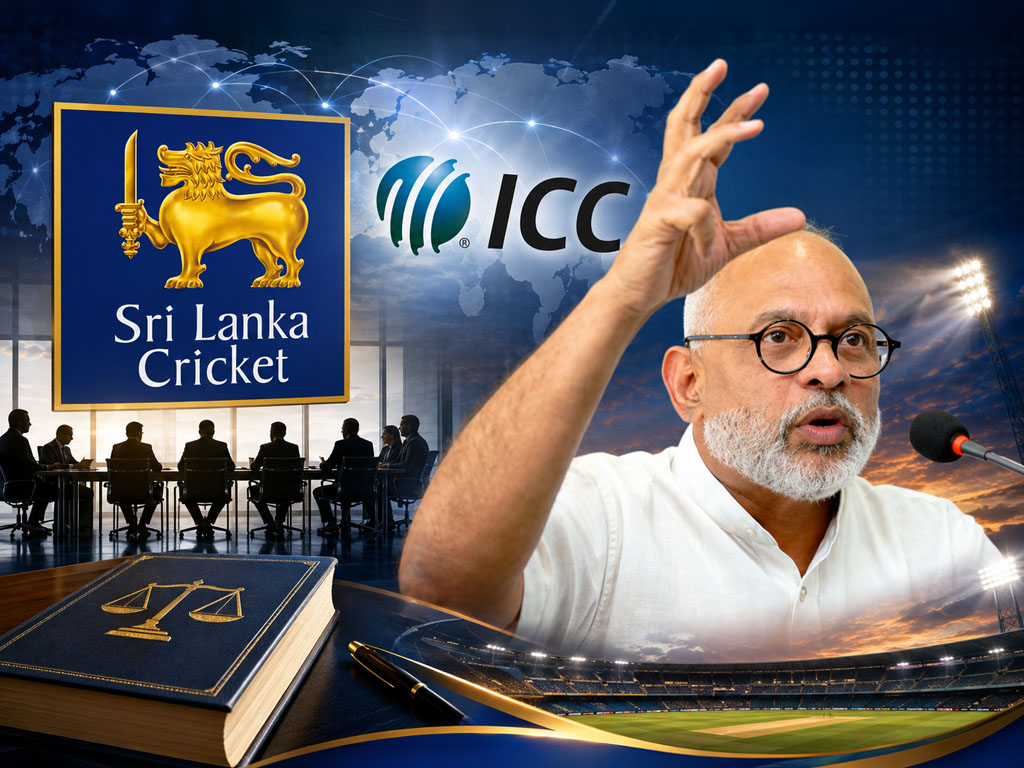
Sri Lanka Cricket reforms have secured more time from the ICC, but the global body still wants elections and a new constitution without delay.
The Sri Lanka Cricket reforms process has secured additional time from the International Cricket Council, although the ICC remains dissatisfied with the country’s current governance arrangement.
The Cricket Transformation Committee, which now runs Sri Lanka Cricket, believes the ICC has allowed valuable time to complete broad governance changes. However, the committee insists that it wants to relinquish control and return the sport to an elected administration as quickly as possible.
CTC Secretary Prakash Schaffter recently attended the ICC Chief Executives’ Meeting in Scotland. He said the message from world cricket’s governing body remained clear.
The present interim structure cannot continue indefinitely. Sri Lanka must hold elections at the earliest opportunity, while a new constitution remains central to restoring normal governance.
However, Schaffter believes the ICC also recognised the exceptional circumstances that led to the committee’s appointment. He said the global body appeared willing to give Sri Lanka time to complete the reform process instead of immediately imposing tougher sanctions.
“They understood where we are coming from,” Schaffter told the Sunday Times in an exclusive interview.
“The discussions were cordial, constructive and based on understanding rather than confrontation.”

ICC Remains Uncomfortable With Current Arrangement
Schaffter’s visit came only days before the ICC Board reaffirmed Sri Lanka Cricket’s continued exclusion from Board Meetings.
That restriction will remain until governance returns to normal under an elected administration.
Schaffter represented Sri Lanka Cricket at the Chief Executives’ Meeting. He also held discussions with senior administrators from Cricket Australia, Cricket South Africa, the England and Wales Cricket Board and the Bangladesh Cricket Board.
He also met ICC Chief Executive Sanjog Gupta.
More importantly, the ICC invited Schaffter to address its Normalisation Committee. During that meeting, he presented the CTC’s progress on constitutional reform.
Schaffter said several senior ICC officials attended, including ICC Chairman Jay Shah, former Deputy Chairman Imran Khwaja, the ICC Chief Executive and other officials.
“I was asked questions with regard to the governance measures that we are hoping to bring in the new constitution. What were the governance issues that Sri Lanka cricket faced, if any? So I went through some of the governance issues that I felt Sri Lanka Cricket had,” he said.
“I explained that we see ourselves purely as an interim caretaker administration. Our sole purpose is to introduce a modern governance structure through a new constitution and then hand over to officials elected under that framework. We have absolutely no desire to remain in office.”
According to Schaffter, the ICC’s concerns focused less on the committee’s stated intentions and more on the existing structure.
Sri Lanka Cricket continues to operate outside the normal governance model recognised by the ICC.
“They made it very clear that they are not comfortable with the present arrangement. We accept that because it is not a normal situation. But we also explained why this temporary intervention became necessary and what we are doing to correct the governance deficiencies.”
Schaffter believes that explanation helped persuade the ICC not to take stronger disciplinary action.
“They could have suspended Sri Lanka Cricket, stopped funding or prevented us from participating even at CEO level. None of that happened. Instead, they have recognised the need for dialogue and have given us time to complete this process.”
Sri Lanka Cricket Reforms Near Final Draft Stage
Despite that progress, the committee will not promise a firm election date.
“We are nearing the end of our work. The draft constitution is almost complete and will shortly be handed over to the Government. After that, the legislative process is outside our control,” Schaffter said.
“We will continue urging the Government to expedite the process because, more than the ICC, we ourselves want Sri Lanka Cricket to return to normal governance.”
A large part of Schaffter’s ICC presentation focused on what he described as long-standing structural weaknesses.
He stressed that those weaknesses did not relate only to the actions of any one administration.
One of the first issues concerned the constitutional rule requiring administrators to have played First Class cricket.
“That restriction simply does not make sense in modern sports administration,” he said.
“Good cricketers do not necessarily become good administrators. Around the ICC Board there are very few former international cricketers. Sports administration requires expertise in governance, finance, law and management. By limiting eligibility, Sri Lanka Cricket has excluded many capable professionals who could contribute to the game.”
The CTC also believes the voting structure has distorted cricket administration for decades.
Dozens of clubs and associations currently hold voting rights. According to Schaffter, many have only limited involvement in competitive cricket.
“Elections become political campaigns because there are too many voters spread across the country. Administrators spend more time canvassing votes than planning long-term development.”
He argued that voting rights should instead reflect each organisation’s genuine contribution to cricket.
“Those actively involved in playing and developing cricket should have the strongest voice in determining its future.”
Grant System and Board Powers Face Scrutiny
Schaffter also criticised the existing system for distributing grants.
He said allocations often depended on requests and recommendations rather than clear and objective criteria.
“When funding is allocated on an ad hoc basis, organisations inevitably become dependent on maintaining favourable relationships with those in office. That is not healthy governance. Financial assistance should be based on transparent principles and strategic priorities.”
Another weakness identified by the CTC concerns what it views as excessive Board involvement in operational decisions.
“The Board should provide strategic direction. Professional executives should manage the organisation.”
Schaffter said one of his biggest surprises after assuming office involved Sri Lanka Cricket’s budget process.
He discovered that management had played only a limited role in preparing the organisation’s budget.
“In any properly governed organisation, management prepares the budget because they are responsible for delivering it. The Board reviews and approves it. Here, we found a very different practice.”
These findings have become central to the proposed Sri Lanka Cricket reforms. The committee wants to separate strategic oversight from day-to-day management while making funding and decision-making more transparent.
Financial Reserves Remain a Long-Term Concern
Governance reform remains the committee’s main priority. However, financial sustainability also concerns the CTC.
Schaffter described Sri Lanka Cricket’s present financial position as stable, although it lacks long-term security.
“We are not in financial difficulty, but neither are we sitting on large reserves.”
He questioned why an organisation that had generated significant income for many years had failed to establish a meaningful financial corpus.
“When successful organisations generate surpluses, they build reserves for future uncertainties. That has not happened to the extent it should have.”
The committee is also continuing efforts to conduct the long-promised forensic audit into Sri Lanka Cricket’s affairs.
Critics have questioned the delay. However, Schaffter said the committee had struggled to identify a suitable independent firm.
The exercise remains politically sensitive, while potential auditors face conflict-of-interest concerns.
“There are conflict-of-interest issues and there are firms reluctant to become involved because of Sri Lanka Cricket’s history of controversy. We remain committed to carrying out the forensic audit.”
For now, the CTC appears to have avoided stronger ICC action and secured more time. However, that flexibility does not amount to approval of the present arrangement.
The ICC still expects elections, a new constitution and the restoration of normal administration.
The success of the Sri Lanka Cricket reforms will therefore depend on whether the draft constitution moves quickly through the Government and legislative process.
Until that happens, Sri Lanka Cricket will remain outside the ICC’s preferred governance model, with its Board-level participation restricted and the future election timetable still uncertain.