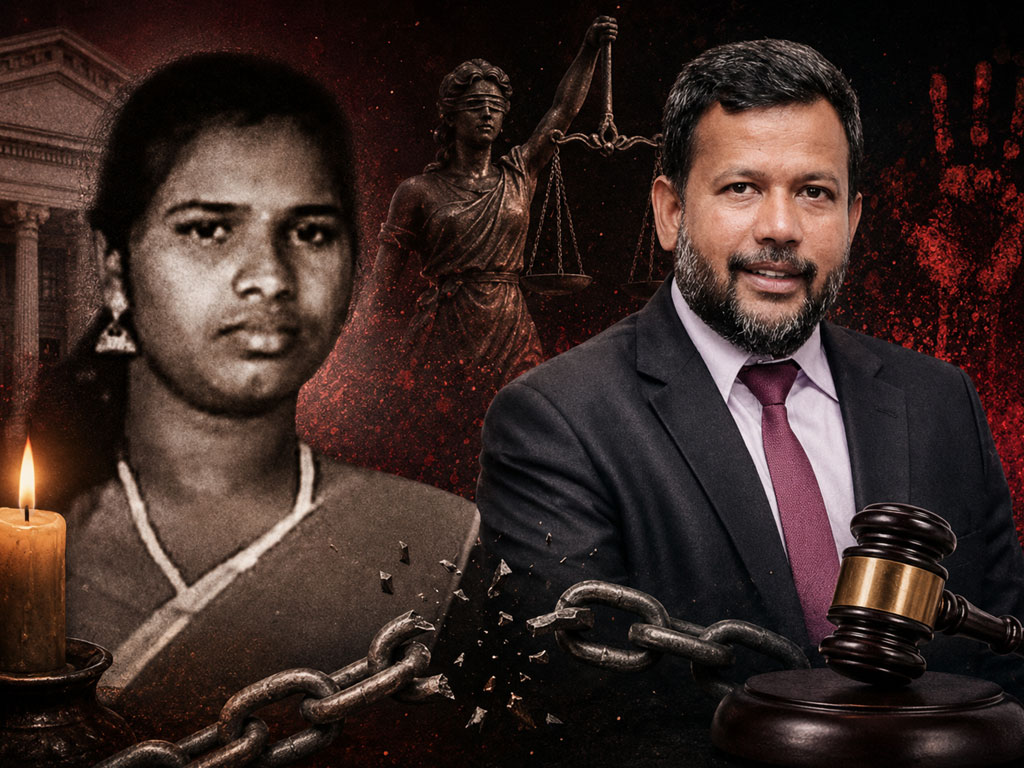
Justice for Ishalini remains in focus as new court testimony raises questions about first aid, child labour, trafficking and accountability.
The demand for justice for Ishalini has returned to public attention after fresh court testimony raised serious questions about the final hours of 16-year-old Ishalini Jude Kumar.
Ishalini came from a plantation community affected by deep poverty. She later worked as a domestic helper at the Colombo residence of former Cabinet Minister Rishad Bathiudeen.
She died on July 15, 2021, after suffering severe burn injuries at the residence.
The case has since developed into a complex legal and social issue involving allegations of child labour, trafficking, sexual abuse, negligence and weaknesses in Sri Lanka’s child protection system.
The proceedings remain before court. Therefore, the allegations against the suspects have not reached a final judicial determination.
However, the legal, medical and social questions surrounding Ishalini’s death continue to demand public attention.
Get Breaking News First
on WhatsApp

New Testimony Presented at Aluthkade Court
Additional Magistrate Lilan Warusawithana heard important evidence at the Colombo Aluthkade Court on July 28, 2026.
Suwasariya 1990 first aid officer Asali Upeksha, 30, testified about what she allegedly witnessed after entering the residence on the day of the incident.
“Upon receiving the information, I entered the house through the garage side. There, on the staircase, I saw a girl sitting in a meditative posture,” she said.
“A bedsheet was draped over her body. She had no clothes on underneath. I could identify burn injuries on her neck, chest, hands and feet. The girl asked me for water.”
The testimony has raised further questions about whether those inside the residence provided adequate and immediate first aid before the ambulance arrived.
According to the evidence presented, emergency responders had reportedly provided basic burn-treatment instructions through the 119 emergency number.
Those instructions allegedly included cooling the burns with water.
However, the testimony suggested that the residents may not have followed those instructions before Suwasariya personnel reached the house.
That issue could become important when the court considers whether any delay or failure to provide assistance contributed to Ishalini’s suffering.
The defence also suggested that residents initially believed a gas leak had caused the fire.
However, the witness rejected that suggestion and said she remained confident about the contents of the Suwasariya audio recordings.
During the hearing, the court temporarily lifted the foreign travel ban imposed on suspect Sheyabdeen Ayesha, the former minister’s wife.
The court granted permission for her to travel abroad on July 29 to attend to her daughter’s medical needs.
The case was postponed until October 21, 2026.
Forensic Evidence Remains Central to Justice for Ishalini
Forensic pathology remains central to establishing the cause, circumstances and manner of Ishalini’s death.
The first post-mortem examination reportedly found indications that she had suffered serious sexual abuse in addition to the burn injuries.
That reported finding became a major turning point in the investigation.
Investigators and legal representatives then faced the possibility that the fire may have concealed other alleged offences.
Following a court order, authorities exhumed Ishalini’s body and conducted a second post-mortem examination.
A three-member panel of Judicial Medical Officers carried out that examination.
The second examination represented an important step towards strengthening transparency and addressing questions raised by the original findings.
The court must ultimately assess the medical evidence, witness testimony and investigative material before reaching conclusions about criminal responsibility.
Until then, all accused persons remain entitled to the presumption of innocence.
Plantation Poverty and the Child Labour Crisis
Beyond the courtroom, Ishalini’s case has exposed the vulnerability of children living in plantation communities.
Economic hardship often forces families to consider arrangements that remove children from school and place them in domestic employment.
Ishalini reportedly left school after Grade 7.
A 60-year-old broker later brought her to Colombo after allegedly claiming that she was 18 years old.
The case has therefore raised serious concerns about recruitment practices, false age declarations and the movement of children into domestic labour.
Sending a child into domestic service to repay family debt may amount to human trafficking under Sri Lankan law.
Authorities have filed charges under Section 360C of the Penal Code, relating to human trafficking, and Section 308A, relating to cruelty to children.
The allegations illustrate how poverty, debt and limited educational opportunities can place children at risk of exploitation.
Recent data and reports received by the National Child Protection Authority show the wider scale of the problem.
More than 100,000 complaints involving child abuse have reportedly been recorded since 2015.
That figure indicates that Ishalini’s case cannot be treated as an isolated tragedy.
It reflects wider structural failures affecting children across Sri Lanka.
Child Protection Reforms Must Be Enforced
Public outrage following Ishalini’s death increased pressure for stronger child protection laws.
Sri Lanka amended the Children and Young Persons Ordinance through Act No. 39 of 2022.
The amendment raised the legal age of a child to 18 years.
Further measures, including protections against corporal punishment and the rehabilitation of children in conflict with the law instead of imprisonment, came into effect from 2024.
These reforms represent progress.
However, strong laws alone cannot prevent abuse if authorities fail to enforce them consistently.
Sri Lanka must strengthen monitoring of domestic employment, investigate brokers and protect children who leave school because of poverty.
The country must also improve access to education and economic support within plantation communities.
Without addressing the conditions that push families into unsafe arrangements, child trafficking and domestic exploitation will continue.
The final outcome of this case will matter far beyond the individuals appearing before court.
It will test whether Sri Lanka can protect vulnerable children, enforce its laws and deliver meaningful accountability.
A verdict cannot reverse Ishalini’s death.
However, a fair and thorough judicial process can send a powerful message that poverty does not make a child invisible and that justice for Ishalini also means greater protection for every child at risk.