Saudi, Turkey & Pakistan sign defence pact creating a NATO style collective security commitment that could reshape the Middle East and South Asian security.
The Saudi Turkey Pakistan defence pact has created a new mutual-defence framework linking three major powers across the Middle East and South Asia.
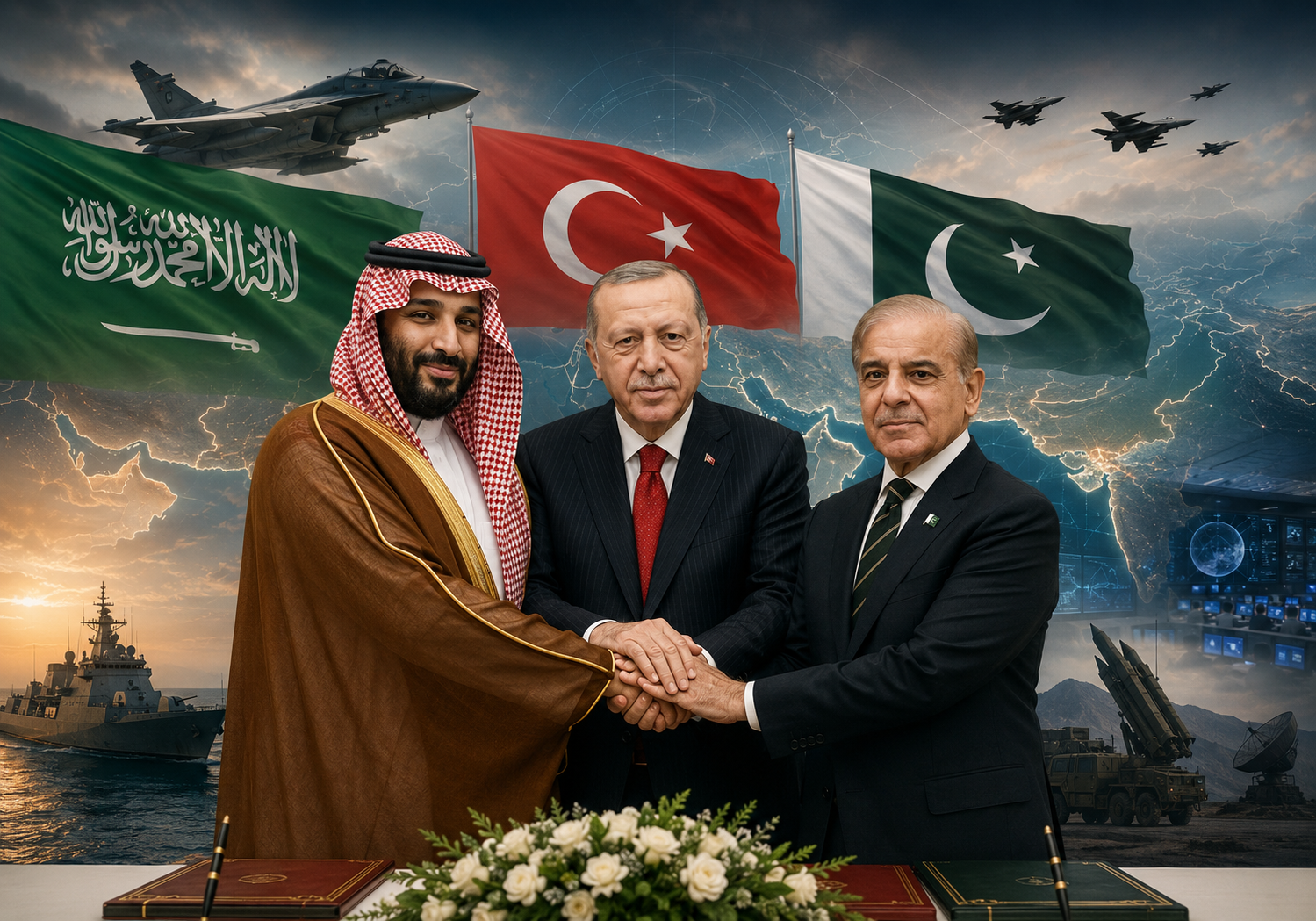
The Mecca Joint Defence Agreement was signed on August 7 by Saudi Crown Prince Mohammed bin Salman, Turkish President Recep Tayyip Erdogan and Pakistani Prime Minister Shehbaz Sharif.
Under the pact, an armed attack on any one of the three countries will be treated as an attack on all three. Turkish Foreign Minister Hakan Fidan said the mechanism is technically comparable to NATO’s Article 5 principle.
However, the agreement does not automatically require an identical military response. The three governments would consult on the scale and form of assistance needed if one member comes under attack.
Saudi, Turkey & Pakistan’s Defence Pact Expands Co-Operation
The Saudi Turkey Pakistan defence pact brings together three countries with different strategic strengths.
Saudi Arabia provides major financial and political influence. Turkey has NATO’s second-largest army and a growing defence industry. Pakistan has extensive military experience and remains the Muslim world’s only nuclear-armed state.
Officials say the agreement is defensive and is not directed at Iran or any other specific country. Saudi Arabia has also rejected suggestions that the pact represents a sectarian military bloc or the start of a regional nuclear arms race.
The agreement builds on a bilateral Saudi-Pakistan mutual-defence pact signed in September 2025. Talks on expanding cooperation into a three-country framework had continued for months before the Mecca signing.
Could More Countries Join?
The alliance may eventually grow beyond its three founding members.
Fidan said President Erdogan wants other regional states included in the framework. Egypt has been identified as one possible future participant once technical issues are resolved.
The members also plan to create a ministerial committee and establish a permanent secretariat in Saudi Arabia. The framework could also deepen cooperation in defence production, military technology, intelligence and logistics.
For now, the pact stops short of creating another NATO. However, its collective-defence clause gives the agreement far greater strategic weight than a standard military cooperation deal and could reshape regional security if other countries decide to join.