Commercial Bank defamation case raises questions over press freedom after Hari Deshaya sought Rs. 100 million over claims its reports were false.
The Commercial Bank defamation case has placed Sri Lanka’s digital media sector under fresh scrutiny, raising questions about press freedom, institutional reputation and accountability.
Independent journalism increasingly relies on digital platforms to investigate powerful financial institutions and corporations. However, such reporting can also expose journalists to legal, financial and reputational risks.
According to Hari Deshaya, Chief Editor Muaz Mohamed has moved against Commercial Bank of Ceylon PLC after the bank publicly challenged reporting published by the website. Hari Deshaya says legal proceedings seek Rs. 100 million in damages. The supplied material identifies the Colombo District Court case as DMR 829/2026, although that case number could not be independently confirmed through publicly accessible court records.
Hari Deshaya had earlier issued a formal Letter of Demand seeking Rs. 100 million and a public apology. Its May 14 statement identified attorney Sanjeewa Kaluarachchi as legal counsel.
Get
Breaking News
First
on WhatsApp
Follow The Morning Telegraph for instant alerts, top stories and exclusive updates delivered straight to your phone.

Commercial Bank Defamation Case Began With Phishing Reports
The dispute followed investigative articles published by Hari Deshaya concerning an alleged phishing operation affecting Commercial Bank accounts.
Hari Deshaya says one of its reports alleged that tens of millions of rupees had been siphoned from 99 accounts and that the CID had opened an investigation.
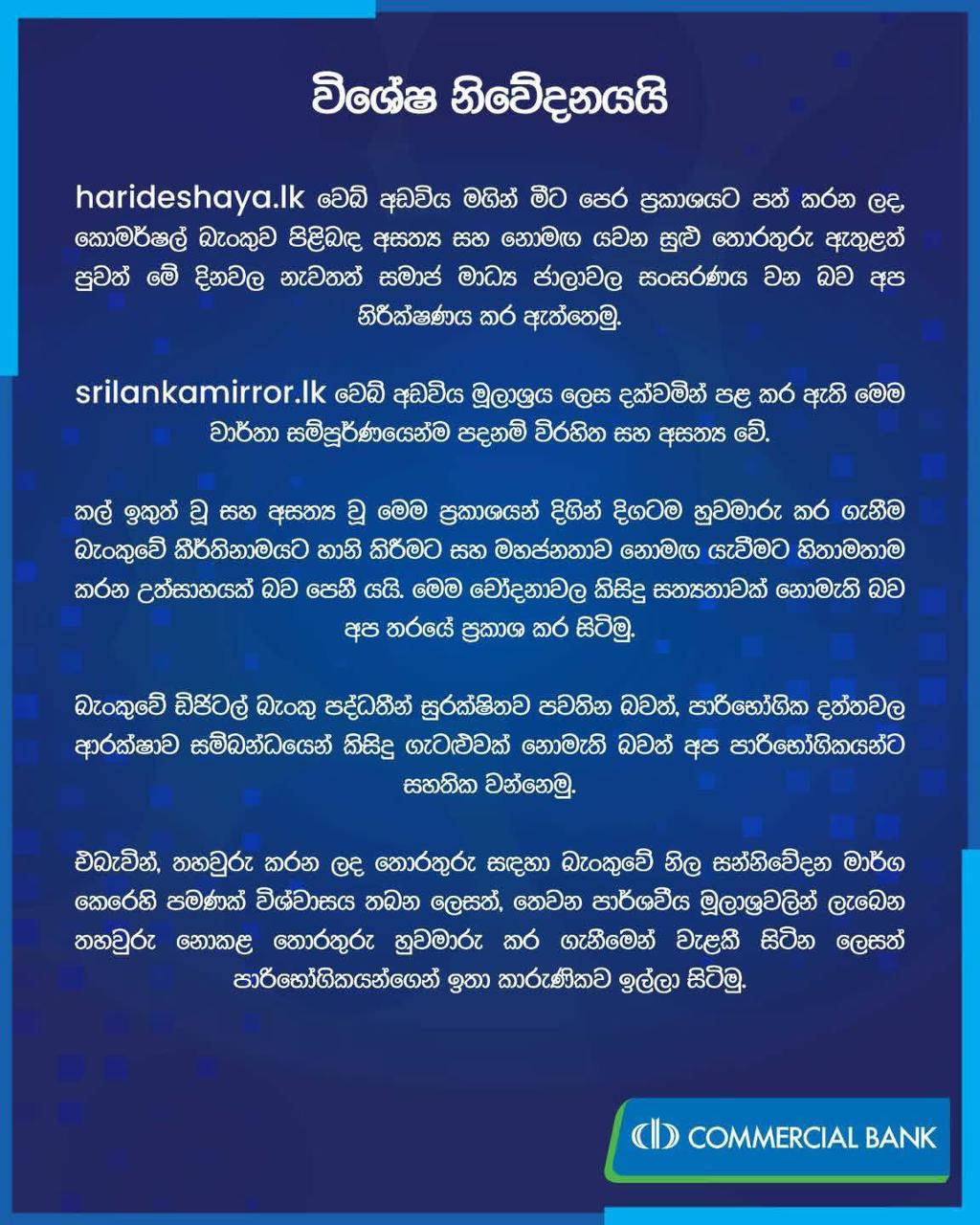
Commercial Bank subsequently published a “Special Notice” on its official Facebook presence.
According to Hari Deshaya’s account of that notice, the bank described the website’s reporting as “false,” “misleading” and “entirely baseless and inaccurate.” Hari Deshaya says the notice specifically identified its publication.
The website disputes the bank’s position and argues that Commercial Bank failed to identify precisely which elements of its reporting were inaccurate.
Those competing claims are central to the dispute. Neither the bank’s public denial nor the website’s allegations, by themselves, determine the truth of the underlying phishing claims.
That determination would require evidence and, where litigation proceeds, judicial assessment.
Hari Deshaya Demanded Rs. 100 Million and an Apology
Before the reported court action, Hari Deshaya sent Commercial Bank a Letter of Demand.
It sought the removal of the disputed social media post, a formal apology and retraction, and Rs. 100 million in damages for alleged reputational harm.
Hari Deshaya also demanded that the bank cease making further statements it considered defamatory.
Muaz Mohamed said the publication would continue its legal fight.
“We will not abandon this fight until this stain on our name is removed… This is a fight for the justice we collectively believe in,” he said, according to the supplied article.
The website portrays the dispute as a wider test of whether independent online media can challenge major financial institutions without being intimidated into silence.
Commercial Bank, however, is equally entitled to dispute reporting it considers false and to protect its reputation through lawful means.
The key question is therefore not whether either side has the right to respond. It is whether the disputed claims can ultimately be supported by evidence.
Questions Over Financial Transparency Need Context
Hari Deshaya also questioned the timing of Commercial Bank’s response and raised concerns about its first-quarter financial disclosure.
However, Commercial Bank has since publicly released its results for the three months ending March 31, 2026.
The bank reported Group assets of Rs. 3.61 trillion, deposits of Rs. 2.87 trillion and net profit of Rs. 17.94 billion for the quarter.
Therefore, any suggestion that the Q1 results remain unpublished should no longer appear as a current factual claim.
The broader argument about financial transparency, however, remains relevant to the dispute because investigative journalism depends on access to verifiable corporate and regulatory information.
Hari Deshaya has also referred to the major fraud identified at NDB Bank as an example of why financial institutions require scrutiny.
NDB itself confirmed fraudulent transactions involving employees and launched an independent forensic review by Deloitte Touche Tohmatsu India LLP. However, it said customer balances remained secure and the bank continued operating normally.
A Wider Test for Sri Lanka’s Digital Journalism
The Commercial Bank defamation case could become important for Sri Lanka’s growing online news sector if it proceeds through substantive judicial determination.
Journalists have the right to investigate matters of public interest. But that right also carries a responsibility to verify allegations, distinguish evidence from suspicion and provide institutions with a fair opportunity to respond.
Corporations likewise have the right to defend their reputations. Yet legal warnings should not become tools for suppressing accurate reporting merely because it is uncomfortable.
Ultimately, neither journalists nor financial institutions should decide the truth through public accusations alone.
If the dispute reaches determination, the court will assess the evidence and legal arguments placed before it.
For Sri Lanka’s web media, the larger principle remains important: investigative journalism must be fearless, but it must also be evidence-based. Likewise, powerful institutions must answer legitimate scrutiny transparently rather than expecting their size or influence to settle public-interest questions.
That balance between press freedom, accuracy and institutional accountability may prove to be the most important issue emerging from this confrontation.