Sri Lanka agriculture reforms will expand irrigation, support paddy prices, diversify farm income and strengthen food security, Minister Lal Kantha says.
Sri Lanka agriculture reforms are being expanded through irrigation, farmer support and market interventions, Agriculture Minister K.D. Lal Kantha has said.
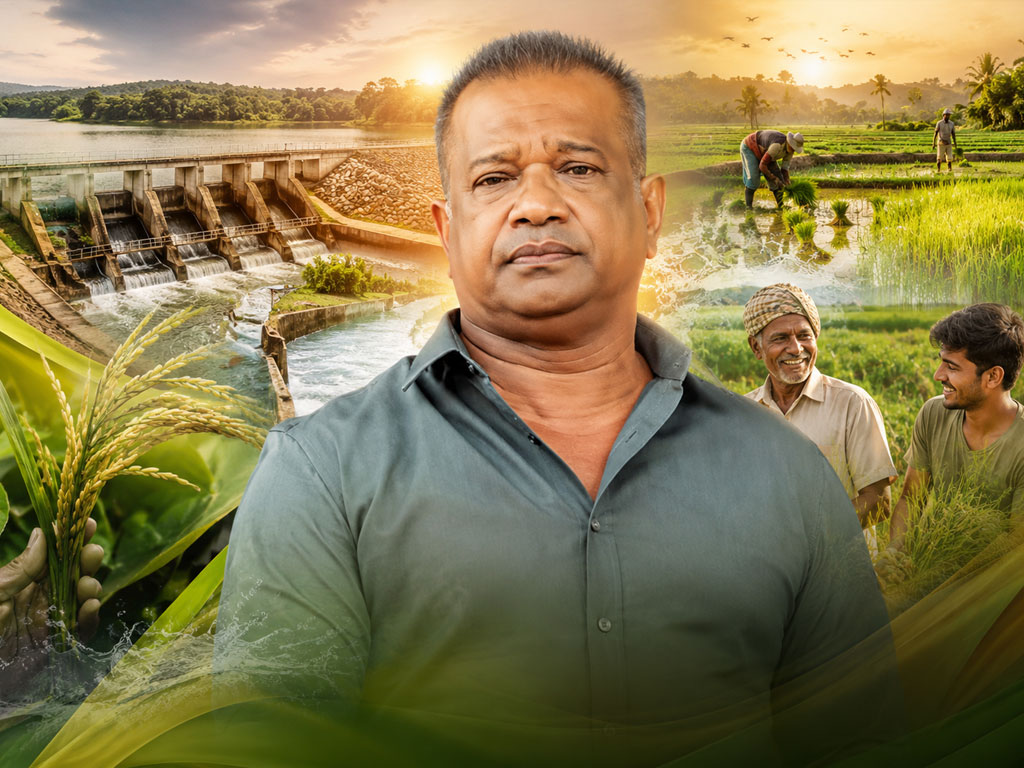
The Minister made the remarks while inaugurating reconstruction work on the Kachchhimaduwa tank, which belongs to the Kottukachchiya farming enterprise.
The tank was damaged during the Ditwa disaster.
The reconstruction project is being implemented by the Irrigation Department under the Ministry of Agriculture, Livestock, Lands and Irrigation.
Its estimated cost is Rs. 200 million.
Minister Professor Chandana Abeyrathna, Puttalam District Parliamentarian Ajith Gihan, political representatives and several government officials attended the event.

Sri Lanka Agriculture Reforms Target Farmer Poverty
Addressing the gathering, Lal Kantha said agriculture continues to face several major challenges.
One of the biggest, he said, is ensuring that farmers receive a fair and reasonable price for what they produce.
“Today, providing a fair and just price for the farmers’ produce in agriculture has become a major challenge. If there is no proper price and economic return in the market, there is no point in cultivating. Generally, the farming community in our country is poor. A major responsibility assigned to our ministry is to eliminate that poverty.”
The Minister said the Government has allocated a large amount of funding for irrigation development.
He also acknowledged that vacancies in the public service are making Government operations more difficult.
“The responsibility of religious leaders is to enrich the spiritual life of the people, while the government’s primary role is to build the secular life,” Lal Kantha said.
Paddy Pricing and Interest-Free Loans for Millers
The Minister also outlined the Government’s programme to ensure a better price for paddy.
He said the Government cannot purchase the entire paddy harvest only for its own storage facilities.
As a result, small and medium-scale rice mill owners are being brought into the purchasing process.
The Government plans to provide interest-free loans of Rs. 25 million each through the state treasury.
Lal Kantha also said large-scale rice mill owners are purchasing paddy at the Government-declared price.
In addition, he said the Government is introducing new technology to help farmers manage the problem of wet paddy.
These measures form part of the wider Sri Lanka agriculture reforms aimed at improving the economic return received by farmers.
Farmers Urged to Diversify Income Sources
Lal Kantha said farmers should not depend only on a single crop or paddy cultivation.
Instead, he encouraged them to diversify their income by also entering the livestock sector.
“You cannot make a profit by getting 80 bushels of paddy per acre. Now in some areas of Lanka, they get 200 bushels per acre. We are implementing a program under the guidance of the Agriculture Department to increase the yield per acre. Farmers should not cultivate haphazardly, but should cultivate according to the recommendations of the Agriculture Department.”
The Minister said productivity must improve if farmers are to build stronger and more sustainable incomes.
Maize Shortage Creates New Role for Paddy
Lal Kantha also highlighted the country’s maize requirements.
He said maize has become a major crop for animal feed.
Sri Lanka’s annual requirement stands at 700,000 metric tonnes, while local production amounts to only 300,000 metric tonnes.
The remaining 400,000 metric tonnes have traditionally been imported.
However, the Minister said steps have been taken to stop importing that amount and instead use paddy as an alternative.
He also argued that farmers could strengthen their incomes by producing additional products from paddy rather than depending only on traditional rice sales.
Fertiliser Support and Irrigation Remain Key Priorities
The Minister further said both chemical and organic fertilisers should be used in paddy cultivation.
He added that the Government remains committed to supporting farmers through fertiliser subsidies and improved irrigation facilities.
Lal Kantha said the Ministry’s central responsibility is to protect national food security while strengthening the economic position of the farming community.
He stressed that the active participation of farmers will be essential to achieving those goals.
The broader direction of Sri Lanka agriculture reforms, he said, is therefore focused on stronger irrigation, improved productivity, better market returns, diversified farm income and long-term food security.