Sri Lanka referendum rules explain how many votes are needed, the two-thirds turnout threshold and what the 1982 national vote reveals.
A Sri Lanka referendum allows voters to directly decide an exceptionally important national question, including certain constitutional changes or matters affecting the sovereignty of the people.
Normally, Parliament makes the country’s laws through representatives elected by the public.
However, when a constitutional amendment affects fundamental provisions, the sovereign power of the people or the independence of the judiciary, the Supreme Court can determine that approval through a referendum is also required.
In such circumstances, the entire electorate gets an opportunity to vote directly on the proposal. Voters generally choose either “Yes” in favour or “No” against it.
The proposed 22nd Constitutional Amendment has once again brought the subject of a referendum into public discussion.
The author, together with the Association of Democratic Social Media Journalists, has also filed a petition arguing that the 22nd Constitutional Amendment requires a referendum. The Supreme Court took up that petition for hearing yesterday.
As that matter remains pending before court, this article does not address the merits of the case. Instead, it explains theoretically how the voting requirements would operate if a referendum were required.

Sri Lanka Referendum: What Does the Constitution Require?
The central question is how many votes would be needed for the 22nd Amendment to succeed at a referendum.
According to Article 85 of the Constitution of Sri Lanka, two conditions become relevant when determining whether a proposal has secured approval through a referendum.
First, the proposal must receive a majority, meaning more than 50%, of the valid votes cast.
Second, if the total number of votes cast falls below two-thirds of all registered voters, the votes in favour must also exceed one-third of the total registered electorate.
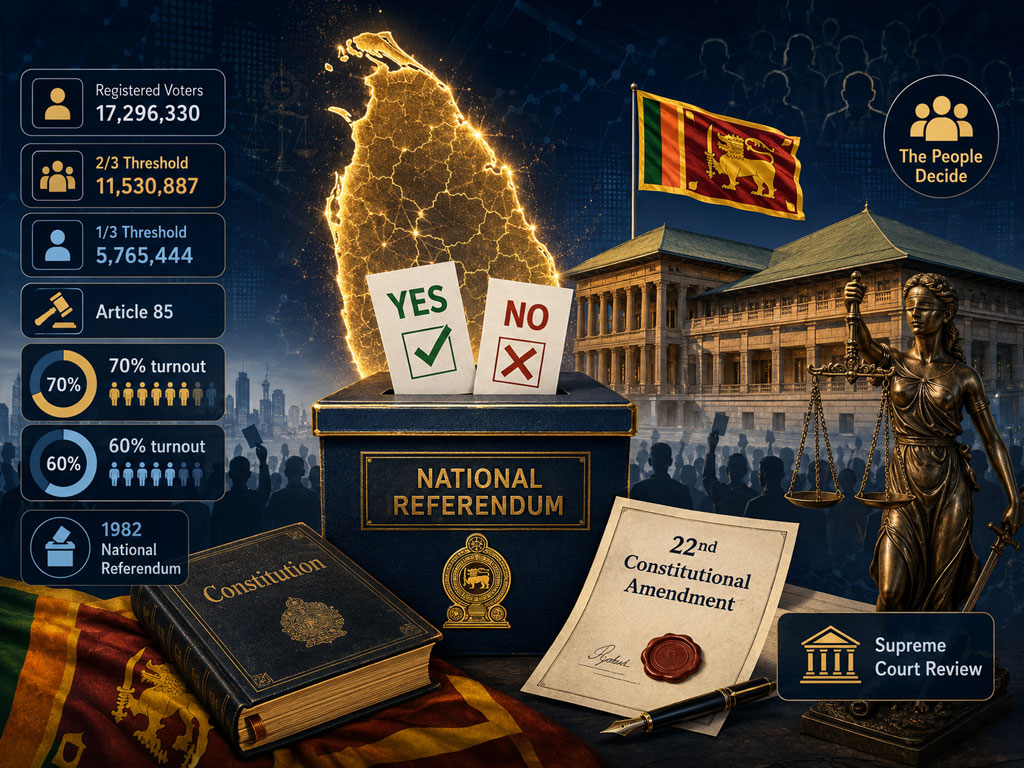
The latest official registered voter population cited from the Election Commission stands at 17,296,330.
From that figure, three important numbers emerge:
- Total registered voters: 17,296,330
- Two-thirds threshold: 11,530,887
- One-third threshold: 5,765,444
These figures determine how the result could change depending on voter turnout.
What Happens if Turnout Exceeds Two-Thirds?
The first scenario involves a high voter turnout.
If the number of valid votes cast exceeds 11,530,887, meaning more than two-thirds of the total registered electorate participates, a simple majority would determine the result.
In such a case, the proposal would need more than 50% of valid votes cast.
For example, if turnout reaches 70%, the number of valid votes cast would be approximately 12,107,431.
The minimum number required for victory at 50% plus one would then be approximately 6,053,716 votes.
Therefore, when turnout rises above the two-thirds threshold, the required number of “Yes” votes also rises because victory depends on securing a majority of the actual valid votes cast.
What if Voter Turnout Falls Below Two-Thirds?
The second scenario creates a different challenge.
If turnout falls below the two-thirds threshold of 11,530,887, a simple majority by itself would not be sufficient.
The proposal would also need to secure more than one-third of the entire registered voter population.
That threshold stands at 5,765,444 votes.
For example, if turnout were 60%, the number of valid votes cast would be approximately 10,377,798.
In that situation, the proposal would still need at least 5,765,444 votes in favour.
That represents approximately 55.55% of the valid votes cast, rather than merely 50%.
This is where the political difficulty becomes much greater.
If turnout is relatively low, the government cannot rely only on winning a narrow majority among those who vote. It must still cross the constitutional one-third threshold calculated against all registered voters.
Therefore, under this interpretation, around 5.8 million votes become a crucial minimum benchmark when turnout remains below two-thirds.
However, once overall turnout exceeds approximately 11.5 million, the number needed for victory rises because the simple majority requirement becomes numerically higher.
In practical terms, lower turnout does not automatically make a referendum easier to win.
If too few voters participate and the proposal fails to obtain more than roughly 5.8 million votes in favour, it would fail to satisfy the required threshold.
Sri Lanka’s Only National Referendum
Sri Lanka has held only one national referendum so far.
The vote took place on December 22, 1982, under the government of then-President J.R. Jayewardene.
Its purpose was to extend the term of the existing Parliament by another six years instead of dissolving Parliament and holding a general election.
Voters chose between two symbols.
The “Lamp” represented support for extending Parliament’s term, while the “Pot” represented opposition to the extension.
Official statistics from the 1982 referendum recorded 8,145,015 registered voters.
Voter turnout stood at 70.82%.
The Lamp received 3,141,223 votes, or 54.66% of valid votes cast.
The Pot received 2,605,983 votes, or 45.34%.
The government therefore won the referendum by a majority of 532,240 votes.
That remains Sri Lanka’s only experience of a nationwide referendum and provides an important historical comparison as debate now surrounds the 22nd Constitutional Amendment.
Whether the proposed 22nd Amendment actually requires a referendum, or whether approval by a two-thirds majority in Parliament is sufficient, remains a matter for the Supreme Court to determine.
Until that determination is delivered, the constitutional arithmetic remains important.
A Sri Lanka referendum is not simply about whether “Yes” receives more votes than “No.” Turnout itself can influence the threshold that a proposal must cross, making both voter participation and the number of affirmative votes central to the final outcome.