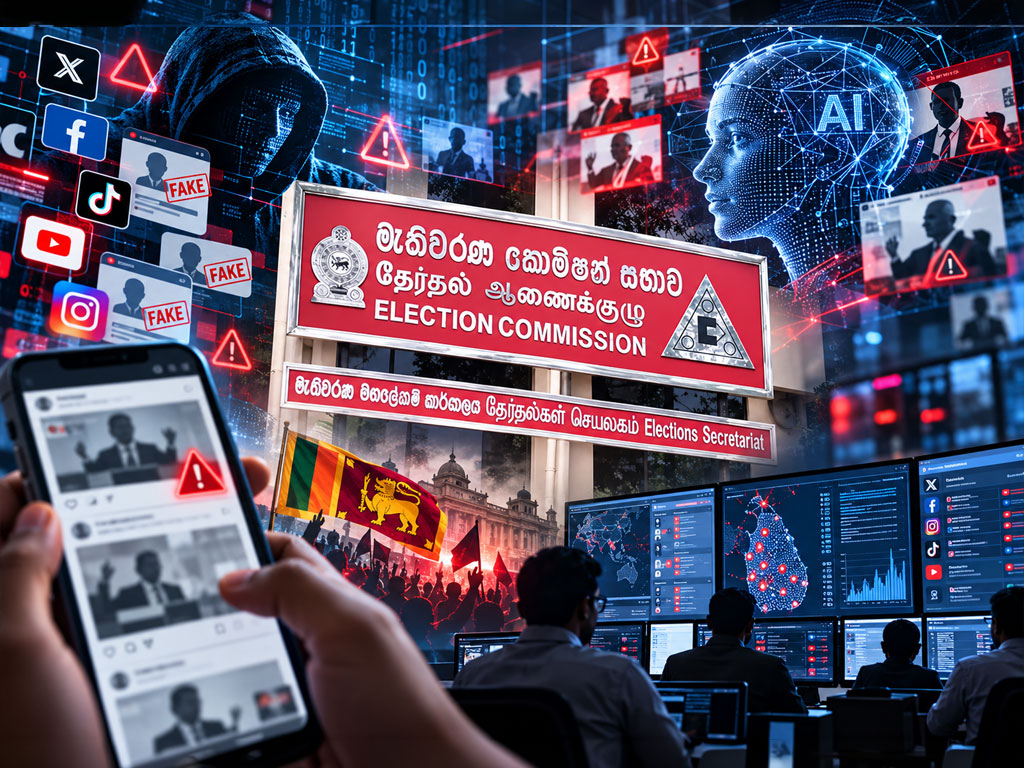
Sri Lanka’s Election Commission is preparing new safeguards against online election manipulation as research identifies 66 questionable TikTok accounts impersonating political parties and candidates, with accounts mimicking the NPP recording the highest engagement.
COLOMBO, October 17, 2026 — Sri Lanka’s Election Commission is developing a coordinated response to artificial intelligence, misleading political content and social media activity that continues during legally restricted campaign periods, as research exposes the scale of political impersonation on TikTok.
The initiative follows concerns arising from the 2024 presidential and parliamentary elections and the 2025 local government polls, when digital campaigning presented difficulties for traditional election regulations.
Additional Election Commissioner (Legal) Chinthaka Kulatunga has warned that the risks associated with social media influencers, AI-generated material and online political messaging could become more serious in future elections.
While Sri Lanka’s election laws impose restrictions on campaigning during the designated silence period, enforcing those rules across social media presents a different challenge from regulating traditional political rallies and advertising.
Research conducted by Democracy Reporting International (DRI), with contributions from Sri Lankan research organisation Factum, illustrates the problem.
Their investigation identified 66 questionable TikTok accounts that appeared to represent political parties, candidates and public figures without clearly disclosing that they were unofficial.
Accounts impersonating the National People’s Power (NPP) were the most prominent in the research sample and attracted substantially higher engagement than those mimicking most other political organisations.
The findings do not establish that the parties concerned created, financed or directed those accounts.
They do, however, demonstrate how unauthorised political identities can attract audiences and circulate campaign material without voters necessarily knowing who operates them.

Election Silence Period Faces Digital Enforcement Problems
Sri Lanka’s election silence period is intended to restrict campaigning immediately before polling, giving voters an opportunity to consider their choices without last-minute political promotion.
The Election Commission has expressed concern that social media activity can continue despite these restrictions.
Figures cited in the supplied Election Commission account indicate that the proportion of monitored political content rose from 39% to 46.8% during a period associated with restrictions on election campaigning.
The original account does not identify the precise sampling periods, platforms or methodology behind those percentages, making it necessary to establish their context before interpreting the increase.
The same account cites 715 instances of monitored content associated with the NPP, compared with 177 for the Sri Lanka Podujana Peramuna (SLPP), 125 for the United National Party (UNP) and 116 for the Samagi Jana Balawegaya (SJB).
These figures reflect the content categories described in the monitoring account. They should not be interpreted as evidence that the political parties themselves published every item or committed an equivalent number of election-law violations.
The figures also differ from the separate DRI TikTok investigation, which examined a sample of impersonation accounts.
Another statistic in the supplied account states that 53 out of every 100 political mentions during the silence period targeted a particular party. However, the wording does not clearly identify which party was being referenced.
That figure requires clarification before it can be assigned to a specific political organisation.
The broader enforcement difficulty remains clear: restrictions designed around identifiable campaign organisers become harder to apply when political messages circulate through influencers, anonymous profiles, automated tools and accounts whose operators are unknown.
Commission Proposes Nine-Part Digital Election Strategy
To address these challenges, the Election Commission has outlined an Operational Matrix consisting of nine proposed areas of intervention.
The measures described include legal and policy reforms, rapid responses to harmful or misleading material, content-removal procedures and expanded voter education.
Other components involve AI-assisted systems for identifying potentially false information, a national social media monitoring network and cooperation among independent fact-checking organisations.
The Commission has also described engagement with international technology companies, including Facebook and YouTube, to improve the handling of problematic political content during elections.
Although the initiative is described as a nine-part programme, the supplied account does not individually identify all nine sub-projects or establish their implementation status.
It is therefore not possible to confirm from the material whether each proposed component is already operational, funded or subject to a published timetable.
Any content-removal system will also need clear safeguards to distinguish unlawful campaigning, impersonation and demonstrably false claims from legitimate political criticism and protected expression.
The effectiveness of the programme will depend not only on detecting questionable material but also on ensuring that enforcement is transparent, consistent and politically impartial.
DRI Study Identifies 66 Questionable TikTok Accounts
The separate DRI investigation, titled Democracy in Disguise: Inauthentic Online Influence on Sri Lanka’s 2025 Local Government Elections, examined political activity on TikTok surrounding the May 6, 2025 polls.
Researchers collected information between April 16 and June 17, 2025, covering both the pre-election and post-election periods.
They investigated accounts described as “murky”, meaning profiles of questionable affiliation that presented themselves as official political identities without identifying themselves as unofficial, parody or fan accounts.
Many used party logos, similar usernames and recognisable political imagery to create the appearance of affiliation.
The research identified 66 such accounts, with the following characteristics:
- 79.0% impersonated political parties.
- 11.3% impersonated candidates contesting the 2025 local government elections.
- 4.8% impersonated President Anura Kumara Dissanayake.
- 4.8% impersonated other politicians.
Among political parties, the NPP was the most frequently impersonated, accounting for 33.3% of the overall sample.
The Sarvajana Balaya Alliance followed with 24.2%, while the SJB accounted for 22.7%.
Accounts impersonating the SLPP represented 10.6%. The People’s Struggle Alliance accounted for 3.0%, while several smaller parties each represented approximately 1.5%.
Unlike similar DRI investigations in several European countries, where questionable accounts frequently supported far-right political organisations, the Sri Lankan sample was predominantly associated with left-wing and centre-left parties.
The researchers suggested that this pattern may partly reflect the visibility and popularity of the political organisations being impersonated.
Crucially, identifying a party as the subject of an impersonation account does not establish any connection between that account’s operator and the party’s official campaign.
NPP Impersonation Accounts Recorded Highest Engagement
The study found substantial differences in the visibility and audience engagement of questionable accounts associated with different political organisations.
Accounts impersonating the NPP recorded an average of 44.6 videos, 1,894.5 followers and 17,190.2 profile likes.
Their videos also attracted the highest average engagement among the principal political groups examined.
Average views per video on identified impersonation accounts
Average Views per Video
TikTok accounts impersonating Sri Lankan political parties
Based on a sample of questionable TikTok accounts impersonating political parties during Sri Lanka’s recent elections. Figures represent average views per video, rounded to the nearest whole number.
These are not official party accounts. The findings do not establish that the political parties created, operated or coordinated the accounts, or that the activity changed election results.
Source: DRI–Factum research, TikTok sample collected April–June 2025. Figures are per-video averages, not votes or official party engagement.
NPP-related impersonation accounts averaged 3,561.3 views, 400.3 likes, 19.1 comments and approximately 10.5 shares per video.
Accounts associated with the Sarvajana Balaya Alliance recorded averages of 1,331.3 views, 56.7 likes, 1.3 comments and 2.9 shares.
For SJB-related accounts, the corresponding figures were 531.5 views, 33.4 likes, 1.2 comments and 1.5 shares.
The SLPP-related sample recorded averages of 176.2 views, 9.1 likes and 6.2 shares, with no comments recorded on average in the study’s table.
The researchers also noted that some smaller or regionally concentrated political organisations generated occasional spikes in engagement despite maintaining limited followings.
For example, accounts associated with the Democratic National Alliance recorded an average of 45 shares per video in the sample, despite comparatively low viewership.
These are descriptive findings from the accounts researchers identified. They do not measure the entire TikTok political environment, establish coordinated wrongdoing or demonstrate that online exposure changed voting behaviour.
Most Questionable Accounts Were Active During the 2024 Election
One of the study’s notable findings concerns when the impersonation accounts were active.
Although the research focused on the 2025 local government elections, account histories indicated that questionable political activity was more concentrated around the 2024 presidential election.
Researchers identified five patterns:
- Inactive accounts with no published content at the time of collection accounted for 21.2% of the sample.
- Accounts whose available posting history ended before 2024 represented 6.1%.
- Accounts posting exclusively during 2024 formed the largest group, at 45.5%.
- Accounts active up to the May 6, 2025 local government election accounted for 21.2%.
- Accounts continuing to publish after the 2025 election represented 6.1%.
Among NPP-related accounts, 59.1% were active during the 2024 presidential campaign period, while 27.3% remained active into the period preceding the 2025 local polls.
SJB-related accounts showed a more fragmented pattern. According to the research, 33.3% were active during the 2024 presidential campaign, 20% continued up to the local elections, and 6.7% remained active afterwards. Another 40% had no published content.
Accounts associated with Sarvajana Balaya were also predominantly active during 2024, while those impersonating the SLPP were mostly dormant or associated with earlier activity.
The findings suggest that some impersonation activity may be concentrated around individual electoral cycles rather than maintained continuously.
The researchers did not, however, establish the identities of the account operators or sufficient evidence to determine whether the observed patterns were centrally coordinated.
Party Logos and Familiar Usernames Used to Create Credibility
The investigation found that questionable accounts frequently copied visual elements associated with recognised political parties.
Some adopted usernames nearly identical to official profiles, introducing small changes such as additional numbers, underscores or altered spelling.
Other profiles reused party logos or displayed political figures prominently.
Examples included accounts resembling the NPP’s official identity through names such as national.people4, national.people3 and national_peoples_power.
Researchers also identified profiles resembling SJB-related identities, including names such as samagi.jana.balawegaya7.
The material highlighted profiles presenting themselves as local election candidates, including Dr. Ruvaiz Haniffa, Hassan Alaldeen and Swasthika Arulingam.
Videos posted by the accounts generally featured campaign speeches, political debates, candidate appearances and interactions with voters.
Many used TikTok’s own editing tools, incorporating music, emojis, captions, visual effects and platform-specific presentation techniques.
The researchers noted recurring similarities in account names and visual branding that could indicate common operating practices.
However, they explicitly acknowledged that the available evidence was insufficient to establish coordination between accounts or identify those responsible for creating them.
That distinction is essential. An account appearing to support a party may be operated by an unrelated individual, supporter, impersonator or another actor entirely.
Researchers Say TikTok Reporting Produced Little Visible Action
Following the investigation, DRI reported the identified accounts through TikTok’s in-app reporting system and contacted platform representatives at the European level.
According to the report, the researchers observed no visible action against the accounts following the in-app complaints.
They also described difficulties communicating with social media companies outside jurisdictions with established platform-accountability arrangements.
The study contrasted these difficulties with European frameworks such as the Digital Services Act and the Code of Conduct on Disinformation.
Researchers argued that the absence of structured reporting channels in Sri Lanka could allow impersonation and misleading political content to remain online during sensitive electoral periods.
They recommended direct communication mechanisms between platforms, election authorities and civil society organisations.
Among their proposals were mandatory verification labels for political entities, more effective restrictions on impersonation accounts, and TikTok community guidelines in Sinhala and Tamil.
They also urged the Election Commission to strengthen cooperation with independent election observers and fact-checking organisations.
The research was prepared by Camila Weinmann and Ognjan Denkovski of DRI, with contributions from Prihesh Ratnayake of Factum and Aingkaran Kugathasan of DRI.
The report was produced under the European Union-funded Strengthening Resilience Against Disinformation in Sri Lanka project. Its findings and recommendations remain those of the researchers rather than official European Union policy.
Election Commission Records 41 New Party Applications
Alongside digital campaigning concerns, the Election Commission has reported continued interest in registering new political parties.
Commission Chairman R. M. A. L. Rathnayake said 41 new political parties had applied for registration by January 2026.
The supplied account places the total number of registered political parties at 84, of which 27 were described as inactive.
Those figures require confirmation against the Commission’s latest published register, particularly because registration status and political activity can change.
Nevertheless, they suggest that interest in establishing new political organisations has persisted despite wider concerns about declining confidence in traditional political parties.
The challenge for election authorities is therefore twofold: maintaining confidence in established electoral procedures while adapting oversight to a political environment in which new organisations and digital campaign networks can develop rapidly.
Protecting Elections Without Restricting Legitimate Debate
The Election Commission’s proposed digital safeguards and DRI’s findings point to a regulatory problem that cannot be addressed through account removals alone.
Political impersonation, misleading content and AI-generated material may distort the information available to voters, particularly when false claims are distributed immediately before polling.
Yet social media also enables candidates, journalists, civil society organisations and ordinary citizens to participate in political debate.
Any new enforcement mechanism must distinguish deceptive impersonation from lawful commentary, criticism, satire and genuine political expression.
Clear removal criteria, accessible appeals procedures and transparent reporting of enforcement decisions will be important to maintaining that distinction.
For the Election Commission, the immediate priority is to turn the proposed Operational Matrix into workable procedures before the next election.
For technology companies, the challenge is to provide faster, more reliable responses to reports of political impersonation and other violations.
The DRI findings establish that questionable political accounts attracted substantial engagement during Sri Lanka’s recent electoral cycles. They do not establish that those accounts changed election results.
What remains unresolved is whether Sri Lanka’s institutions and technology platforms can develop effective safeguards before the next campaign places the digital electoral environment under renewed pressure.
Democracy in Disguise
Inauthentic Online Influence on Sri Lanka’s 2025 Local Government Elections
Research: DRI / Factum | 26 Pages