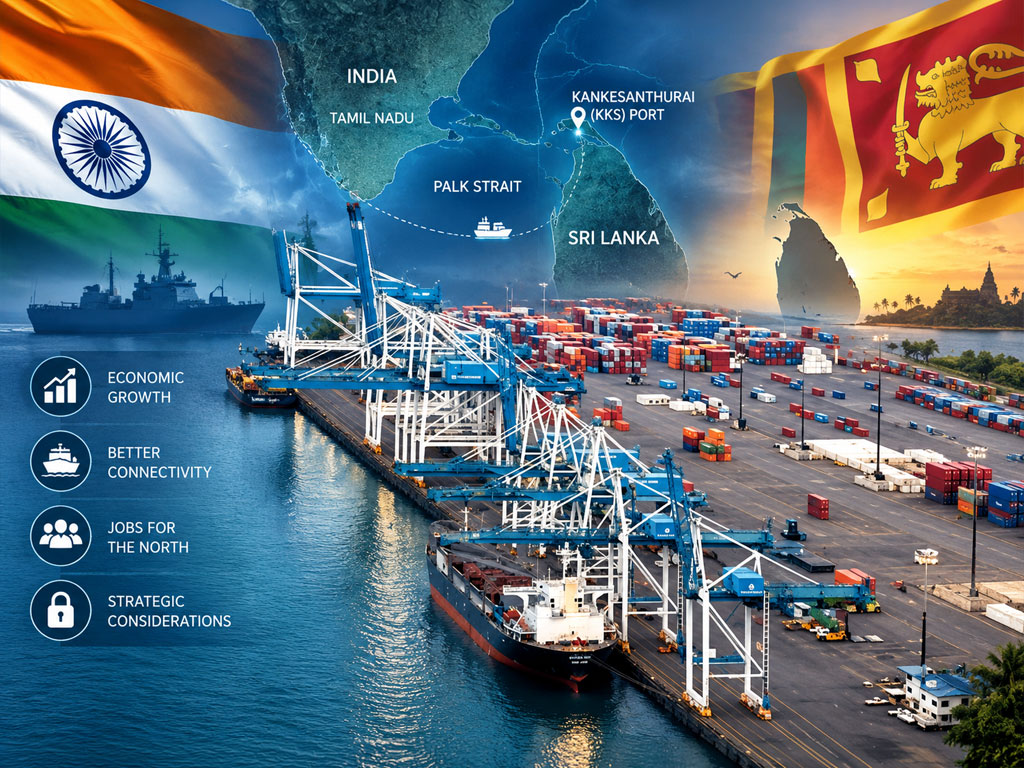
KKS Port redevelopment, backed by a US$61.5 million Indian grant, promises growth but raises questions over Sri Lanka’s strategic autonomy.
The KKS Port redevelopment is moving closer to reality with US$61.5 million in Indian grant funding, promising major benefits for Sri Lanka’s Northern Province.
Yet behind the prospect of a modernised Kankesanthurai Port lies a much larger strategic question. How far could the project deepen India’s economic, logistical and geopolitical influence in Sri Lanka’s strategically sensitive north?
Officials from Sri Lanka and India have reportedly resolved several outstanding issues surrounding agreements for the project following discussions in Colombo.
Ports Minister Anura Karunathilaka and India’s Deputy High Commissioner Maitrey Kulkarni led the negotiations.
Although the proposed memorandums of understanding have not yet been signed, both countries appear determined to move towards implementation.
India’s Foreign Ministry has confirmed that New Delhi will finance the redevelopment through a US$61.5 million grant.

The two sides also propose establishing a joint steering committee and technical committee to supervise and advance the project.
On the surface, grant financing offers Sri Lanka considerable advantages.
A major northern port could improve maritime connectivity and stimulate regional commerce. It could also reduce logistical isolation and create new economic opportunities in Jaffna and surrounding areas.
However, port infrastructure is rarely only about commerce.
KKS Port redevelopment carries strategic significance
KKS occupies an exceptionally sensitive geographical position, facing India across the Palk Strait.
Its proximity to Tamil Nadu gives the port significance far beyond its physical size.
Any substantial improvement in KKS maritime capabilities could eventually influence passenger movement, coastal shipping, logistics and regional trade.
That geography creates an unavoidable strategic dimension to India’s investment.
The central concern is not necessarily that India is financing the project. Instead, the key question is whether Sri Lanka will retain complete strategic autonomy as the investment develops into a broader operational relationship.
Other strategically located infrastructure projects have demonstrated how the source of financing can influence future institutional relationships.
Grant financing may initially appear attractive because it creates no conventional debt obligation.
However, longer-term influence can potentially emerge through technology, maintenance arrangements, operational expertise, training, logistics networks and associated commercial partnerships.
For that reason, the proposed steering and technical committees deserve close public scrutiny.
Who will ultimately make operational decisions?
What role, if any, will Indian agencies or companies have after construction ends?
Will Sri Lanka retain exclusive authority over security, vessel access, operational data and port management?
Furthermore, will future agreements permit Indian participation beyond the redevelopment phase?
These are important questions because KKS sits within Sri Lanka’s politically and strategically sensitive Northern Province.
Economic opportunity comes with wider questions
The KKS Port redevelopment also carries potentially significant economic consequences for northern Sri Lanka.
If KKS develops into an efficient maritime gateway, the port could reshape established transport and trade patterns across the region.
Such a transformation could benefit local businesses and consumers. Better maritime links could improve connectivity and create opportunities around Jaffna and surrounding areas.
However, closer connectivity could also increase the Northern Province’s economic dependence on links with India.
For Colombo, the challenge is therefore clear. Sri Lanka must ensure that economic development does not quietly evolve into strategic dependency.
Sri Lanka needs investment in its ports and northern economy. Indian assistance can make a significant contribution towards that objective.
However, the government must establish transparent safeguards before signing the agreements.
Those safeguards should provide clarity over decision-making, security, operations and the nature of any continuing foreign involvement associated with the redevelopment.
The strategic implications should therefore receive the same public attention as the economic benefits.
Ultimately, the real test of the project will not simply be whether Sri Lanka receives a US$61.5 million Indian grant.
It will be whether Sri Lanka can modernise Kankesanthurai Port, unlock new opportunities for the Northern Province and strengthen regional connectivity while retaining control over its strategic future.