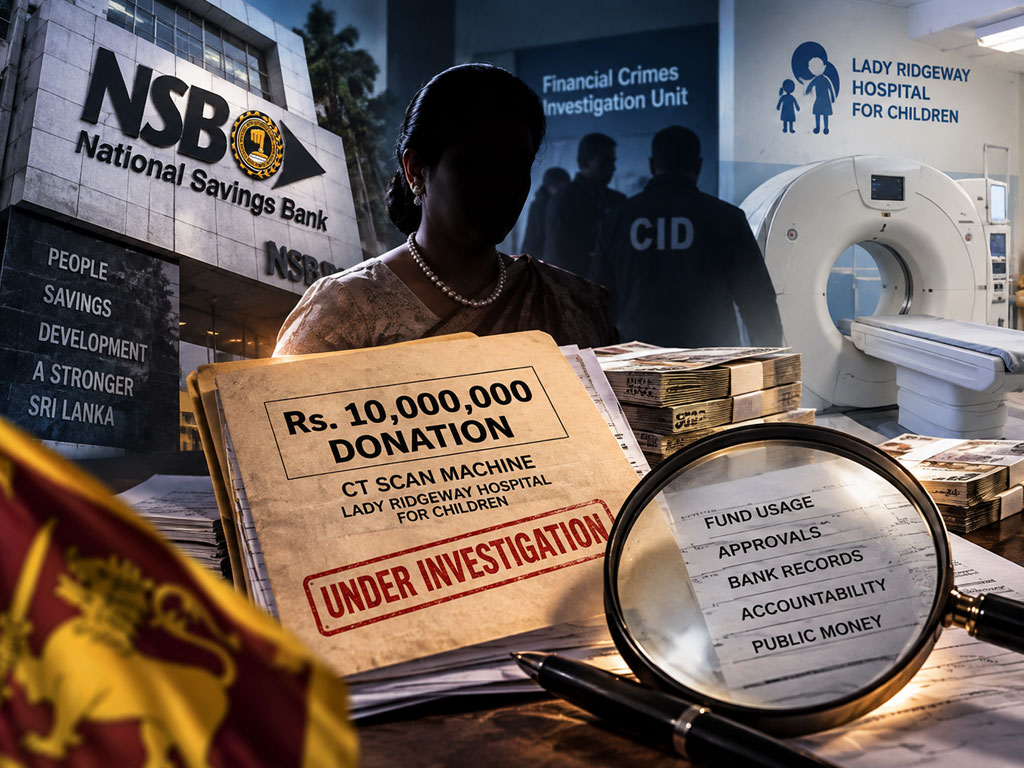
NSB donation investigation examines whether Rs. 10 million intended for a children’s hospital CT scanner was used for its stated purpose.
Sri Lanka’s NSB donation investigation into Rs. 10 million intended for a children’s hospital has raised questions over whether the money funded its stated purpose.
At the centre of the inquiry is a critical question. Was the money obtained to purchase a CT scanner actually used for that purpose? Or was an already available scanner later presented as the donation?
The Financial Crimes Investigation Unit of the Criminal Investigation Department is investigating the alleged misappropriation of funds released by the National Savings Bank to the Siriliya Foundation. Former First Lady Shiranthi Rajapaksa chairs the foundation.
The inquiry also covers foundation board members and other officials linked to the transaction.

According to preliminary findings cited in the case, the foundation requested the money to purchase a CT scan machine for the Lady Ridgeway Hospital for Children in Colombo.
However, investigators are examining allegations that the donated funds did not purchase the machine. Instead, a scanner supplied to Sri Lanka by the Chinese government under a loan agreement was subsequently donated to the hospital.
If investigators establish that allegation, it would raise serious questions about why the NSB funds were obtained. It would also raise questions about representations made to the bank and the accountability of those who authorized and received the money.
NSB Donation Investigation Focuses on Hospital Equipment
The issue extends beyond whether a CT scanner eventually reached the hospital.
Lady Ridgeway Hospital serves children who require specialized medical care. Therefore, access to diagnostic equipment can directly affect the speed and quality of treatment.
A donation made to improve healthcare also creates a public expectation of transparency. The promised resource should be acquired, funded and delivered for its stated purpose.
Additional Solicitor General President’s Counsel Dilipa Peiris, acting on behalf of the Attorney General, has instructed the investigation.
CID officers have already questioned several people and recorded statements. They include former NSB Chairman Pradeep Kariyawasam, who allegedly authorized the release of the funds based on verbal instructions.
That alleged authorization forms another significant part of the inquiry.
Public-sector financial institutions are expected to maintain documentary evidence, approval procedures and clear audit trails when releasing substantial amounts of money.
Therefore, if investigators establish that the Rs. 10 million payment proceeded without adequate written authorization or verification, the inquiry could reveal weaknesses extending beyond the foundation itself.
CID Expected to Question More Officials
The CID is expected to summon Shiranthi Rajapaksa, other foundation directors and responsible officials as the NSB donation investigation progresses.
Their statements could help investigators determine whether anyone misused the money, whether the bank received misleading information and who was responsible for the eventual donation.
The case also renews scrutiny of the Siriliya accounts. Those accounts previously attracted attention over alleged irregular documentation, including the alleged use of the national identity card number “222 222 222V” in banking transactions.
The central question is now whether charitable fundraising created the appearance of a privately funded contribution while public financing provided the actual medical equipment.
Investigators must establish what happened through documentary evidence, financial records and witness testimony.
Until that process is complete, the allegations remain unproven. However, the questions surrounding the Rs. 10 million payment, its authorization and the CT scanner remain central to determining whether the money reached its intended purpose and whether those involved followed the required financial procedures.