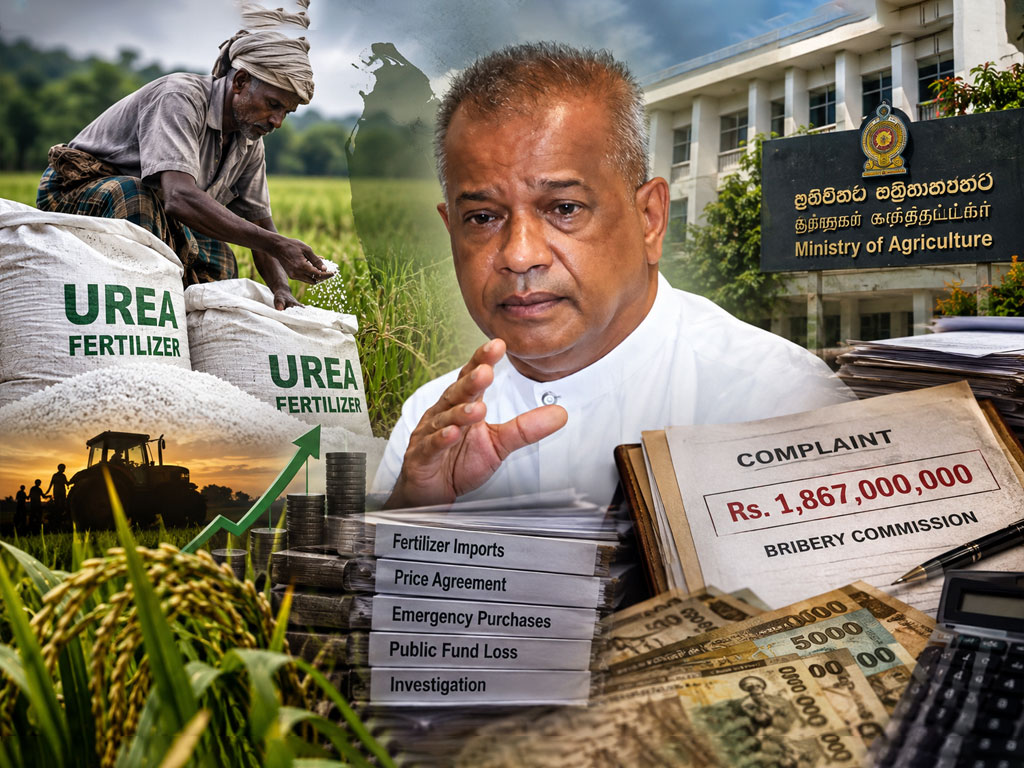
Fertilizer procurement scandal raises questions after a Rs. 1.867 billion complaint over urea supplies, prices and emergency purchases.
Sri Lanka’s fertilizer procurement scandal has returned to the spotlight after a Rs. 1.867 billion complaint raised serious questions over urea supplies and public spending.
Agriculture is not merely another economic sector in Sri Lanka. It remains deeply connected to rural livelihoods, social stability and national politics.
For decades, however, fertilizer procurement has repeatedly faced allegations involving politicians, officials and private businesses.
The latest controversy follows a complaint lodged with the Bribery Commission by Nimal Wattuhana, Coordinator of the National Farmers’ Federation. He alleges financial irregularities amounting to Rs. 1.867 billion. Reporting on the complaint confirms the core figures cited by Wattuhana, but the allegations have not been established as findings of corruption.

How the Fertilizer Procurement Scandal Unfolded
The dispute centres on what Wattuhana describes as a violation of an earlier agreement.
According to his complaint, agricultural authorities and private importers reached an agreement on March 17, 2026. It concerned 101,000 metric tons of urea and a price of Rs. 9,500.
However, he alleges that only 46,566 metric tons were ultimately supplied under the arrangement. He further claims that fertilizer was supplied at Rs. 10,200 instead of the agreed price. These figures were also reported when the complaint was filed.
The government subsequently moved to obtain another 16,000 metric tons through emergency or spot purchases from private companies.
Wattuhana alleges that this process resulted in Rs. 1.867 billion being paid from the Treasury. His complaint calls for an impartial investigation into whether public money was improperly spent.
The original commentary goes further. It alleges that private interests created an artificial shortage, placed pressure on the government and then benefited from higher fertilizer prices.
Those assertions remain allegations and require investigation.
Questions Over Minister Lal Kantha’s Intervention
The controversy also raises questions about Agriculture Minister K.D. Lal Kantha’s involvement.
Wattuhana says the Minister presented a Cabinet memorandum on June 18 relating to the transaction. He questioned why fertilizer initially expected at Rs. 9,250 was instead obtained from private suppliers at higher prices.
The commentary asks whether procurement procedures and Cabinet approval effectively provided legal protection for decisions that benefited private suppliers.
There is no established finding that Lal Kantha committed corruption or misused Cabinet procedures. The complaint asks CIABOC to investigate the transaction and determine responsibility.
The author compares the controversy with the Chinese organic fertilizer dispute during former Agriculture Minister Mahindananda Aluthgamage’s tenure under President Gotabaya Rajapaksa.
That earlier controversy resulted in a US$6.7 million payment connected to the rejected fertilizer shipment. The commentary argues that, although the political actors have changed, weaknesses in procurement remain vulnerable to exploitation.
It also criticises the National Fertilizer Secretariat, which regulates fertilizer imports.
According to the article, authorities have cited Rs. 4.8 billion allegedly outstanding from the government to private companies. The commentary argues that liquidity difficulties among importers should not justify allowing private interests to dominate the market.
It characterises the situation as more than administrative weakness and alleges deliberate disorder. That interpretation is the author’s argument, not an established official finding.
Farmers Carry the Cost of Higher Fertilizer Prices
The article argues that farmers ultimately bear the consequences of the fertilizer procurement scandal.
Wattuhana claims higher fertilizer costs have increased the production cost of one kilogram of paddy by approximately Rs. 12.50.
The government has spoken of ensuring farmers a 30% profit through guaranteed paddy prices. However, the commentary argues that rising fertilizer costs undermine that objective.
It further argues that farmers can then become vulnerable to selling their harvest at lower prices to powerful private mill owners.
The issue therefore extends beyond procurement prices. Fertilizer costs can directly affect cultivation expenses and farmer income.
Procurement Systems Cannot Replace Accountability
The commentary argues that even strict online procurement mechanisms cannot guarantee integrity if domestic governance is politicised.
It cites the World Bank’s STEP system as an example. STEP is designed to let borrowers plan, record and track procurement under World Bank-financed investment projects, while improving transparency and accountability.
However, technology cannot by itself determine whether the allegations in this fertilizer transaction are true.
The article also notes the political importance of farmers and agricultural policy. Rather than endorsing any political candidate or outcome, the underlying point is that fertilizer affordability and agricultural governance can become significant public-policy issues.
The complaint now places responsibility on the Commission to Investigate Allegations of Bribery or Corruption to examine the allegations impartially.
Sri Lanka’s Anti-Corruption Act No. 9 of 2023 expanded CIABOC’s mandate, including its ability to investigate and prosecute additional categories of corruption-related offences.
The commentary calls for the strongest applicable legal remedies against politicians, officials or businessmen if investigators establish wrongdoing. Any penalties, confiscation or remand must, however, follow the provisions of law and judicial process.
It also proposes replacing physical fertilizer distribution with a transparent digital system that transfers subsidies directly to farmers’ bank accounts. The author further advocates reducing Agrarian Services staffing where positions are considered surplus.
Whether those reforms would produce better outcomes requires separate policy assessment.
For now, the Rs. 1.867 billion allegation requires an independent investigation that establishes what happened to the fertilizer, why prices changed, how emergency purchases were authorised and whether public funds suffered any unlawful loss.
Until that process establishes the facts, the alleged fertilizer procurement scandal remains a serious complaint requiring answers, rather than proof of guilt against any individual named.