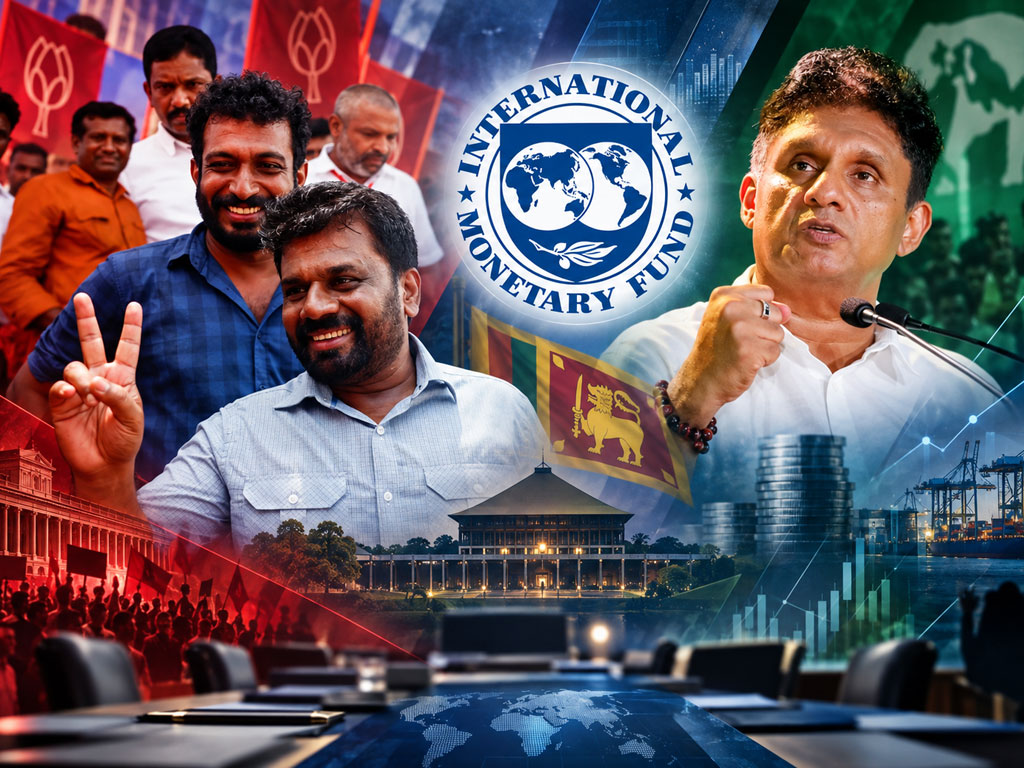
Sri Lanka political realignment gathers pace as the SLPP reorganizes, the SJB mobilizes and the Government faces pressure over the IMF and 22A.
COLOMBO — Sri Lanka’s major political camps are entering a new phase of reorganisation, with the Sri Lanka Podujana Peramuna attempting to rebuild around the Rajapaksa family, the Samagi Jana Balawegaya preparing a fresh opposition campaign, and the Government facing growing pressure over economic policy, constitutional reform and rural discontent.
Much of last week’s political attention centred on the SLPP rally in Anuradhapura and the Government-backed farmers’ gathering in Polonnaruwa, held on the same day. Both events were intended to demonstrate political strength, but the aftermath has triggered a wider contest over party leadership, alliances and the direction of the country’s economic programme.
The political atmosphere has been further sharpened by the remand of SLPP National Organiser Namal Rajapaksa in separate proceedings linked to the Airbus investigation, the continuing investigations involving members of the Rajapaksa family, and the Government’s proposed 22nd Amendment to the Constitution.
Behind the public rallies, discussions are also taking place over the future leadership of the SLPP, the internal direction of the National People’s Power administration, cooperation among Tamil and Muslim parties and the Opposition’s approach to the International Monetary Fund.

SLPP looks beyond Anuradhapura rally
The Anuradhapura rally demonstrated that the SLPP remains determined to maintain a visible political presence despite the legal difficulties confronting several of its leading figures.
Namal Rajapaksa remains in remand custody in connection with allegations arising from the Airbus aircraft procurement controversy. In one bribery-related proceeding, the Colombo Chief Magistrate’s Court has ordered that he remain in custody until September 29. A separate money laundering case linked to the same broader transaction has also been proceeding before the Fort Magistrate’s Court.
The allegations have not been determined at trial, and Rajapaksa has not been convicted in connection with them.
Within the SLPP, his detention has nevertheless become an important organisational issue. Party figures are discussing how rallies and other political activity should continue if he remains unable to participate directly.
Former President Mahinda Rajapaksa continues to retain an important symbolic and political role within the party, while Namal has become one of its most visible organisers.
Other members of the family remain less active. Former President Gotabaya Rajapaksa has largely remained outside day-to-day party politics, while Basil Rajapaksa is currently overseas.
The source column reports that discussions within the family have focused on ensuring that the SLPP continues operating regardless of the legal difficulties facing individual Rajapaksas.
Following the Anuradhapura rally, party discussions reportedly included plans to conduct rallies around the country on a monthly basis.
There had initially been consideration of broader participation by political figures outside the SLPP, including Wimal Weerawansa and Udaya Gammanpila, but the eventual preference was reportedly for rallies centred primarily on Pohottuwa members.
Leadership question remains unresolved
The longer-term issue is who would assume greater responsibility if Namal Rajapaksa remains unavailable for an extended period.
The column describes internal consideration of alternative leadership arrangements involving members of the wider Rajapaksa family, although no formal decision has been publicly announced.
Claims of longstanding competition within the family, including suggestions of differences involving Namal Rajapaksa and Shashindra Rajapaksa, remain political reporting and should not be treated as established fact.
The same applies to suggestions that former President Ranil Wickremesinghe influenced divisions within the family. No publicly established evidence has been presented to substantiate that claim.
What is clearer is that the SLPP intends to use the coming months to test whether the Anuradhapura rally can be converted into sustained political mobilisation.
The party’s challenge will be to maintain organisational momentum while several of its figures remain involved in investigations or court proceedings.
Shiranthi Rajapaksa’s Singapore stay attracts attention
Former First Lady Shiranthi Rajapaksa’s departure for Singapore has added another politically sensitive element to the week.
She travelled to Singapore on September 16 for medical attention after receiving treatment at a private hospital in Colombo.
Rajapaksa has been summoned to appear before the Financial Crimes Investigation Division on September 24 in connection with an investigation into financial transactions involving the Siriliya Saviya organisation.
A notice requiring her attendance was delivered at Bandaranaike International Airport before she departed.
Earlier information from representatives of the Rajapaksa family indicated that she intended to return on September 19. As of September 20, however, she had not returned to Sri Lanka.
Her representatives have confirmed that the trip was for medical treatment.
Claims contained in the source column that Sri Lankan authorities arranged surveillance of her movements in Singapore, including alleged observations at Orchard Road shopping centres, could not be independently established and should therefore not be presented as confirmed fact.
The relevant legal question remains whether she appears before the FCID as required on September 24.
Government faces questions after Polonnaruwa meeting
While the SLPP focused on Anuradhapura, President Anura Kumara Dissanayake addressed a farmers’ gathering in Polonnaruwa.
The absence of Agriculture Minister K.D. Lalkantha and Deputy Minister Namal Karunaratne from that event drew political attention because both have been closely associated with the Government’s agricultural policy.
The source column attributes their absence to internal concerns over criticism from farming communities and claims that party organisers had urged the leadership to keep them away from the stage.
That account has not been publicly confirmed by the Government.
Lalkantha has remained active as Agriculture Minister, while Karunaratne has continued to speak publicly on agricultural matters. Their absence from a single political event therefore does not by itself establish that either has been politically sidelined.
Claims that a Cabinet reshuffle is being considered have also circulated repeatedly, but no formal announcement has been made.
Claims over Harini Amarasuriya lack confirmation
Social media speculation concerning Prime Minister Harini Amarasuriya has also intensified.
Posts circulated suggesting that she opposed the 22nd Amendment and could leave the Government alongside a group of National People’s Power parliamentarians.
There is no verified evidence supporting those claims.
Amarasuriya has continued performing her duties as Prime Minister and Minister of Education, Higher Education and Vocational Education, including official engagements throughout the past week.
The Prime Minister’s Office has previously warned that fabricated social media material using her name, images and videos has circulated online.
The source column also refers to internal discussion over whether the premiership could eventually return to a senior JVP figure, with Minister Bimal Ratnayake mentioned as a possible name.
No official decision or publicly confirmed agreement exists establishing such a transition.
Any discussion of a possible change in prime minister should therefore be regarded as political speculation unless and until confirmed by the President, Government or relevant party leadership.
Tamil and Muslim parties explore greater coordination
Another strand of opposition politics is developing among Tamil and Muslim parties.
Political representatives have been holding discussions on common issues, particularly the demand for Provincial Council elections and concerns affecting minority communities.
The source column says a meeting at the Colombo residence of Ceylon Workers’ Congress leader Jeevan Thondaman brought together political figures including Palani Digambaram, Rauff Hakeem, Rishad Bathiudeen, Mano Ganesan, Shanakiyan Rasamanickam and M.A. Sumanthiran.
Separate reporting has confirmed discussions among several Tamil and Muslim parties about creating a mechanism to coordinate their positions on shared political concerns while retaining their separate party identities.
The talks should not yet be described as the creation of a formal electoral alliance.
Participants have instead discussed closer coordination, including greater pressure on the Government to hold Provincial Council elections.
That issue has particular significance in the North and East, where political parties have repeatedly called for the restoration of elected provincial administrations.
SJB prepares September 24 protest
The Samagi Jana Balawegaya is meanwhile preparing a public protest in Colombo on September 24 against the proposed 22nd Amendment to the Constitution.
Opposition Leader Sajith Premadasa has accused the Government of threatening judicial independence through the amendment, an allegation the Government disputes.
The Bill proposes changes to the retirement ages of superior court judges and an increase in the maximum number of Court of Appeal judges.
Parliament has scheduled the Twenty Second Amendment to the Constitution Bill and the Judicature (Amendment) Bill for debate on September 24 and 25.
The SJB has been mobilising organisers and local representatives from Colombo and surrounding districts ahead of the protest.
The source column says the party also intends to place greater emphasis on electorate-level political activity instead of relying primarily on large district rallies, with Hiriyala in Kurunegala identified as an early focus.
IMF programme becomes another political dividing line
Economic policy is likely to become an equally important battleground.
Sri Lanka’s current IMF Extended Fund Facility arrangement was approved in March 2023 for 48 months and is scheduled to run until March 2027.
The source column claims that the Government had been considering completing the existing programme without entering another IMF arrangement after its expiry.
No formal Government announcement confirming a decision to reject any future IMF programme has been made.
That distinction is important. Completion of the present Extended Fund Facility in March 2027 is different from terminating the programme early, and any decision about a subsequent arrangement would require separate negotiations between Sri Lanka and the IMF.
The continuing Middle East conflict has increased the economic uncertainty surrounding that debate.
Higher global oil prices have created additional pressure for Sri Lanka, while the IMF has already identified the conflict as a downside risk to growth, inflation, the current account and tourism.
Opposition Leader Sajith Premadasa has argued that Sri Lanka should continue discussions with the IMF while seeking terms he considers more favourable to the country.
That position gives the SJB an opportunity to distinguish itself from both those advocating withdrawal from IMF involvement and those supporting implementation of the existing programme without major renegotiation.
Fuel subsidies remain sensitive
Fuel prices are a particularly difficult issue for the Government.
The IMF programme has required temporary fuel subsidies introduced during the current external shock to remain limited and to be phased out under agreed programme parameters.
The source column describes a recent discussion between President Dissanayake and IMF representatives in which the President reportedly opposed an immediate removal of fuel support, arguing that higher prices would impose excessive pressure on households and the wider economy.
The precise private exchanges described in the column have not been officially documented in full.
What is publicly established is that the IMF and Sri Lankan authorities have discussed temporary subsidy measures and their fiscal limits.
Any extension or alteration of such support would have to be considered within the wider fiscal framework agreed under the programme.
IMF engagement with opposition also watched
The SJB is also seeking a larger role in discussions surrounding the IMF programme.
The source column says IMF representatives are expected to meet Premadasa and other opposition representatives on September 22.
Such meetings would allow the Opposition to raise concerns over programme targets, taxation, social protection and the broader economic outlook.
They should not, however, be interpreted as evidence that the IMF is endorsing any Sri Lankan political party or preparing for a particular future government.
The IMF routinely engages with political, institutional and civil society stakeholders during country missions.
The Fund’s programme remains an agreement with the Sri Lankan state, not with an individual administration or party.
Political competition entering a new stage
The next several days will bring together many of the pressures now reshaping Sri Lankan politics.
Namal Rajapaksa remains before the courts. Shiranthi Rajapaksa faces an FCID summons on September 24. Parliament will debate the 22nd Amendment on September 24 and 25. The SJB is preparing street protests against that legislation, while the Government must also navigate IMF discussions and the economic consequences of higher energy prices.
At the same time, the SLPP is attempting to rebuild its organisational network, minority parties are exploring closer cooperation and speculation persists over possible changes within the Government.
Some of the claims circulating around these developments remain unverified political intelligence rather than established fact. What is already visible, however, is that Sri Lanka’s main political blocs are preparing for a more competitive phase in which court proceedings, constitutional reform, economic policy and grassroots mobilisation are increasingly converging.