Sri Lanka fuel price revision looms as oil stays above $100, private suppliers report heavy losses and the Government weighs three options.
COLOMBO — Sri Lanka is heading towards a critical fuel price review at the end of September as global oil prices remain above $100 a barrel, forcing the Government to balance consumer protection against rising import costs and commitments under the International Monetary Fund programme.
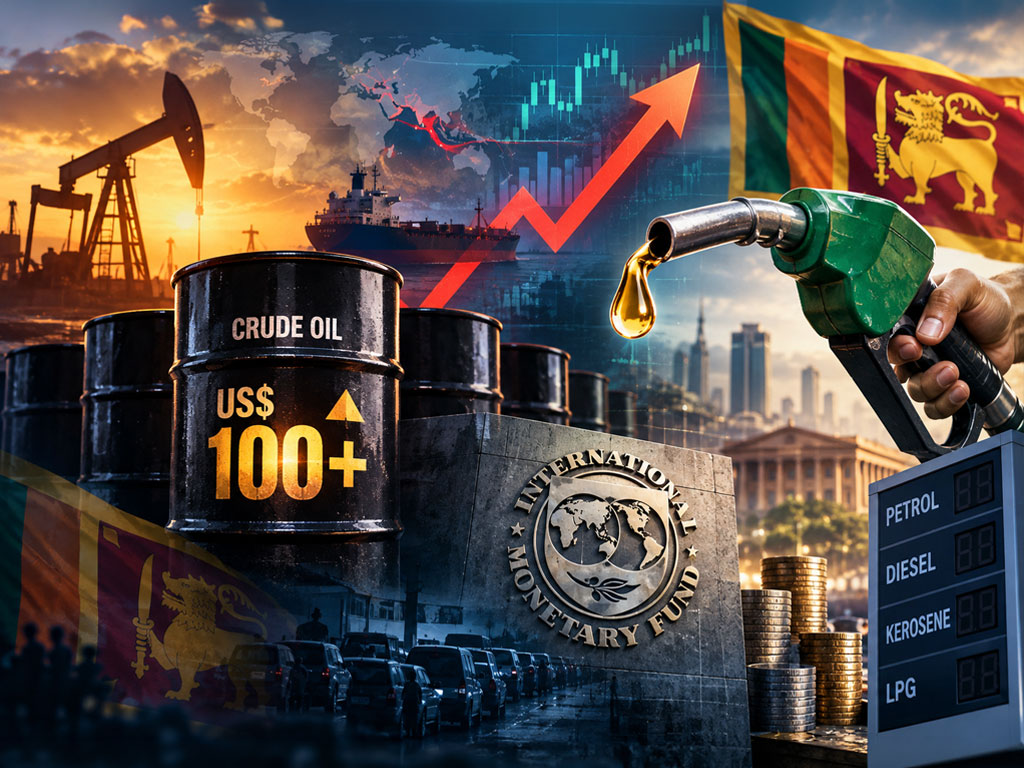
Brent crude was trading at around $103 a barrel over the weekend, while West Texas Intermediate had climbed above $101, as continuing Middle East tensions and disruptions to regional energy and shipping routes kept international petroleum markets under pressure.
The surge has widened the gap between the cost of imported fuel and Sri Lanka’s regulated retail prices, placing mounting pressure on both the Ceylon Petroleum Corporation (CPC) and private fuel suppliers.
For the Government, the approaching monthly price review presents a difficult choice: pass more of the international increase on to motorists, provide further financial relief, or modify the pricing mechanism to give suppliers greater flexibility.
The decision also carries implications for Sri Lanka’s IMF-supported economic programme, under which cost-recovery energy pricing remains a key commitment.

Government holds back immediate increase
Despite the sharp rise in international prices, the Government has so far refrained from imposing an immediate increase at the pump.
The CPC has been absorbing part of the difference between international costs and domestic selling prices, providing a temporary buffer for consumers already facing pressure from higher living costs.
Its position differs from that of the private distributors because the state-owned company has benefited from refinery earnings and fuel purchased earlier at lower international prices.
Those buffers, however, cannot indefinitely insulate the domestic market if global prices remain elevated.
CPC is estimated to be incurring a diesel loss of around Rs. 60 per litre under current conditions. Its ability to offset part of that loss through refinery operations has given the Government more room to delay a full adjustment.
The regular end-of-September review is therefore becoming increasingly important, particularly if international prices remain around or above present levels.
Private suppliers report heavy diesel losses
Private suppliers face a more immediate commercial problem.
Lanka IOC, Sinopec and RM Parks have reported substantial losses on diesel sold at prevailing domestic prices because they do not have the same refinery buffer available to CPC.
Figures submitted to the Ministry of Energy indicate that Lanka IOC is losing approximately Rs. 141 per litre of diesel, RM Parks about Rs. 160 and Sinopec around Rs. 163.
The financial pressure has already affected distribution.
All three companies have restricted diesel deliveries to parts of their dealer networks, leaving some filling stations unable to obtain the quantities they have ordered.
Industry representatives have warned that prolonged restrictions could disrupt operations at hundreds of filling stations and potentially shift additional demand towards CPC outlets.
That raises another concern for the Government. Even if national fuel stocks remain adequate, uneven distribution between competing networks could create localised shortages and queues.
Private operators have sought changes that would allow retail prices to reflect their actual landed costs more closely.
IMF requires return to cost-recovery pricing
The Government’s room for manoeuvre is complicated by its commitments under the IMF programme.
Cost-recovery fuel pricing is a continuing structural requirement of the programme, designed to prevent losses at state enterprises from being transferred indefinitely to public finances.
Sri Lanka temporarily departed from full cost-recovery pricing after the Middle East conflict drove energy costs higher.
Under the programme arrangements, the Government agreed to compensate CPC for fuel subsidies through explicit budget transfers while limiting temporary support and eventually restoring formula-based pricing.
Current temporary subsidies are due to be fully phased out by the end of September or earlier if the overall agreed subsidy ceiling is reached.
That timetable places the approaching fuel price review directly at the intersection of domestic political pressure, consumer affordability and Sri Lanka’s fiscal commitments.
Any decision to continue shielding motorists from the full international cost would therefore have to be structured without undermining the country’s primary budget targets and the financial position of CPC.
Three options under consideration
Energy Minister Anura Karunatilaka has indicated that the difficulties confronting private fuel companies, as well as the limits of what consumers can reasonably bear, will be considered when prices are reviewed at the end of September.
Three broad options have emerged.
The first would involve the Government providing some form of targeted relief or subsidy to cushion consumers from the international price shock.
Sri Lanka previously used temporary fuel support after global energy prices rose sharply, but extending broad subsidies would create additional fiscal costs and would have to be reconciled with IMF programme commitments.
A second possibility would be to introduce a minimum and maximum retail price range, giving individual fuel companies limited freedom to determine their own prices within an approved band.
Such a system could allow differences in import costs to be reflected without completely deregulating the retail fuel market.
The third option would be a conventional price adjustment reflecting international market conditions and the actual cost of supplying fuel.
That would strengthen cost recovery but could produce a substantial increase at the pump if global prices remain elevated.
No final decision on which approach will be adopted has been announced.
Consumer relief versus fiscal discipline
The dilemma extends well beyond motorists.
Diesel prices directly affect public transport, freight, agriculture, fisheries, construction and the cost of moving goods around the country. A sharp increase could therefore feed into broader inflation.
Holding prices artificially low for an extended period carries a different cost. Losses incurred by CPC ultimately have implications for the state balance sheet, while private suppliers cannot reasonably be expected to continue selling imported fuel indefinitely below cost.
The IMF programme specifically requires retail fuel prices to return to cost-recovery levels through monthly formula-based adjustments.
It also allows support for vulnerable households to be provided through more targeted mechanisms once broad temporary subsidies are withdrawn, provided Sri Lanka continues to meet its fiscal targets.
That distinction could become central to the Government’s eventual response. Instead of suppressing the retail price for every consumer, targeted assistance could provide relief to vulnerable households while allowing the pricing formula to reflect actual costs.
End-September decision becomes critical
The immediate outlook will depend heavily on international oil prices over the remaining days of September.
A decline in crude prices would give the Government and suppliers additional breathing room. Sustained prices above $100 would make the existing gap increasingly difficult to absorb.
Private distributors are already signalling that current diesel prices are commercially unsustainable, while CPC’s ability to use refinery earnings and older stocks as a cushion is necessarily limited.
The Government must consequently reconcile three competing objectives: keeping fuel affordable, maintaining reliable supplies across all distribution networks and honouring the fiscal framework underpinning Sri Lanka’s economic programme.
The end-of-September fuel review will determine how that burden is divided between the Treasury, petroleum suppliers and consumers.