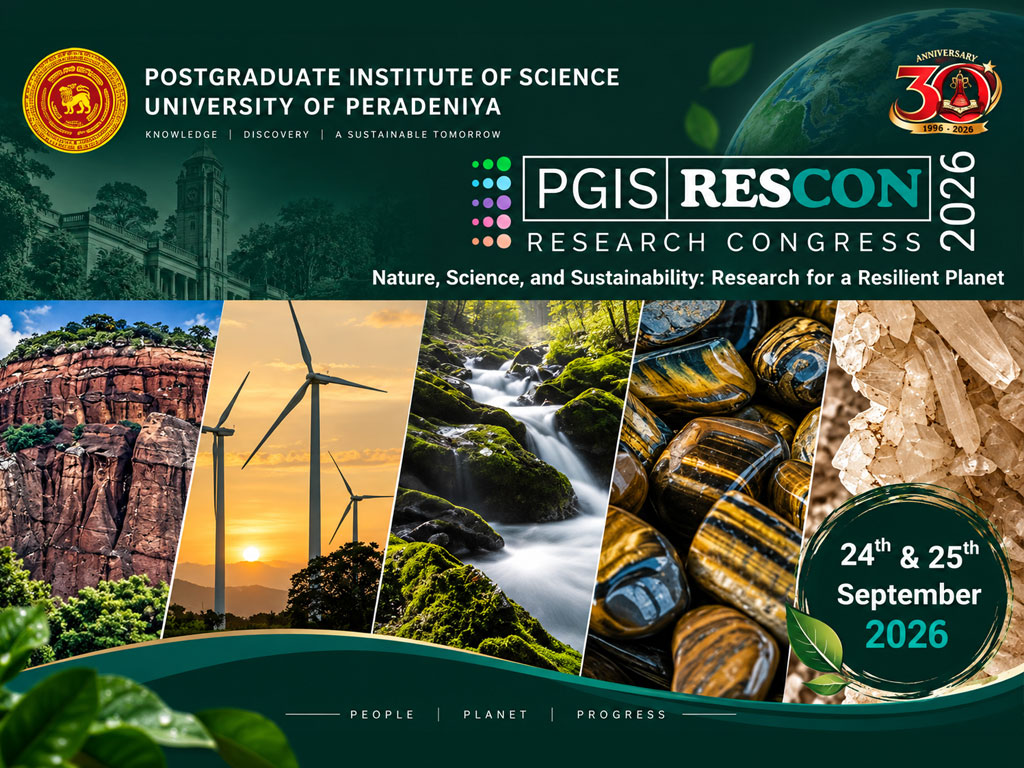
RESCON 2026 Peradeniya will bring researchers and planetary scientists together on September 24 and 25 to explore science for a resilient planet.
PERADENIYA — Scientists working on Mars, planetary science, climate, artificial intelligence and environmental sustainability will join researchers from Sri Lanka and overseas when RESCON 2026 opens at the University of Peradeniya on September 24.
The two-day Annual Research Congress, organised by the Postgraduate Institute of Science (PGIS), will be held on September 24 and 25 at the institute, bringing together scientists, researchers and students across a broad range of scientific disciplines.
This year’s congress coincides with the 30th anniversary of PGIS, which was established in 1996 and has developed into one of Sri Lanka’s principal institutions for postgraduate education and research in the natural sciences.
More than 200 research papers are expected to feature in the congress programme, while organisers anticipate participation by more than 500 local and international researchers, scientists and students.
RESCON 2026 will be held under the theme “Nature, Science, and Sustainability: Research for a Resilient Planet,” placing particular emphasis on how scientific research can respond to environmental pressures, climate change, food security and other challenges affecting the future of the planet.

Five major areas of scientific research
Research presented at the congress will span five principal areas:
- Earth and Environmental Sciences
- Computer Science, Artificial Intelligence, Mathematics and Statistics
- Life Sciences
- Physical Sciences
- Science Education
The programme is designed to provide researchers with a platform to present new work while encouraging collaboration among scientists working in Sri Lanka and abroad.
PGIS describes RESCON as its major annual research conference, providing opportunities to exchange knowledge, establish scientific networks and present current research across the natural sciences.
Technical sessions are scheduled for the afternoon of September 24 and throughout September 25, following the inauguration ceremony.
Mars scientists among RESCON 2026 keynote speakers
Planetary science will have a prominent place in this year’s programme, with two researchers whose work focuses extensively on Mars delivering keynote addresses.
Professor Suniti Karunatillake of Louisiana State University in the United States is among the keynote speakers. His research encompasses planetary science, remote sensing, Mars geochemistry, regolith hydration and the interpretation of satellite and in-situ planetary data.
Karunatillake has contributed to NASA-funded research and mission development, with his work examining the geological and hydrological evolution of Mars and other planetary bodies.
Joining him will be Professor Yuyan Zhao of Chengdu University of Technology in China, a planetary scientist whose research focuses on the geochemical and surface processes of terrestrial planets, particularly Mars.
Zhao is a member of the science team associated with China’s first Mars exploration mission, Tianwen-1, and has contributed to the analysis of data collected by the Zhurong rover.
Her research includes Martian surface chemistry, iron oxidation, halogen cycling and the potential conditions for past habitability.
Professor Ross Mitchell of the Chinese Academy of Sciences and Dr. S. Viswanath, former Director of the Kerala Forest Research Institute in India, are also scheduled to deliver plenary lectures.
Central Province Governor Dr. Harsha Suranga Fernando is expected to attend the inaugural ceremony as chief guest on September 24.
Research beyond the conference hall
RESCON 2026 forms part of a broader programme of scientific engagement taking place alongside the University of Peradeniya’s International Week.
The university’s programme lists the RESCON inauguration for the morning of September 24, followed by plenary talks and congress sessions, with the second day continuing from 8.30 a.m. to 5 p.m. on September 25.
A series of workshops and lectures has also preceded the congress.
These have covered areas including aquatic biodiversity research using environmental DNA, or eDNA, modern water technology, wildlife conservation and approaches to diabetes management through precision nutrition.
The wider programme reflects an effort to connect academic research with practical scientific problems rather than confining the congress to the presentation of research papers.
PGIS marks 30 years
The timing carries additional significance for the Postgraduate Institute of Science as it celebrates three decades since its establishment.
PGIS was created in 1996 as a national institute attached to the University of Peradeniya, with a mandate to provide, promote and develop postgraduate education in science.
Over the years, it has expanded its postgraduate programmes and research activities across multiple scientific disciplines.
This year’s congress is being held under the guidance of PGIS Director Professor Nanda Balasooriya. The organising leadership includes Congress Chairman Professor Sanjeewa Malaviarachchi, Secretary Dr. Sachinthani Karunarathne and Editor-in-Chief Professor Rohana Chandrajith.
With researchers spanning subjects from artificial intelligence and environmental science to Mars exploration, RESCON 2026 will place Peradeniya at the centre of two days of scientific exchange focused on one central question: how research can contribute to a more resilient and sustainable planet.