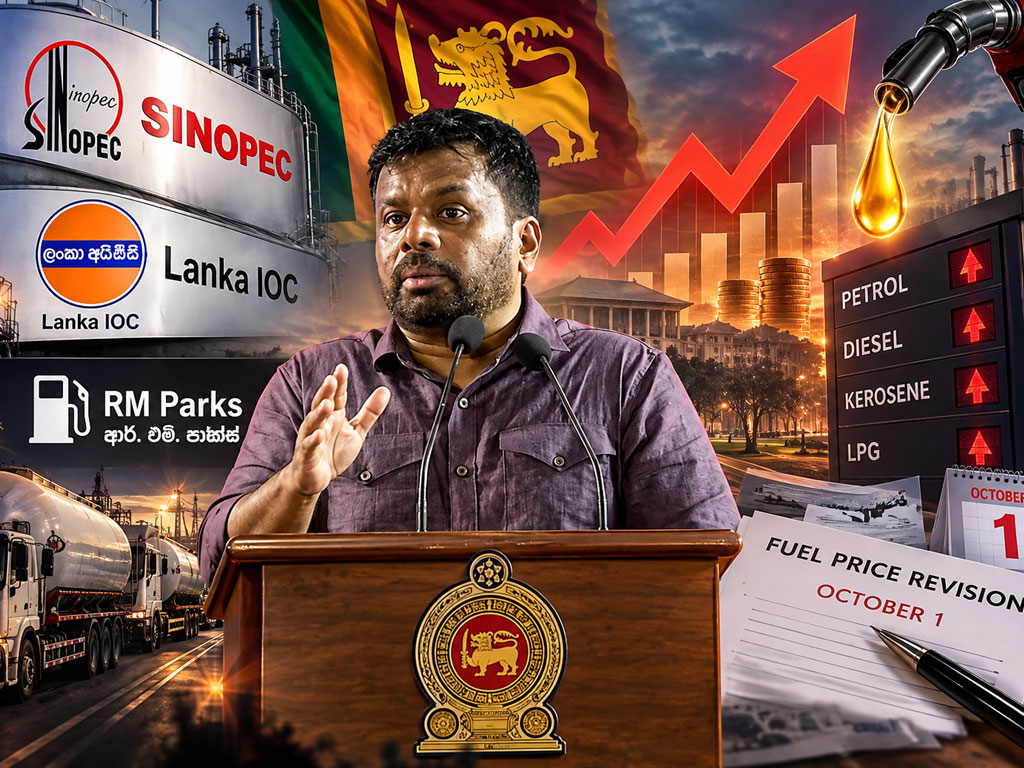
Sri Lanka fuel subsidy plans emerge as President AKD says the Government will cushion consumers from a possible October 1 price increase.
AKURESSA — President Anura Kumara Dissanayake has said the Government expects to subsidise fuel to cushion consumers from a possible price increase on October 1, as higher international petroleum costs place renewed pressure on Sri Lanka’s pricing system.
Addressing a public rally in Akuressa on September 20, Dissanayake said prevailing global prices indicated that domestic fuel prices would have to rise when calculated using imported fuel costs and the existing pricing formula.
“According to world market prices, fuel prices must be increased in October. When calculating costs based on imported fuel prices and the pricing formula, this price increase will take effect from the first of next month. But when a heavy burden falls on the people, it cannot be placed entirely on them. The government must provide some relief to ease that burden,” he said.
His remarks indicate that the Government intends to intervene rather than pass the full impact of higher international costs directly to consumers.
They do not, however, establish that retail fuel prices will remain unchanged from October 1. The precise subsidy, the fuels it will cover and the resulting retail prices have yet to be officially announced.

Private suppliers push for higher prices
The President’s comments come amid a dispute involving Sri Lanka’s private fuel suppliers, which have sought higher diesel prices after reporting substantial losses caused by rising international energy costs.
Lanka IOC, Sinopec and RM Parks have told authorities that current retail prices do not adequately reflect their increased costs.
Figures submitted to the Ministry of Energy and reported earlier this month indicated that Lanka IOC was losing approximately Rs. 141 on each litre of diesel, while RM Parks and Sinopec reported losses of around Rs. 160 and Rs. 163 respectively.
Private suppliers have consequently sought a revision of fuel prices in line with their landing costs. Energy Minister Kumara Jayakody has previously said there are no legal obstacles to considering price adjustments under agreements with the companies, although no decision granting their requested increases had been announced at the time.
Distribution problems have also emerged. Fuel dealers reported that the three private operators had restricted diesel supplies to parts of their networks as the financial pressure intensified.
The Government’s decision on October prices will therefore have consequences not only for motorists but also for private operators attempting to sell fuel under the prevailing pricing arrangements.
Private Fuel Supply Curbs Put Standards Under Scrutiny
Sri Lanka fuel supply restrictions deepen as private operators report heavy diesel losses, renewing scrutiny of pricing and fuel quality controls.
The Morning Telegraph • September 20, 2026 • 7 min readDoes AKD’s speech amount to a warning?
The President did not explicitly identify Lanka IOC, Sinopec or RM Parks in the remarks on fuel subsidies reported from the Akuressa rally. Nor did he publicly say that the Government would reject any price adjustment sought by foreign fuel suppliers.
For that reason, interpreting his speech as a direct “red light” to the three companies goes beyond what Dissanayake actually said.
His comments nevertheless establish a clear policy priority: the Government does not want the entire increase generated by international prices and the domestic pricing formula passed directly to consumers.
That position could affect negotiations with private suppliers if their requests for higher prices conflict with the Government’s objective of limiting the increase motorists ultimately pay at the pump.
How that tension will be resolved remains unclear.
The Government could subsidise suppliers, absorb part of the additional cost through public finances, revise retail prices while cushioning part of the increase, or adopt another mechanism within the existing petroleum pricing framework.
Government has subsidised fuel before
Subsidising fuel suppliers would not be a new policy response for the Dissanayake administration.
Cabinet approved a fuel-price stabilisation measure in March following external shocks associated with the Middle East conflict. Under that arrangement, the Government authorised payments to fuel import suppliers of up to Rs. 20 per litre for 92-octane petrol and up to Rs. 100 per litre for auto diesel when import prices exceeded declared selling prices.
The measure took effect from March 22 and was intended to limit the impact of higher international prices on consumers.
More recently, private suppliers have argued that worsening market conditions have pushed their diesel losses substantially beyond the level previously covered by the subsidy.
Asian diesel refining margins have also risen sharply amid concerns over regional supply and geopolitical disruption, adding pressure across petroleum markets.
Dissanayake’s latest comments suggest the Government is again prepared to use public funds to prevent the entire external price shock from reaching consumers.
October decision will reveal how costs are shared
What remains unresolved is how much of the additional cost the Treasury is prepared to absorb and how much will ultimately be reflected at filling stations.
The original argument that the President’s Akuressa speech represents a definitive rejection of the private companies’ demands cannot be established from his remarks alone. The supplied commentary interprets his statement as a political warning to foreign petroleum companies, but the President did not make that connection explicitly. Pasted text
There is, however, a genuine policy conflict behind that interpretation.
Private suppliers want retail prices to better reflect rising costs. The Government wants to prevent those same increases from falling entirely on consumers.
The October 1 fuel-price revision will show how the administration intends to reconcile those competing pressures and, crucially, how much of the cost will be borne by motorists, petroleum suppliers and the Treasury.