By Dwayne Ferreira.
Saudi Arabia investigates how Houthi drones and missiles penetrated Riyadh airport defences, raising questions about early warning and Patriot systems.
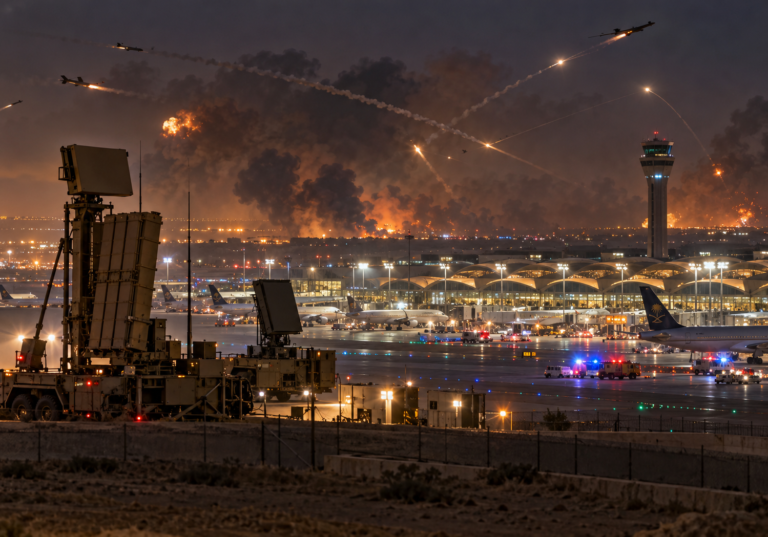
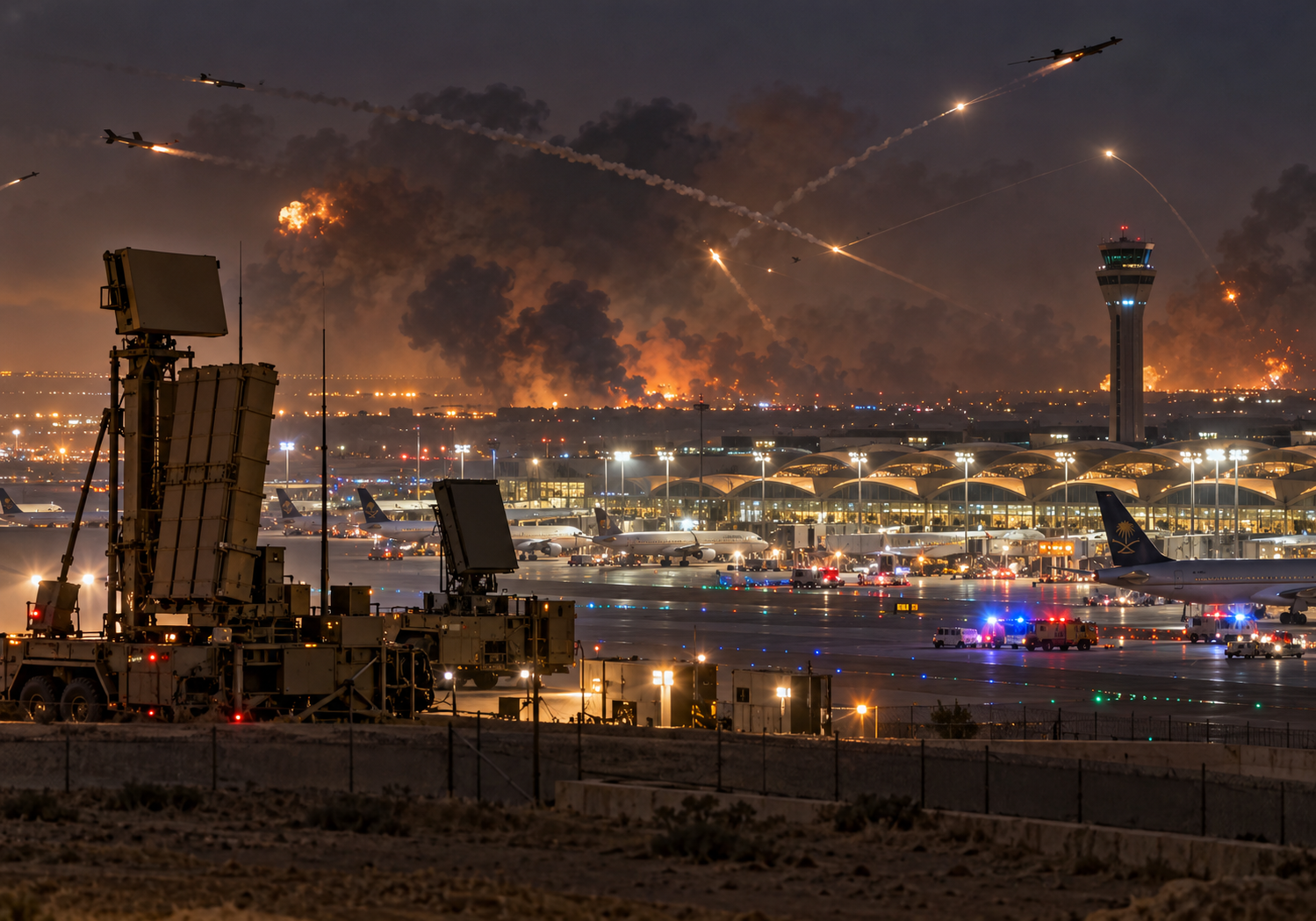
Saudi Arabia has launched an investigation into how missiles and drones fired by Yemen’s Houthi movement penetrated the air-defence network protecting Riyadh’s King Khalid International Airport, killing at least 14 people and injuring hundreds in a series of attacks that have exposed serious questions about the kingdom’s ability to defend critical civilian infrastructure.
The investigation comes as the airport remains closed following successive strikes over the weekend, disrupting international aviation and prompting widespread concern about the effectiveness of Saudi Arabia’s sophisticated missile-defence systems.
According to the Associated Press, investigators are examining whether the Houthis deliberately launched drones ahead of a combination of cruise and ballistic missiles, potentially complicating Saudi efforts to identify, track and intercept the incoming threats.

Two regional officials familiar with the preliminary investigation told AP that the attack involved multiple types of weapons and that some missiles may have been capable of manoeuvring around interceptors launched by Patriot air-defence batteries.
However, the precise reasons the weapons reached their targets have not yet been independently established.
How the Attackers May Have Penetrated Riyadh’s Defences
The preliminary findings suggest the Houthis may have used a coordinated sequence of aerial attacks rather than relying on a single missile.
According to the officials cited by AP, drones were launched first, followed by cruise and ballistic missiles directed towards the airport.
Such an operation presents different detection and interception challenges because the weapons do not all travel at the same speeds, altitudes or along the same trajectories.
Cruise missiles generally fly at lower altitudes than many ballistic missiles and can change direction during flight. Drones can also have relatively small radar signatures, depending on their design.
Ballistic missiles, meanwhile, can travel at extremely high speeds during portions of their flight, leaving defenders with limited time to respond.
An integrated air-defence system must detect these different threats, determine their trajectories and coordinate an effective response.
Investigators have not yet established whether radar detection, command decisions, interceptor performance or other factors contributed to the Riyadh incident.
Why Did Early Warning Signs Fail?
One of the most significant questions concerns the distance travelled by the attacking weapons.
The regional officials cited by AP said the missiles and drones travelled more than 1,000 kilometres before reaching the Saudi capital.
Investigators are examining why the incoming threats did not generate sufficient early warning despite crossing such a considerable distance.
Long-range detection is a central component of modern air defence. Early identification provides additional time to assess an approaching threat, alert the relevant authorities and prepare interception measures.
However, a weapon’s detection depends on several factors, including its altitude, radar signature, flight path and the coverage provided by available sensors.
Low-flying cruise missiles, for example, can be particularly challenging for ground-based radars because the curvature of the Earth and surrounding terrain can limit detection distances.
That is a general technical vulnerability, not proof that it explains what happened in Riyadh.
The Saudi investigation will need to determine what the country’s sensors detected, when warnings were issued and whether the information reached the relevant defence units in time.
Patriot Missile Systems Face Renewed Scrutiny
Saudi Arabia has invested heavily in advanced air-defence equipment, including the American-made Patriot system.
Patriot batteries are designed to detect, track and engage various aerial threats, with capabilities depending on the particular radar, command equipment and interceptor missiles deployed.
The system has previously been used in the region against ballistic-missile threats.
However, no air-defence system can guarantee the interception of every incoming weapon, particularly during complex attacks involving multiple targets and different flight characteristics.
The initial AP reporting suggests investigators are examining the possibility that some incoming missiles manoeuvred in ways that complicated interception.
That does not establish that Patriot equipment malfunctioned or that individual operators made errors.
A proper assessment would require detailed technical evidence, including radar records, interceptor performance data and a reconstruction of the attack.
Saudi officials have not publicly released findings establishing the precise point at which the defensive response broke down.
Why the Airport Remains Closed and International Flights Grounded?
The consequences have extended far beyond the damage caused by the missiles.
Reuters reported on Monday that closure of the King Khalid International Airport had been extended, with authorities yet to announce a reopening date.
The airport is one of Saudi Arabia’s most important international aviation facilities and a major gateway for travellers, businesses and foreign workers.
According to aviation data cited by Reuters, almost all scheduled flights were grounded on Sunday.
International carriers have suspended or cancelled services, while aviation authorities have warned airlines to exercise caution when operating through affected Saudi airspace.
Schools in Riyadh have shifted to online learning, and businesses in the King Abdullah Financial District have instructed some employees to work remotely.
The disruption demonstrates the wider economic and social consequences of attacks against major transport facilities.
Saudi Arabia Responds as Regional Conflict Intensifies
The Houthis have claimed responsibility for attacks against Saudi aviation and energy facilities and warned of additional operations unless Saudi military activity in Yemen stops.
Saudi-led forces have reported intercepting further incoming weapons, demonstrating that some defensive operations remain effective even as investigators examine the breaches.
On Monday, Saudi state media reported further military responses to drone and cruise-missile attacks.
Meanwhile, the Houthis reported that airstrikes in Yemen’s capital, Sanaa, killed one person and wounded 12 others.
The escalating confrontation has raised concerns about a prolonged cycle of attacks and retaliation.
Iran, which maintains relations with the Houthi movement, has reiterated its willingness to help mediate a settlement between the two sides.
A Security Crisis With Global Aviation Implications
The investigation is particularly important because an international airport is not an ordinary military target.
Commercial aircraft, passengers, airport employees and supporting transport systems operate within a complex civilian environment where even a limited security breach can cause widespread casualties and disruption.
The strikes have raised questions about the ability of regional air-defence networks to protect civil aviation against evolving aerial threats.
For international airlines, the immediate considerations include the risk posed by further attacks, the reliability of operational warnings and the availability of safe alternative routes.
For Saudi Arabia, the consequences also affect confidence in its ambitious economic-development and tourism programmes.
The kingdom is investing heavily in infrastructure, international events and economic diversification, all of which depend on reliable transport links and a secure operating environment.
What Investigators Must Now Establish
The central questions remain unresolved.
Investigators must determine whether the incoming weapons were detected early enough, whether their movements complicated interception, and whether weaknesses in communication or defensive coordination contributed to the attack.
They must also examine what changes, if any, are necessary to prevent similar incidents.
The initial findings point towards a sophisticated and coordinated aerial assault. But they do not yet provide a definitive explanation for the failure to stop the weapons that struck the airport.
Until the investigation produces more detailed evidence, assigning responsibility to a particular weapons system, technical failure or operational decision would be premature.
What is clear is that the attacks have exposed the limits of even heavily defended infrastructure when confronted with evolving missile and drone threats.
For Saudi Arabia, the challenge now extends beyond reopening Riyadh’s airport.
It must also demonstrate that the lessons from the attack can be translated into stronger protection for civilians and critical national infrastructure.
Sources:
Associated Press, October 12, 2026; Reuters, October 12, 2026.