By Dwayne Ferreira.
Delhi Cockroach protests escalate as thousands face detention and an eyewitness report describes mob violence amid an electoral dispute.
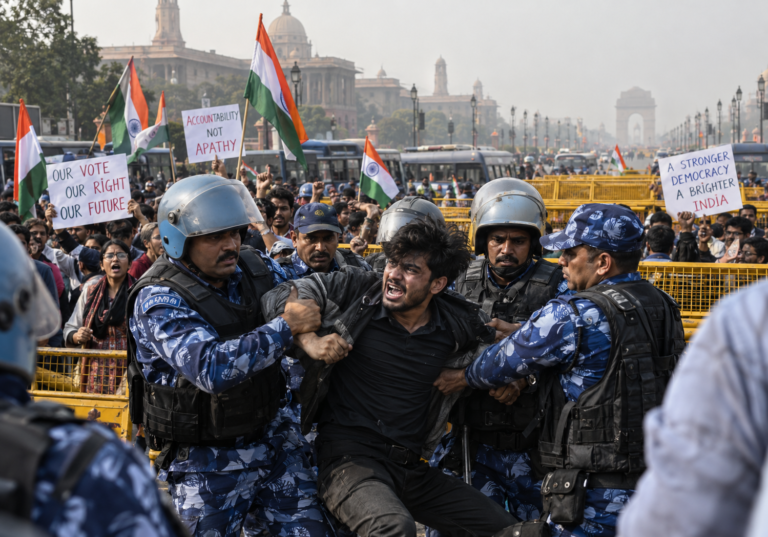
NEW DELHI – India’s capital has become the centre of a growing confrontation over electoral transparency, civil liberties and the right to peaceful protest after thousands of demonstrators were detained, roads barricaded and internet services restricted during a major security operation against the youth-led Cockroach Janta Party (CJP).
The protests, demanding the resignation of Chief Election Commissioner Gyanesh Kumar, have escalated following allegations of widespread irregularities in India’s electoral-roll revision process, which has reportedly resulted in the removal of more than 130 million voter entries.

The situation took a more troubling turn when The Independent reported witnessing a group described as Hindu nationalists attack protesters in full view of nearby police personnel.
Journalist Namita Singh, reporting from New Delhi on October 10, described a heavily secured capital where demonstrators struggled to reach designated protest locations and security personnel detained people attempting to voice their grievances.
The eyewitness account raises further questions about the conduct of security forces and the protection afforded to peaceful demonstrators.
Delhi Transformed Into a City of Barricades
Authorities launched an extensive security operation ahead of the planned October 10 demonstration at Jantar Mantar, a recognised site for public protests in India’s capital.
Police barricaded major roads, deployed paramilitary personnel and restricted movement across several parts of New Delhi.
According to The Independent, even relatively short journeys towards the protest area became difficult because of diversions and repeated road closures.
Mobile internet services were restricted within approximately four kilometres of the designated protest location, while several metro stations and railway services were affected.
Connaught Place, normally one of Delhi’s busiest commercial districts, experienced extensive closures.
The Hindustan Times reported that more than 25,000 police and paramilitary personnel were deployed across the capital during the security operation.
Meanwhile, the Supreme Court intervened over blanket transport restrictions, raising concerns about the proportionality of measures imposed on the public.
Eyewitness Report Describes Hindu Nationalist Mob Violence
Among the most serious developments was an incident witnessed by The Independent, involving individuals described as Hindu nationalists confronting demonstrators.
According to Singh’s eyewitness account, a group charged towards protesters and assaulted an individual while police personnel remained nearby.
One person within the group accused the protester of making a threat against India’s Parliament.
However, The Independent stated that it could not independently establish the truth of that accusation, identify the individual being attacked or determine whether police had initiated proceedings against the attackers.
The newspaper also reported speaking to a man who identified himself as a supporter of the authorities and claimed that like-minded individuals were helping detain protesters before handing them to police.
His remarks reflected the hostility between some supporters of the government and those participating in the demonstrations.
There is no verified evidence that the alleged mob attack was organised or authorised by the Indian government or the ruling Bharatiya Janata Party.
Nevertheless, the reported incident raises questions about whether law-enforcement personnel intervened appropriately to protect demonstrators from violence.
Protesters Claim Legitimate Voters Have Been Removed
The dispute surrounding India’s electoral-roll revision remains the central issue driving the protests.
Campaigners accuse the Election Commission of overseeing a process that could prevent eligible citizens from exercising their right to vote.
The controversy concerns the Special Intensive Revision, a programme intended to update electoral registers by identifying duplicate, deceased, relocated or otherwise ineligible entries.
Opposition groups contend that the exercise has disproportionately affected marginalised communities and could favour the governing BJP.
The Election Commission rejects allegations of deliberate electoral manipulation and maintains that the revisions are necessary to improve the accuracy of voter records.
Importantly, the reported 130 million deletions do not establish that an equivalent number of eligible citizens have permanently lost their voting rights. Entries can be removed for different reasons, and affected individuals may have access to review or appeal procedures.
Internal Concerns Within the Election Commission
The controversy has also drawn attention to reported disagreements within the commission.
The Independent, citing an investigation by The Indian Express, reported that two election commissioners had raised formal concerns on 14 occasions over a ten-month period.
The reported objections involved aspects of voter registration, procedures for challenging deletions and the centralisation of software used to update electoral rolls.
One case highlighted, involved 97 voters in Goa who were reportedly excluded from final lists because local officials could not make authorised corrections through the centralised system.
The Election Commission maintained that internal discussions are part of normal institutional decision-making and rejected suggestions that disagreements demonstrated wrongdoing.
These examples do not prove nationwide electoral manipulation, but they have intensified demands for transparent procedures and independent scrutiny.
Protesters Detained While Demanding Answers
The police operation affected students, political activists, journalists and other ordinary citizens attempting to participate in demonstrations.
Among those interviewed by The Independent was a protester who said that a living family member had been removed from the electoral register.
He maintained that he had committed no violence and had been detained while seeking an explanation.
Another protester, identified as Jyoti Rawat, was detained after challenging restrictions that prevented her from proceeding towards the demonstration.
The newspaper also described journalists facing difficulties while covering the events, including an incident involving Suhasini Haidar, diplomatic editor of The Hindu, who was reportedly pushed by police personnel.
Police defended their operations as preventive measures following the refusal of permission for the planned gathering.
Detention estimates have varied significantly.
Reuters reported more than 2,000 detentions on October 10, while other Indian media accounts placed the number considerably higher.
The differing totals may reflect separate reporting periods, locations and methods of counting detainees.
What Is the Cockroach Janta Party?
The Cockroach Janta Party began as an unconventional youth movement challenging unemployment, educational controversies and the treatment of young Indians by political institutions.
Its name emerged from a controversy involving language used about young critics, which activists turned into a symbol of political resistance.
Under founder Abhijeet Dipke, the movement has grown beyond its original education-focused demands.
Its supporters now campaign on electoral accountability, institutional independence and civil liberties.
The movement’s leaders, including Dipke, were detained after arriving in Delhi ahead of the October demonstrations.
They were subsequently released following judicial proceedings and pledged to continue their campaign.
Protests have also been reported beyond the capital, including in Mumbai and Kolkata.
Courts and Human Rights Groups Respond
The United Nations human-rights office called for respect for peaceful assembly following reports of mass detentions.
India’s Foreign Ministry rejected the international criticism as interference in domestic matters.
Meanwhile, the Supreme Court considered restrictions affecting journalists, lawyers and members of the public.
The legal issues surrounding the demonstrations include the extent to which authorities may restrict gatherings for public-order reasons and whether those restrictions remain proportionate.
Police argue that they must prevent disorder and protect public safety.
Civil-rights advocates counter that preventive policing must not become a means of suppressing peaceful political expression.
Those competing responsibilities have become central to the controversy.
October 12: Restrictions Ease, but the Confrontation Continues
By Sunday, authorities had partially relaxed restrictions across New Delhi.
Metro services resumed, and some internet limitations were lifted.
However, The Indian Express reported on October 12 that central Delhi remained under prohibitory orders, with groups of five or more people continuing to face detention in restricted areas.
Smaller demonstrations continued at different locations as protesters adapted their tactics in response to the security measures.
The continued detentions indicate that the dispute remains unresolved despite the release of senior CJP organisers.
The movement has pledged further demonstrations, while authorities maintain that gatherings must comply with applicable public-order restrictions.
A Wider Test of India’s Democratic Accountability
The Delhi protests have developed into a dispute about far more than the administration of voter lists.
They now involve questions about the independence of electoral institutions, the ability of citizens to challenge government decisions and the responsibilities of police officers during political demonstrations.
The reported assault on protesters by individuals identifying with Hindu nationalist politics adds another dimension to the confrontation.
India’s government and Election Commission deny allegations of electoral wrongdoing, while campaigners continue to demand greater transparency and accountability.
The central challenge is whether the competing claims can be examined through credible institutional processes without further violence or unnecessary restrictions on peaceful assembly.
For a country whose democratic system involves hundreds of millions of voters, public confidence in electoral administration and fundamental freedoms remains essential.
What began as a protest organised by a youth movement with an unusual name has developed into a national controversy over voting rights, public accountability and the boundaries of state power.