Gnanasara Thero robe controversy intensifies as monks march to Colombo, while religious leaders challenge the handling of his prison attire.
COLOMBO – A campaign led by members of the Maha Sangha over the treatment of imprisoned Ven. Galagodaaththe Gnanasara Thero is developing into a politically sensitive test for the Government, combining questions of prison procedure, Buddhist religious tradition and the wider use of religion in Sri Lankan politics.
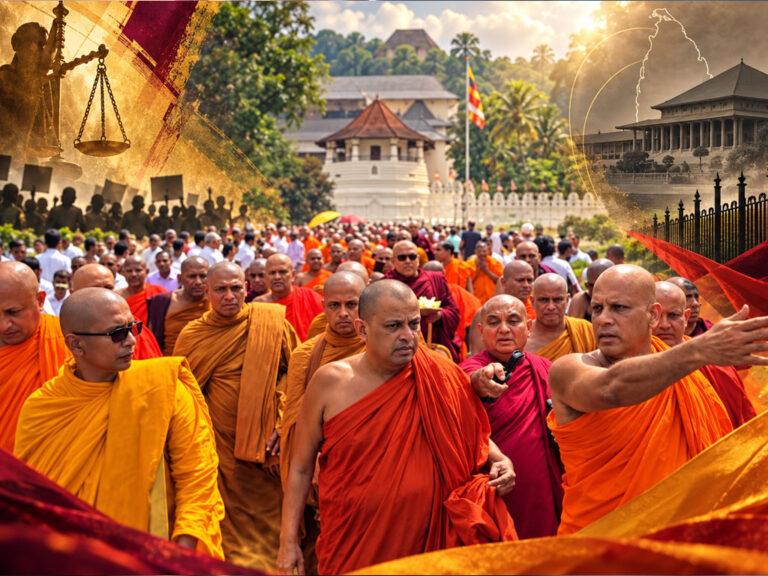
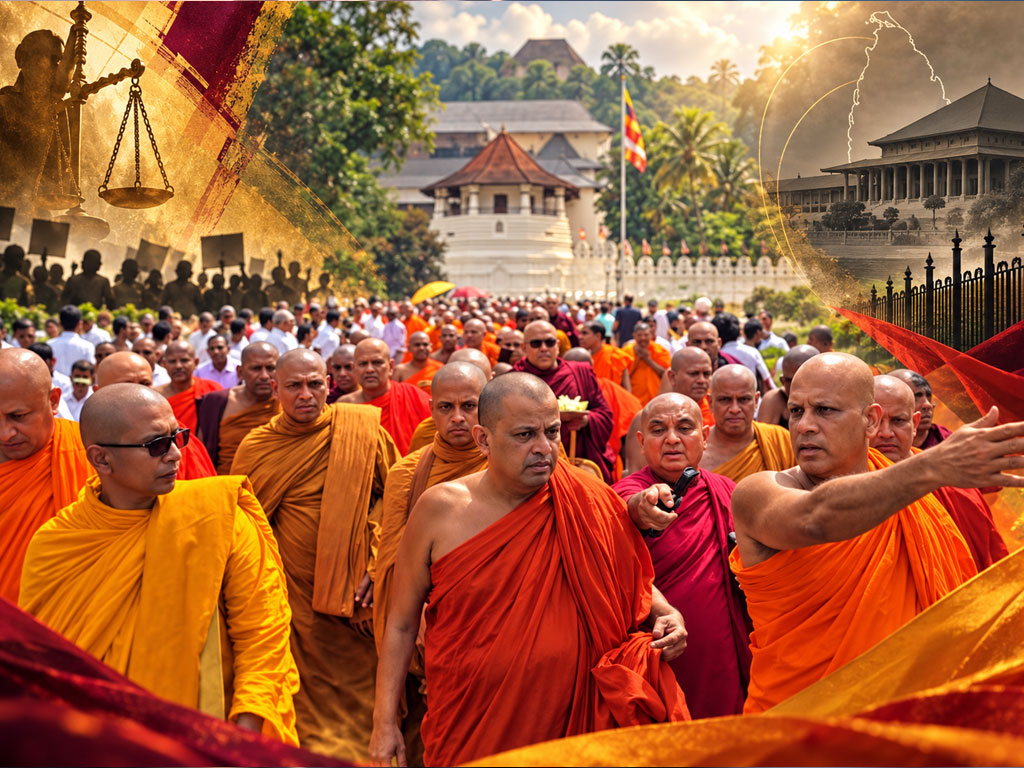
The “Justice for the Robe – National Resolution Offering and Freedom Walk”, organised in support of Gnanasara Thero and what its organisers describe as the protection of monks’ rights, began outside the Sri Dalada Maligawa in Kandy.
On its second day, October 11, the procession continued from Kadugannawa towards Colombo and is scheduled to reach the capital on October 15.
At the centre of the dispute is the claim that Gnanasara Thero was required to remove his monastic robe while in prison.
That issue has become the focal point of a wider debate over whether prison regulations can override religious convention governing the status and attire of an ordained Buddhist monk.

Robe Issue Deepens Religious and Political Debate
Public reaction has divided sharply.
Supporters of the campaign argue that the removal of a monk’s robe is not merely a matter of prison administration, but touches the authority of the Sangha and established Buddhist tradition.
Critics of Gnanasara Thero, by contrast, have questioned attempts to turn his treatment in prison into a broader political or religious confrontation.
The debate has also become entangled with claims that the Government is hostile towards Buddhism because of its ideological background.
Political commentary and social-media posts have further alleged that non-Buddhist religious groups, including movements described as “Born Again”, have developed close links with figures around the Government.
No evidence establishing that such relationships have influenced Government policy is contained in the material provided for this report.
Separate criticism involving the Catholic Church and Cardinal Malcolm Ranjith in connection with legal proceedings and public debate surrounding the Easter Sunday attacks has further contributed to an already sensitive intersection between religion and politics.
These issues involve distinct institutions and disputes and should not be treated as evidence of a coordinated religious or political campaign.
Mahanayake Says Only Sangha Can Remove a Monk’s Robe
The controversy gained further weight after the Mahanayake of the Kotte Sri Kalyani Samagri Dharma Maha Sangha Sabha, Most Ven. Ittepane Dhammalankara Mahanayake Thero, publicly challenged the handling of Gnanasara Thero’s robe.
He made the remarks during a meeting with Opposition Leader Sajith Premadasa.
The Mahanayake Thero said:
“Historically, this country is a Buddhist country. Protecting Buddhism is our responsibility and duty. A letter was also sent. To the President too. Also, one of the Theros of our Sangha Sabha is a skilled orator, a Dhamma preacher. A date has been requested again. To meet the President. That robe can be removed only by the monks themselves, not by anyone else. If the robe had not been removed, it could have been tolerated. There is no right to remove the robe. Ninety-nine per cent of all three Nikayas in the country are against it. Against what was done. I am the Mahanayake of the Kotte Sangha Sabha. At least the Kotte Sangha Sabha should have been asked when taking this decision.”
His intervention places the dispute beyond the political activities of Gnanasara Thero himself and into the wider question of whether State institutions should consult recognised Buddhist authorities when decisions directly affect the religious status or attire of ordained monks.
The Mahanayake also said a letter had been sent to President Anura Kumara Dissanayake and that another meeting with the President had been requested.
Government Faces a Delicate Balancing Act
The Government now faces two competing considerations.
On one side is the principle that prison regulations and court-imposed sentences must apply through established legal and administrative procedures.
On the other is the religious sensitivity surrounding Buddhist monastic robes and the position taken by senior members of the Maha Sangha that only the Sangha has authority to remove a monk from the robe.
How the Government responds could have consequences beyond the individual circumstances of Gnanasara Thero.
A confrontational response risks allowing the matter to develop into a broader dispute over Buddhism, State authority and religious identity.
Equally, political pressure should not be allowed to determine how lawful prison procedures are applied.
The challenge is therefore to establish clearly what prison rules required, why the robe was removed, whether any discretion existed and whether consultation with Buddhist religious authorities was legally or administratively possible.
Claims of Anti-Buddhist Conduct Require Restraint
Some Government critics have portrayed the episode as evidence of hostility towards Buddhism.
Such a conclusion cannot be established solely from the treatment of one prisoner or from hostile exchanges on social media.
Likewise, provocative or insulting commentary directed at monks, Buddhists or other religious communities can deepen tensions without resolving the underlying legal question.
Political actors on all sides have an interest in preventing the dispute from becoming an instrument for wider religious confrontation.
That is particularly important in Sri Lanka, where religion, ethnicity and political mobilisation have repeatedly intersected in ways capable of producing lasting social consequences.
Could the Dispute Benefit the Rajapaksas?
The original political argument surrounding the controversy goes further, suggesting that an escalating Sinhala-Buddhist grievance could ultimately benefit forces associated with the Rajapaksa family.
That remains political analysis rather than an established outcome.
The Rajapaksas have historically drawn significant electoral support from Sinhala-Buddhist nationalist constituencies, and any perception that the present administration is insensitive to Buddhist institutions could provide political opponents with an issue around which to mobilise.
Whether that translates into a meaningful political recovery for the Rajapaksa camp would depend on many factors beyond this dispute.
It would therefore be premature to describe the controversy as a political “trump card” that has already shifted public support.
What is clear is that religion remains a powerful political force in Sri Lanka and that disputes involving the Maha Sangha can quickly acquire significance far beyond their immediate legal context.
Transparency May Defuse the Crisis
Much of the political tension could be reduced through a clear official explanation.
Several questions remain central:
- Under what prison regulation was Gnanasara Thero required to remove his robe?
- Does the regulation apply uniformly to all imprisoned Buddhist monks?
- Were senior Buddhist authorities consulted before the decision was implemented?
- Could prison security and disciplinary requirements have been met without removing the robe?
- Has the Government received the letter referred to by the Mahanayake Thero, and will the President meet representatives of the Sangha?
Answers to those questions would allow the debate to move from political accusation towards verifiable facts.
The Government’s immediate challenge is not simply to contain a protest march. It is to demonstrate that the rule of law can be applied without appearing dismissive of deeply held religious traditions.
With the march due to reach Colombo on October 15, the administration has only a limited window in which to clarify its position before the dispute acquires still greater political momentum.