By Dwayne Ferreira
Andy Burnham says Britain has lost more than it gained from Brexit, reopening debate over rejoining the EU ahead of a crucial Brussels summit.
LONDON, November 18, 2026 – Ten years after Britain voted to leave the European Union, Prime Minister Andy Burnham has delivered a direct challenge to the political establishment, declaring that the country has gained less than it lost through Brexit and signalling that its future relationship with Europe must be fundamentally reconsidered.
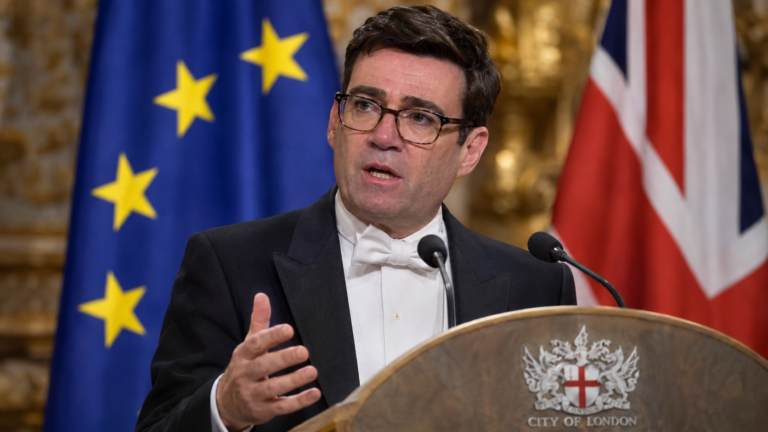
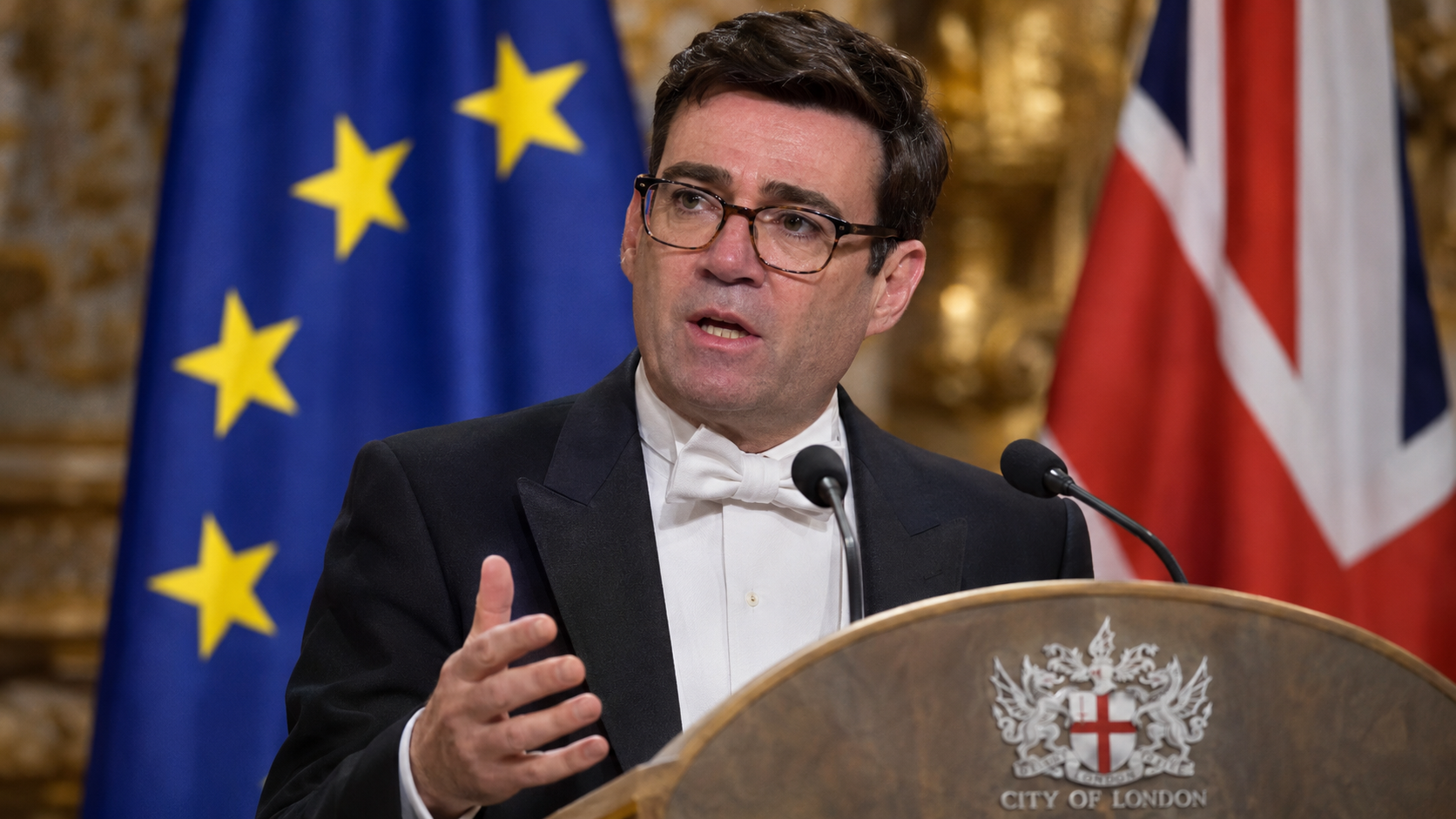
Speaking at the annual Lord Mayor’s Banquet at Guildhall in the City of London on Monday, November 16, Burnham argued that Britain’s withdrawal from the European Union had damaged its economic prospects, weakened its international standing and failed to deliver the changes many voters believed they were supporting in the historic 2016 referendum.

His remarks came just four days before a crucial summit with European leaders in Brussels, where the British government hopes to secure agreements aimed at reducing trade barriers and strengthening economic cooperation.
Burnham has previously acknowledged that he would personally like to see Britain rejoin the European Union during his lifetime. However, he has not announced a decision to seek readmission or committed his government to another referendum.
Instead, he is preparing to reopen a discussion that has divided British politics for more than a decade.
The Emperor’s New Clothes: Burnham Confronts Brexit
Addressing an audience of senior political, diplomatic and business figures, Burnham criticised what he considers Westminster’s reluctance to acknowledge the consequences of Brexit.
He compared the political silence surrounding Britain’s relationship with Europe to Hans Christian Andersen’s famous tale, The Emperor’s New Clothes, in which people refuse to acknowledge an uncomfortable reality.
The prime minister argued that Britain could no longer afford to avoid difficult questions about its economic future simply because they remained politically sensitive.
He acknowledged that some industries, particularly financial services and technology, had adapted successfully to life outside the European Union.
However, he maintained that other sectors had suffered from increased trading barriers and the disruption of relationships with European partners.
His comments were particularly notable because they came from a serving prime minister whose party had previously ruled out returning to the EU’s single market or customs union.
Brexit’s Economic Cost Comes Under Scrutiny
Burnham’s assessment is supported in part by economic modelling from Britain’s Office for Budget Responsibility.
The independent fiscal watchdog estimates that the post-Brexit trading relationship will leave UK productivity approximately 4% lower in the long run than it would otherwise have been had Britain remained in the European Union.
Burnham also referred to other estimates placing the economic impact at up to 8% of GDP.
These figures require careful interpretation. They represent estimates of economic activity relative to a hypothetical scenario in which Britain remained an EU member, rather than measured falls of 4% or 8% in national output.
Nevertheless, they illustrate the potential scale of the economic consequences that continue to shape the country’s political debate.
Brexit introduced additional administrative requirements, customs procedures and regulatory barriers affecting businesses trading with the EU.
Supporters of Brexit argue that leaving the bloc restored control over laws, immigration policy and trade agreements, while allowing Britain greater freedom to pursue independent economic policies.
Burnham, however, contends that the arrangements ultimately negotiated created more economic obstacles than many voters had anticipated.
The People Who Voted Leave May Hold the Key
One of the most significant aspects of Burnham’s speech was his recognition that the Brexit referendum was not simply a rejection of European integration.
He pointed to his Makerfield constituency, which voted decisively to leave the EU, and argued that the referendum reflected widespread frustration with economic inequality, insecure employment and declining living standards.
In his interpretation, many voters were expressing dissatisfaction with Westminster as much as Brussels.
Burnham said that the economic and social problems which contributed to the Brexit vote had not been adequately addressed.
His proposed response is built around what he calls the Makerfield Test — the principle that government decisions, including international agreements, should be judged by whether they improve everyday life in communities that have experienced economic neglect.
That approach could become central to the government’s argument for closer European cooperation.
Rather than presenting EU integration primarily as a constitutional or ideological issue, Burnham is seeking to connect it to household expenses, job opportunities, investment and living standards.
Polling Reveals Support for Rejoining — With Conditions
New opinion polling suggests that the British public may be increasingly receptive to reconsidering EU membership.
An Ipsos survey conducted between October 15 and 22 found that 56% of British adults would vote for the UK to apply to rejoin the European Union, compared with 30% who would vote to remain outside.
However, a separate YouGov study published on November 17 revealed that support could change substantially depending on the terms of any future membership agreement.
The survey, involving 12,150 British adults, tested 18 hypothetical scenarios covering Britain’s relationship with the euro, the Schengen passport-free travel area and its former EU budget rebate.
When respondents were presented with the possibility of restoring Britain’s previous membership arrangements — including retaining the pound, remaining outside Schengen and recovering its budget rebate — 56% supported rejoining, while 26% preferred remaining outside.
But support fell considerably in scenarios requiring Britain to adopt the euro and surrender its former rebate.
Under one such scenario, only 35% supported rejoining, compared with 43% who preferred staying outside.
The findings reveal a difficulty confronting any future government seeking to reverse Brexit.
Support for the idea of EU membership does not necessarily translate into support for the conditions that European governments might require Britain to accept.
Would Brussels Welcome Britain Back?
Even if Britain eventually voted to rejoin the European Union, membership could not be restored through a referendum alone.
Under Article 49 of the Treaty on European Union, Britain would need to submit a formal application, negotiate accession conditions and secure the necessary approval from existing EU member states and European institutions.
The terms could prove politically contentious.
Before Brexit, Britain enjoyed several special arrangements, including an exemption from adopting the euro, remaining outside Schengen and receiving a rebate on its contributions to the EU budget.
Those privileges would not automatically be restored.
Former EU Brexit negotiator Michel Barnier has suggested that exemptions relating to the euro and Schengen might be possible, but has indicated that restoring Britain’s former budget rebate would be far more difficult.
For British voters, those financial and sovereignty-related questions could prove decisive.
The result is a political dilemma: Britain could seek closer economic integration with Europe, but achieving full membership might require concessions that some voters would find unacceptable.
The £8.9 Billion Opportunity
Before considering such long-term questions, Burnham faces a more immediate test.
On Friday, November 20, he is scheduled to meet European Commission President Ursula von der Leyen and European Council President António Costa in Brussels.
The summit will focus on three major areas of cooperation.
The first is a proposed food and agricultural trade agreement designed to simplify cross-border transactions and reduce paperwork for businesses.
British government estimates suggest the agreement could eventually generate up to £5.1 billion in annual economic benefits.
The second is an agreement linking British and European emissions trading systems, which officials estimate could contribute a further £3.8 billion annually and protect certain British exports from EU carbon border charges.
Together, the projected benefits amount to approximately £8.9 billion a year, although these are forecasts, not realised gains.
The third proposal involves opportunities for young people to live, study and travel between Britain and EU countries.
Negotiations over the youth scheme remain complicated by disagreements over participant numbers and reciprocal access.
The government also hopes to strengthen cooperation on migration and border security.
For Burnham, these agreements represent an opportunity to demonstrate that closer ties with Brussels can deliver practical benefits without immediately reopening the question of EU membership.
Britain Is Not Rejoining — At Least Not Yet
Despite the prime minister’s remarks, the British government has explicitly confirmed that its existing Brexit commitments will remain in place throughout the current Parliament.
A government briefing issued on November 17 stated that the UK would not rejoin the European Union, its customs union or its single market during this parliamentary term.
The government has also ruled out restoring freedom of movement within that period.
Burnham’s longer-term ambitions therefore remain separate from his government’s immediate policy.
He has indicated that discussions with EU partners about Britain’s future relationship will begin after the Brussels summit, with options to be assessed ahead of decisions in the next Parliament.
This could eventually include a customs union, single-market participation or full EU membership.
But no formal proposal has been adopted, and no timetable for another referendum has been announced.
Political Opposition Is Already Emerging
Burnham’s comments have also revived opposition among prominent supporters of Brexit.
Former Prime Minister Boris Johnson has warned against returning to EU membership, while David Cameron, who called the original 2016 referendum, has also cautioned against reopening the issue.
New campaign groups have emerged to oppose any attempt to take Britain back into the bloc.
Their arguments centre on preserving the sovereignty, immigration controls and regulatory independence that supporters of Brexit regard as important gains from leaving the European Union.
Within Labour, the debate presents another challenge.
The party entered government under commitments not to restore membership of the EU’s single market or customs union.
Moving beyond those commitments would require a significant change of policy, potentially reopening divisions among voters who supported Brexit but subsequently backed Labour.
Burnham is therefore attempting to balance his stated preference for eventual EU membership with the political reality that any major change would require a broader public mandate.
Ten Years After Brexit, Britain Faces Another Decision
The United Kingdom voted to leave the European Union by 51.9% to 48.1% in June 2016.
It formally departed the bloc on January 31, 2020, before leaving the single market and customs union at the end of that year.
A decade after the referendum, Britain is again debating its place in Europe.
However, the circumstances have changed.
The original Brexit campaign centred on sovereignty, immigration, trade and restoring national control.
The current discussion is increasingly concerned with economic growth, international security, business competitiveness and the cost of living.
Burnham’s intervention does not mean Britain is on an agreed path back into the European Union.
It does, however, mark a change in how openly the country’s political leadership is prepared to discuss the possibility.
His immediate task is to secure an agreement with Brussels that produces measurable economic benefits without breaching his government’s existing promises.
His longer-term ambition raises a more fundamental question: whether Britain can negotiate a relationship with Europe that addresses the economic consequences of Brexit while satisfying voters who remain divided over membership.
Ten years after Britain voted to leave the European Union, the debate is no longer confined to whether Brexit was the right decision. It now concerns what the country should do next — and whether the terms of any return would be acceptable to Britain and Europe alike.
Sources
- UK Government — Andy Burnham’s Lord Mayor’s Banquet speech, 16 November 2026
- UK Government — UK–EU Summit Factsheet, 17 November 2026
- Associated Press — Burnham says Brexit has not worked
- Ipsos — Majority support applying to rejoin the EU
- YouGov — How rejoining terms affect public opinion, 17 November 2026
- Reuters — Details of November 20 UK–EU summit proposals
- Full Fact — Burnham has not announced EU readmission
- European Union — Article 49, EU accession procedure