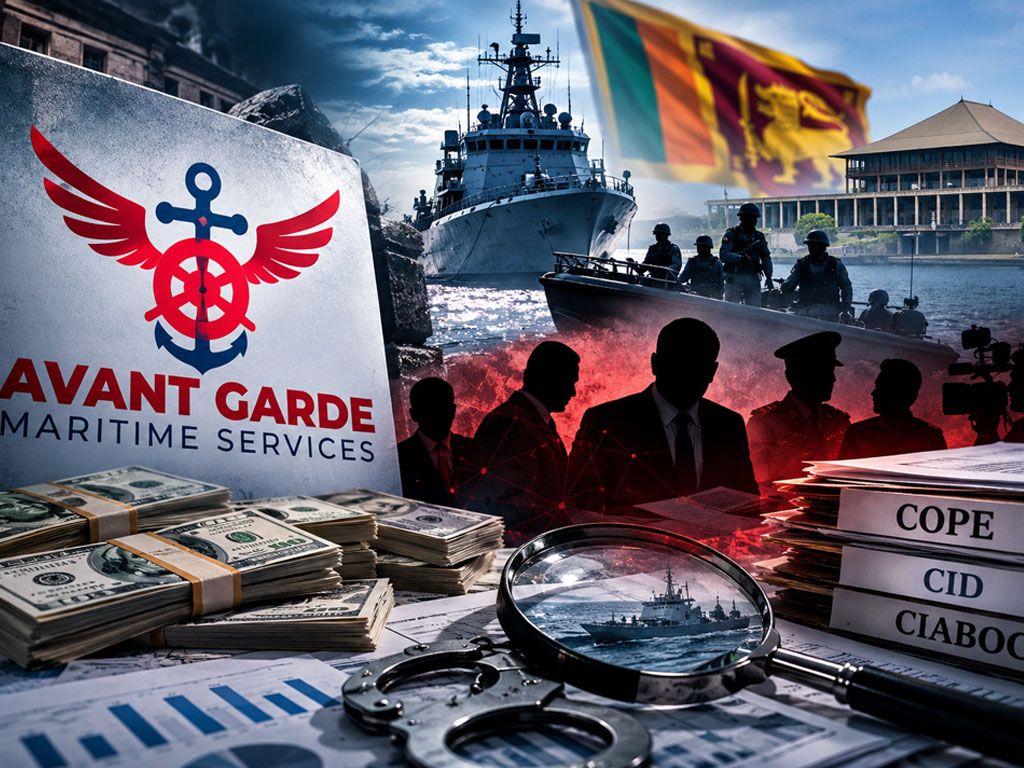
Avant Garde maritime security deal faces fresh scrutiny as COPE prepares complaints to the CID and CIABOC over alleged state losses.
COLOMBO — Parliament’s Committee on Public Enterprises (COPE) is preparing to refer Avant Garde’s involvement in maritime security operations to the Criminal Investigation Department (CID) and the Commission to Investigate Allegations of Bribery or Corruption (CIABOC), amid questions over revenue earned by the private company while state resources were used for the service.
COPE Chairman Dr. Nishantha Samaraweera has said complaints will be lodged with the two investigative bodies over the decision to involve Avant Garde in maritime security services conducted with Rakna Arakshaka Lanka Limited and the Sri Lanka Navy.
Samaraweera has alleged that the arrangement caused substantial financial losses to the Government and said COPE would examine the possibility of recovering those losses and cancelling agreements involving the company.
Figures cited in connection with the arrangement show that maritime security operations generated USD 14.12 million between September 2021 and July 2025.
Under the revenue-sharing structure, Avant Garde Maritime Services received 80.75%, or approximately USD 11.4 million, while the Navy received 15% and Rakna Arakshaka Lanka Limited received 4.25%.
The figures have become central to questions over whether the State could have retained a substantially greater share of the revenue by providing the service directly.

Outstanding Payments Also Under Scrutiny
Questions surrounding the arrangement extend beyond how revenue was divided.
The supplied information states that Avant Garde owed Rakna Arakshaka Lanka Rs. 1.63 billion by March 2020. It also cites National Audit Office findings that Rs. 782 million was owed to the Navy for an earlier period.
Separate reporting on the maritime security operation has also identified the Rs. 782 million as an unpaid service fee due to the Navy for the period from December 1, 2014, to November 13, 2015.
Those figures add a second financial dimension to COPE’s scrutiny: not only how income from the operation was distributed, but whether all amounts due to state entities were ultimately paid.
COPE’s decision to seek investigations by the CID and CIABOC could now place those financial arrangements under renewed examination.
Navy Earned USD 598,250 After Taking Direct Control
A comparison with the Navy’s subsequent operation of the service has intensified scrutiny of the previous model.
Following a Cabinet decision in July 2025 and a Presidential Order issued under the Navy Act, the Sri Lanka Navy began independently conducting maritime security operations on October 3, 2025.
Between October 3, 2025, and February 8, 2026, the Navy completed 323 maritime security operations and generated USD 598,250. The entire amount was credited directly to the Government’s Consolidated Fund.
The Navy has said it already possesses most of the physical and human resources required for such operations, allowing the service to be conducted and expanded with minimal additional expenditure.
Its responsibilities include storing firearms, ammunition and equipment used by Onboard Security Teams at naval armouries, while the movement of those items is conducted under Navy security and oversight.
The contrast between the two arrangements is significant. Under the earlier joint-venture model, the private operator received the largest share of revenue. Under the Navy’s current model, the full revenue generated by the operation is remitted to the Consolidated Fund.
That comparison does not by itself establish criminal wrongdoing under the earlier arrangement. Whether offences were committed, whether losses can legally be recovered and who, if anyone, bears responsibility are matters for the relevant investigative and legal authorities to determine.
Claims of a Wider Financial Network Remain Unsubstantiated
The original commentary accompanying the financial allegations goes considerably further, claiming that money connected with the maritime security business reached politicians, public officials and sections of the media and was used to obstruct or suppress previous investigations.
No evidence establishing those claims, identifying particular recipients or demonstrating specific payments is provided in the supplied material. They therefore cannot responsibly be presented as established facts.
Questions surrounding Avant Garde have nevertheless been examined over many years through political, legal and parliamentary processes. Historical parliamentary records contain extensive debate over the company and its agreements with Rakna Arakshaka Lanka, while litigation and criminal proceedings have also arisen from aspects of the wider controversy.
Those earlier proceedings should not be conflated with the allegations now being considered by COPE, nor do they establish the broader claims about politicians, officials or media organisations contained in the source commentary.
The immediate development is narrower and more concrete: COPE says it intends to refer concerns over Avant Garde’s involvement in the maritime security arrangement to the CID and CIABOC and examine whether alleged losses to the State can be recovered.
Any investigation that follows would be responsible for establishing the financial trail, determining whether laws were breached and identifying any individuals or entities against whom evidence supports further action.