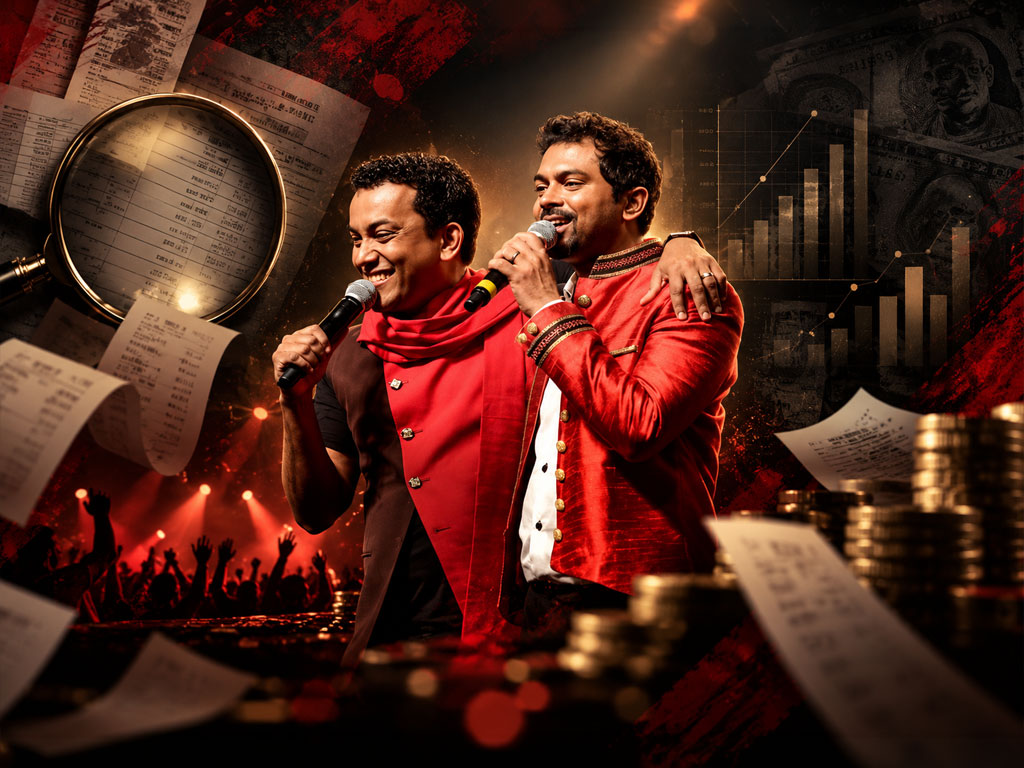
A Bathiya Santhush tax complaint filed with CIABOC questions cash income, tax declarations and a Rs. 27.6 million state-linked payment.
COLOMBO — A complaint filed with the Commission to Investigate Allegations of Bribery or Corruption has raised questions over whether income earned by prominent musicians Bathiya Jayakody and Santhush Weeraman from concerts and related business activities has been fully declared for tax purposes.
The complaint, which has been reported publicly, refers to performance fees exceeding Rs. 1 million for individual shows and alleges that substantial portions of such payments may at times have been made in cash rather than through the banking system.
Those claims remain allegations. There has been no finding that either Jayakody or Weeraman evaded tax, concealed income or committed any offence.
The existence of large cash transactions, by itself, does not establish tax evasion. The relevant question is whether income was properly recorded, declared and taxed in accordance with Sri Lankan law.

Complaint Focuses on Concert Income
According to the complaint, the duo can command fees exceeding Rs. 1 million for performances.
It alleges that some payments may have been received directly in cash, prompting questions about whether all such earnings were reflected in the relevant accounts and tax declarations.
For tax purposes, the payment method is not the decisive issue.
Income received in cash can be entirely lawful provided it is properly recorded and declared. Equally, a bank transfer does not automatically establish that the underlying income has been correctly reported.
The central questions are therefore straightforward:
- What income was earned?
- Through which individuals or companies was it received?
- Was the income properly recorded in the relevant accounts?
- Were legitimate expenses accurately identified?
- Was the correct taxable income declared to the Inland Revenue Department?
- Were the applicable taxes paid?
Until those questions are answered through records and an authorised investigation, suggestions of tax evasion remain unproven.
Cash Economy Raises Wider Transparency Questions
The complaint nevertheless touches on a broader issue extending beyond any individual artiste.
Large sections of Sri Lanka’s service economy still operate partly through cash, where transactions may leave a weaker digital trail than bank transfers or electronic payments.
That does not make such transactions unlawful.
It can, however, make effective tax administration more dependent on accurate bookkeeping, invoicing, declarations and audits.
Salaried workers whose income falls within the relevant thresholds can have Advance Personal Income Tax deducted through formal payroll systems, while professionals, entertainers, business owners and self-employed individuals may have more complex income streams.
That distinction makes consistent enforcement important.
Public confidence in the tax system depends not only on the rates imposed, but on the perception that people with high incomes are subject to the same legal obligations as ordinary salaried taxpayers.
Rs. 27.6 Million Payment Returns to Attention
The complaint also draws attention to an earlier payment of Rs. 27.6 million involving Showtown Entertainment and the Sri Lanka Land Development Corporation in connection with the opening of the Bellanwila-Warase River walking path.
Jayakody and Weeraman had previously rejected the suggestion that the entire amount represented a personal performance fee.
They said the payment covered broader event-production expenses, including stage construction, sound, lighting, subcontractors and payments connected with the production.
That distinction is important.
Turnover received by a company is not the same as personal income or business profit. A company may receive a large payment and incur substantial legitimate costs in delivering an event.
The relevant accounting question is whether those expenses were genuine, properly documented and treated correctly for tax purposes.
Nothing in the mere size of the Rs. 27.6 million payment proves tax evasion, improper procurement or corruption.
State Procurement Questions Are Separate
The payment also raises a separate issue concerning public procurement.
Where money is paid by a State institution, legitimate scrutiny can extend to how the contract was awarded, what services were purchased, whether procurement procedures were followed and whether the State received value for money.
Those are separate questions from personal tax liability.
A payment may be properly procured but incorrectly declared for tax purposes.
Conversely, income may be correctly declared while questions remain about how the public contract itself was awarded.
Conflating the two can create misleading conclusions.
Any examination of the Showtown Entertainment payment should therefore distinguish procurement, corporate accounting, personal income and taxation.
Business Expenses Are Not Automatically Tax Avoidance
Another concern raised in the supplied commentary is whether company expenses could be used to reduce taxable income.
Legitimate business expenses are ordinarily part of calculating taxable profit.
Stage hire, sound equipment, lighting, employee payments, subcontractors, venue expenses and other costs genuinely incurred to deliver an event may all form part of the financial accounts of an entertainment company, subject to the applicable tax rules.
That is fundamentally different from fabricating expenses, inflating costs or concealing revenue.
Any allegation that expenses were falsely used to avoid tax would require evidence from invoices, company accounts, tax returns and payment records.
Without that evidence, it would be improper to describe ordinary business deductions as tax evasion.
Popularity Cannot Determine Tax Treatment
The wider principle raised by the complaint is nevertheless valid.
Celebrity status should neither create an exemption from taxation nor create a presumption of guilt.
Musicians, actors, athletes, professionals and high-income business figures are entitled to the same legal protections as every other taxpayer, but they are also subject to the same obligation to accurately report taxable income.
The same standard should apply to politically connected individuals, corporations and ordinary citizens.
Tax enforcement is most credible when it is based on records and applied consistently rather than influenced by status, popularity or public pressure.
What Investigators Would Need to Establish
If authorities examine the allegations further, the most useful evidence would come from financial records rather than speculation.
That could include:
- contracts for concerts and corporate events
- invoices issued by relevant companies
- bank statements
- cash receipt records
- audited financial statements
- income tax returns
- expense documentation
- payments to subcontractors
- agreements with brand partners
- records connected to State-funded events
Such documentation could establish whether revenue was accurately recorded and whether declared expenses corresponded to genuine business activity.
Only after such an examination would it be possible to draw reliable conclusions.
Complaint Is Not Proof of Wrongdoing
Public allegations involving taxation can cause significant reputational damage, particularly when they concern high-profile personalities.
For that reason, the distinction between a complaint and an established offence is essential.
At present, the publicly reported information establishes that a complaint has been lodged with CIABOC questioning financial and tax-related matters concerning Jayakody and Weeraman.
It does not establish that the duo failed to pay tax.
Nor does it prove that cash payments were concealed, that company expenses were improperly claimed or that the Rs. 27.6 million State-linked payment involved wrongdoing.
Any such findings would have to emerge from a competent investigation and, where appropriate, formal legal proceedings.
The Broader Test Is Equal Enforcement
The complaint has nevertheless opened a legitimate debate about Sri Lanka’s tax culture.
At a time when salaried employees, businesses and consumers face increased taxation, the State must be able to demonstrate that high-income professionals and cash-intensive industries are also subject to effective scrutiny.
That principle applies far beyond the entertainment sector.
The answer is not to treat every cash transaction as suspicious or every wealthy public figure as a tax evader.
It is to build a tax system capable of tracing income, verifying declarations and enforcing the law consistently.
If the allegations concerning Bathiya Jayakody and Santhush Weeraman are investigated, the outcome should depend on financial records and evidence, not celebrity, political sentiment or public speculation.
That is the only standard capable of protecting both public revenue and the rights of those accused.
SOURCE:- HARI DESHAYA