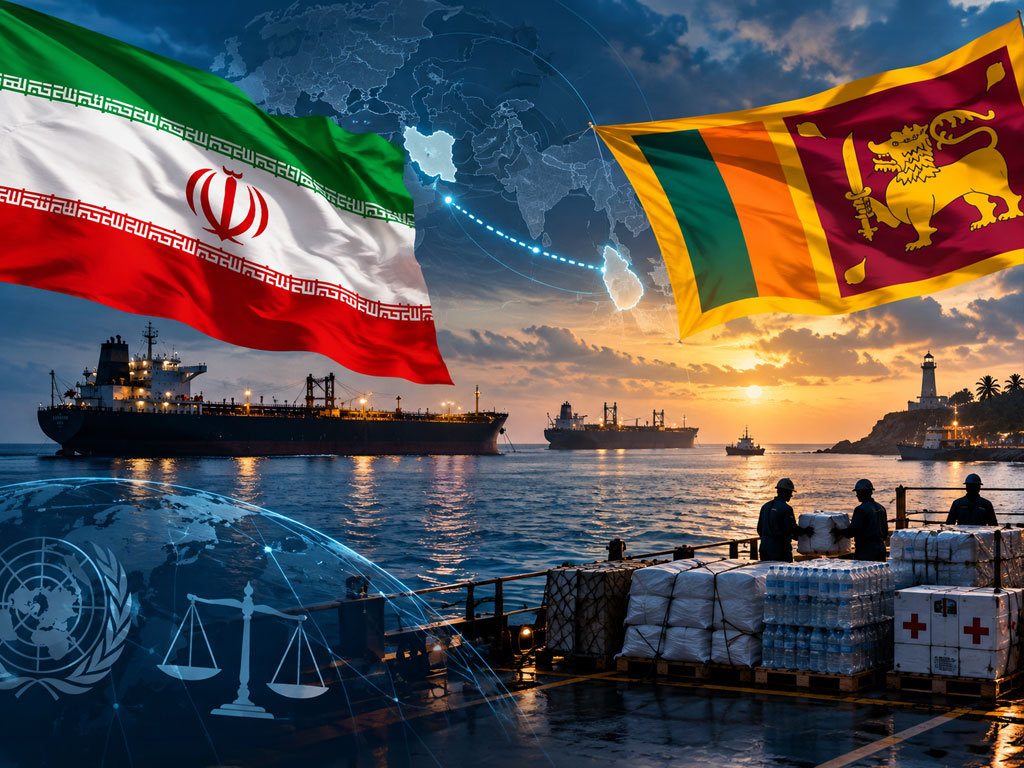
Iranian vessels near Sri Lanka have triggered debate over humanitarian assistance, sanctions risks and Colombo’s longstanding relationship with Tehran.
Sri Lanka’s decision not to facilitate routine supplies of food, drinking water and other provisions to Iranian vessels waiting in international waters near the island deserves scrutiny beyond the immediate question of sanctions.
The vessels are outside Sri Lanka’s 12-nautical-mile territorial sea, and the Government has stressed that it is not under direct US instruction to deny them assistance. Foreign Minister Vijitha Herath has also said Sri Lanka would intervene if a genuine humanitarian emergency placed lives at risk.
Yet the episode raises a broader question.
Should a country with a long diplomatic and economic relationship with Iran wait until crews are in acute distress before seeking a lawful humanitarian route to assist them?
That question becomes more significant when Sri Lanka’s history with Iran is considered, from the Uma Oya Multipurpose Development Project to decades of petroleum cooperation and the tea-for-oil mechanism used to settle a large outstanding fuel debt.

What International Maritime Law Actually Requires
The strongest humanitarian argument should not be weakened by overstating international law.
Article 98 of the United Nations Convention on the Law of the Sea establishes a clear duty to render assistance to persons in danger at sea.
Its first paragraph requires states to oblige masters of ships flying their flag to assist people in danger of being lost at sea and to proceed to rescue persons in distress where reasonably possible.
For coastal states, Article 98 also requires the promotion, operation and maintenance of adequate search-and-rescue services.
That is important, but it does not automatically create a general legal obligation for Sri Lanka to commercially provision every foreign vessel waiting outside its territorial waters simply because it is short of food, water or fuel.
Likewise, the International Convention for the Safety of Life at Sea is primarily concerned with the safety of ships, navigation and persons at sea. It should not be simplified into a blanket rule compelling a coastal state to deliver supplies to every vessel outside its jurisdiction.
The legal position therefore depends heavily on whether crews are merely experiencing logistical shortages or have entered genuine distress.
That distinction matters.
But legal minimums and diplomatic choices are not the same thing.
Sri Lanka may not be legally compelled to act in every circumstance, yet it can still ask whether a humanitarian solution is possible without compromising its sanctions obligations or international financial relationships.
Sri Lanka Rejects Supply Request for Iranian Tankers Offshore
Iranian vessels off Sri Lanka will not receive Government supplies, while local companies have been warned to consider US sanctions exposure.
Read MoreSanctions Do Contain Humanitarian Pathways
The sanctions question is equally nuanced.
Sri Lankan maritime companies have reportedly been warned to examine carefully whether providing services to sanctioned Iranian vessels could expose them to US secondary sanctions or other financial consequences.
Those concerns cannot simply be dismissed.
Iran-related sanctions are complex, vessel-specific and transaction-specific. A company dealing with a designated vessel, blocked entity or sanctioned commercial activity can face substantial legal and financial exposure.
At the same time, humanitarian exemptions and licensing mechanisms do exist.
The US Treasury Department’s Office of Foreign Assets Control maintains exemptions, general licences and specific licensing procedures for certain humanitarian transactions involving Iran.
Food, agricultural commodities, medicine and other humanitarian activities can fall within authorised channels, subject to the relevant programme, parties involved and conditions.
OFAC itself states that where humanitarian assistance is not already exempt or authorised under a general licence, it has a policy of considering specific licences for such activities.
That does not mean every delivery of food or water to every sanctioned vessel is automatically lawful.
Nor does it mean a Sri Lankan company can simply ignore the sanctions status of a ship and describe the transaction as humanitarian.
Due diligence remains essential.
What it does mean is that the law is more complex than a binary choice between refusing all assistance and risking exclusion from the dollar-based financial system.
UNSC Resolution 2664 Has Limits
United Nations Security Council Resolution 2664 is also relevant, but its scope should be stated accurately.
Adopted in 2022, the resolution created a standing humanitarian exemption from asset freezes imposed under United Nations sanctions regimes for specified humanitarian actors and activities supporting basic human needs.
It does not constitute a universal exemption from every unilateral sanction imposed by the United States or another country.
In particular, it cannot simply be cited as proof that any private Sri Lankan company may service an Iranian vessel without sanctions exposure.
The more defensible argument is narrower.
International sanctions architecture increasingly recognises that legitimate humanitarian activity should not be unnecessarily obstructed. That principle creates room for governments to explore lawful humanitarian channels rather than treating sanctions as an automatic bar to every form of assistance.
Could Sri Lanka Have Sought a Humanitarian Mechanism?
That is where the Government’s handling deserves closer examination.
If sailors aboard the vessels are genuinely short of essential provisions, Sri Lanka could explore whether assistance can be channelled through an organisation or mechanism capable of operating within recognised humanitarian frameworks.
That could involve consultation with the International Committee of the Red Cross, other qualified humanitarian organisations, the International Maritime Organization or relevant diplomatic channels.
Such an approach would require legal clearance and sanctions screening.
It would also need to ensure that assistance is limited to genuine humanitarian requirements and does not become indirect commercial support for sanctioned shipping operations.
But attempting to construct such a mechanism would be consistent with the principle Sri Lanka frequently invokes in foreign policy: neutrality without abandoning humanitarian responsibility.
The alternative should not be to wait until crews face a medical emergency before diplomacy begins.
Iran’s Long Relationship With Sri Lanka
The controversy also has a historical dimension.
Iran has maintained economic ties with Sri Lanka for decades.
Official Sri Lankan records note Iranian petroleum facilities dating back to the late 1960s, while Tehran later became involved in major development projects.
The most prominent example is the Uma Oya Multipurpose Development Project.
The project was implemented by Iran’s FARAB Engineering Company with a contract value exceeding USD 500 million.
Iran’s Export Development Bank was originally expected to provide substantial financing, with a USD 450 million facility included in the original financing structure.
International sanctions later prevented the Iranian bank from continuing to fund the project as initially intended, and Sri Lanka ultimately financed much of the remaining work itself.
Nevertheless, Iranian engineering participation remained central to the project, which was officially inaugurated in April 2024.
That history makes the present episode diplomatically sensitive.
The Tea-for-Oil Arrangement
The relationship became even more important during Sri Lanka’s foreign-exchange difficulties.
Sri Lanka owed approximately USD 250.9 million to the National Iranian Oil Company for earlier petroleum purchases.
Because sanctions made conventional international settlement difficult, Colombo and Tehran developed an alternative mechanism using Ceylon Tea.
Under the agreement, Sri Lanka used rupee payments to compensate local tea exporters while tea shipments to Iran were credited against the outstanding petroleum debt.
The arrangement avoided international dollar transfers and blacklisted Iranian banks.
By July 2024, around USD 55 million of the debt had been settled through tea exports.
The mechanism was an example of both countries finding a practical route through sanctions restrictions without abandoning a longstanding commercial relationship.
It also demonstrated that diplomatic creativity is possible when both sides have sufficient incentive to find a lawful solution.
Friendship Does Not Override Sanctions Risk
None of this means Sri Lanka should disregard the United States or expose its banking system to sanctions.
That would be economically reckless.
Sri Lanka remains deeply dependent on access to international banking, dollar clearing, Western export markets and global financial institutions.
Its diplomatic relationship with Iran must therefore be managed alongside its wider international obligations and economic interests.
Neutrality does not mean treating sanctions risk as irrelevant.
Equally, neutrality should not mean allowing fear of sanctions to eliminate all diplomatic initiative.
The challenge is to distinguish prohibited commercial assistance from narrowly defined humanitarian relief.
That distinction should be explored rather than assumed away.
Humanitarian Judgment Should Come Before Crisis
Foreign Minister Herath has said Sri Lanka would act if a genuine humanitarian emergency threatened lives.
That position recognises an important principle.
The question is whether the threshold for action should be allowed to rise so high that assistance begins only after sailors are already in serious distress.
Food and drinking water are not luxury supplies.
If crews have adequate provisions and are simply requesting routine commercial resupply, the Government can reasonably treat the matter as a sanctions and shipping issue.
If essential supplies are becoming genuinely scarce, however, a different calculation should apply.
Good diplomacy should identify that point before people become sick, dehydrated or otherwise endangered.
A Test of Sri Lanka’s Claimed Neutrality
Sri Lanka often describes its foreign policy as independent, non-aligned and guided by friendship with all nations.
Such principles matter most when they are difficult to apply.
Iran’s relationship with Sri Lanka has included energy cooperation, infrastructure development, tea trade and diplomatic engagement over many years.
That history does not give Iranian vessels a special right to ignore sanctions.
But neither should it be irrelevant when Sri Lanka decides how energetically it searches for a humanitarian solution.
The Government does not need to choose between Washington and Tehran.
It needs to demonstrate that it can protect Sri Lanka’s financial interests, comply with applicable sanctions, respect maritime law and still preserve space for basic humanity.
The strongest response would therefore be neither uncontrolled commercial servicing nor absolute refusal.
It would be a transparent, legally reviewed humanitarian mechanism that becomes available when essential crew needs genuinely arise.
If such a path is possible, pursuing it would say far more about Sri Lanka’s independence than simply declaring neutrality.