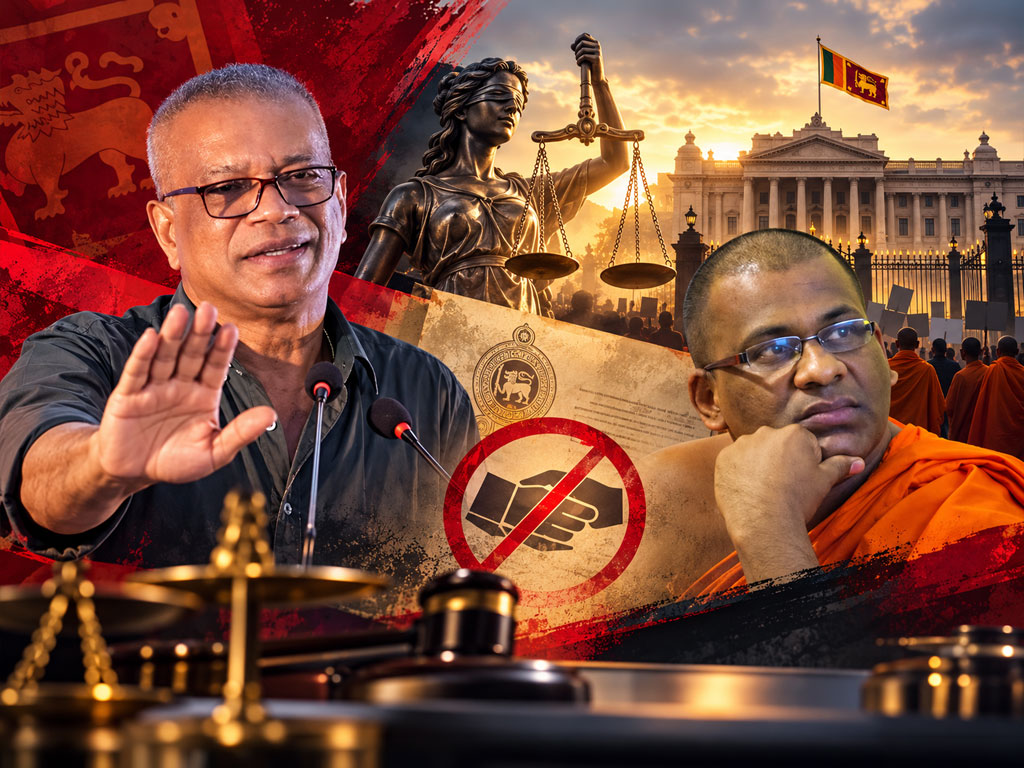
Agriculture Minister K. D. Lal Kantha says the administration will not depart from its commitment to equality before the law, as Buddhist monks continue to challenge the imprisonment of Ven. Galagoda Aththe Gnanasara Thero.
COLOMBO, October 16, 2026 — Agriculture, Livestock, Lands and Irrigation Minister K. D. Lal Kantha has rejected demands for a presidential pardon for Ven. Galagoda Aththe Gnanasara Thero, declaring that the Government will not act contrary to its commitment to the rule of law and equal treatment of citizens.
Speaking to reporters on Friday, the Minister said neither President Anura Kumara Dissanayake nor the Government would support a decision that undermined the mandate received from voters.
His remarks followed protests by Buddhist monks and supporters demanding the release of Gnanasara Thero, who is serving the remainder of a six-year prison sentence for contempt of court.
Lal Kantha maintained that political or religious pressure should not determine how the law is applied, arguing that the administration had been elected partly because of public dissatisfaction with preferential treatment under previous governments.

Government Says Public Mandate Must Be Respected
The Minister said the Government’s responsibility was to uphold the law without making exceptions based on an individual’s influence, religious position or political connections.
Referring to demands for Gnanasara Thero’s release, Lal Kantha stated:
“We cannot go against the mandate under any circumstances. I am certain that the President will not take a decision contrary to the mandate. One should make demands that can be fulfilled.”
The Government’s position follows renewed attention to the use of presidential pardons, particularly where executive clemency affects sentences imposed by the judiciary.
Sri Lanka’s Constitution provides for presidential pardons under Article 34, subject to the applicable constitutional requirements.
A presidential pardon is therefore a recognised constitutional power. However, exercising that power is not unrestricted, and any such decision must satisfy the relevant legal requirements.
Lal Kantha’s objection is principally that granting clemency in the present circumstances would contradict the Government’s declared policy of ensuring equal application of the law.
Supreme Court Invalidated Previous Presidential Pardon
Gnanasara Thero’s imprisonment follows a Supreme Court ruling that invalidated the presidential pardon granted to him by former President Maithripala Sirisena in May 2019.
He had originally been sentenced to six years’ imprisonment for contempt of court arising from his conduct during proceedings at the Homagama Magistrate’s Court concerning the disappearance of journalist Prageeth Eknaligoda.
After serving part of that sentence, he was released under the presidential pardon.
On September 10, 2026, the Supreme Court ruled that the pardon was legally invalid.
Following that determination, the Court of Appeal ordered on October 5 that the remainder of the six-year sentence be enforced.
The decision returned Gnanasara Thero to prison and prompted renewed demands from sections of the Buddhist clergy for presidential intervention.
Debate Continues Over Gnanasara Thero’s Prison Attire
A separate controversy has arisen over the requirement that Gnanasara Thero wear prison-issued clothing rather than his customary Buddhist robes.
His appearance in court without monastic robes drew objections from members of the clergy and his legal representatives.
The source material attributes to Lal Kantha an explanation that recommendations from a committee examining the matter identified no legal obstacle to wearing robes during court appearances.
According to that account, the Minister indicated that the Government would respect the relevant Nikaya’s authority concerning a monk’s religious status and would not itself determine whether he should be disrobed.
Those specific remarks require confirmation from the Minister’s complete statement or the committee’s recommendations.
The question of prison attire has also become the subject of legal proceedings.
On October 14, Court of Appeal President Justice Rohantha Abeysuriya withdrew from the bench considering petitions challenging the prison authorities’ decision. A three-judge bench was subsequently appointed to hear the matter.
The dispute over religious attire is distinct from the legal status of Gnanasara Thero’s prison sentence.
Monks’ Protest Ends Following Court Order
The Minister’s comments came as Buddhist monks and their supporters continued pressing for Gnanasara Thero’s release near the Presidential Secretariat in Colombo.
The demonstration, held under the banner of the “Justice for the Robe” campaign, reached the Presidential Secretariat on October 15.
Representatives of the protesters met officials from the Presidential Secretariat, who acknowledged their demands but did not provide an immediate commitment to release the imprisoned monk.
On October 16, Colombo Fort Magistrate Pasan Amarasena issued an order restricting Ven. Ulapane Sumangala Thero and 53 others from remaining within specified areas near the Presidential Secretariat.
The protesters subsequently dismantled their temporary shelters and vacated the site.
Lal Kantha maintained that citizens and religious organisations were entitled to express their views and present demands through democratic means.
Nevertheless, he said the Government would not grant requests that conflicted with its commitment to the rule of law.
Equality Before the Law Remains Government’s Position
The dispute places two distinct matters before the Government: the request for executive clemency and the treatment of a Buddhist monk while serving a prison sentence.
The former concerns constitutional powers and the legal consequences of an earlier pardon that was invalidated by the Supreme Court.
The latter concerns prison administration, religious rights and the pending legal challenge over the wearing of monastic robes.
Both matters require decisions consistent with the Constitution and applicable judicial rulings.
For now, the Government has ruled out granting Gnanasara Thero a presidential pardon in response to the protesters’ demands.
His remaining prison sentence continues to be enforced, while the separate proceedings concerning his religious attire await further consideration by the Court of Appeal.