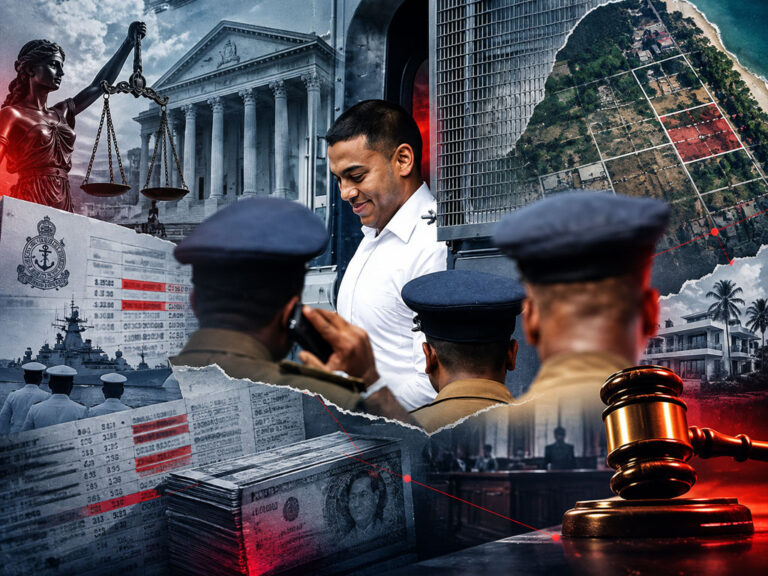
Colombo High Court hears evidence on the former naval officer’s earnings, overseas training allowances, National Savings Bank accounts and a disputed Rs. 73 million land acquisition, as witnesses also testify about a broadcasting vehicle imported for CSN.
COLOMBO — Former naval officer Yoshitha Rajapaksa received Rs. 5,159,626 in salary during nearly a decade of service in the Sri Lanka Navy, a naval officer told the Colombo High Court on October 15, as prosecutors continued presenting evidence in a money laundering case involving the purchase of five plots of land.
Captain Nuwan Thushara Arandara, who served in the Navy’s Salary and Allowance Division, produced records detailing payments made to Rajapaksa, the son of former President Mahinda Rajapaksa.
The Attorney General has accused Rajapaksa of offences under the Prevention of Money Laundering Act in connection with the alleged use of more than Rs. 73 million, described in the original proceedings as Rs. 730 lakh, to purchase five plots of land in Dehiwala and Ratmalana.
Prosecutors allege that the funds used for the purchases were unlawfully obtained. The allegations remain contested and have not been established by a conviction.
The trial is being heard before Colombo High Court Judge Uddesh Ranatunga.
Testimony also covered payments approved for overseas naval training, transactions involving two National Savings Bank accounts, court proceedings relating to Daisy Forrest’s property, and the clearance of a broadcasting vehicle imported for the Carlton Sports Network (CSN).

Navy Salary Records Submitted to Colombo High Court
Giving evidence under examination by Senior State Counsel Oswald Perera, Captain Arandara explained that he had served in the Navy’s Salary and Allowance Division in 2009.
His testimony concerned salary payments made to Rajapaksa during his naval service, including the period when he held the rank of lieutenant.
The witness submitted documentary records to support the payments.
According to the account of proceedings, one document covered payments between December 14, 2006, and February 2016.
A discrepancy emerged concerning the final date recorded in the document.
Arandara told court that the record contained the date February 30, 2016, which is not a valid calendar date. He said it should be corrected to February 28, 2016.
The witness subsequently referred to a salary period beginning on February 14, 2006, rather than December 14, 2006.
Both starting dates appear in the supplied account of his evidence. The precise commencement date must therefore be confirmed against the original Navy records or certified court transcript.
Arandara placed Rajapaksa’s recorded salary payments at approximately Rs. 5,159,626 for the period examined.
That figure became the subject of questioning by defence counsel.
Defence Questions Whether Allowances Were Included
President’s Counsel Sampath Mendis, appearing for Rajapaksa, questioned whether the reported salary total included allowances paid during his naval career.
Arandara replied:
“Allowances are not included… Your Honour.”
Asked to explain which payments constituted allowances, the witness identified house rent, special duty payments and uniform allowances.
He also distinguished those payments from allowances associated with training courses and participation in sporting events.
The distinction matters because the Rs. 5.16 million figure presented to court represented salary payments rather than necessarily accounting for every payment Rajapaksa may have received while serving in the Navy.
The witness acknowledged that he knew Rajapaksa had attended an overseas training course.
He said, however, that he was unaware of Rajapaksa having participated in rugby tournaments in several countries.
Consequently, the salary figure alone cannot be treated as a complete calculation of Rajapaksa’s income, allowances, reimbursements or other lawful financial resources during the period.
Those matters would require examination of the separate payment records and any additional evidence placed before court.
Overseas Naval Training Payments Examined
Another prosecution witness, Navy Commodore Gamini Priyadarshana, provided evidence concerning payments approved for an overseas training programme attended by Rajapaksa.
According to his testimony, the payments included GBP 20,362 and a further GBP 4,174 in allowances.
Together, those amounts total GBP 24,536.
Priyadarshana stated that the request for the payments had been submitted by former Navy Commander Wasantha Karannagoda to the Secretary of the Ministry of Defence.
The testimony establishes that approval was sought for the amounts described, but the supplied proceedings do not establish the precise nature of every expenditure, when all payments were disbursed or how they were recorded in Rajapaksa’s personal financial accounts.
The evidence is relevant to the broader examination of his financial circumstances, but the approval of an overseas training allowance does not itself establish unlawful conduct.
National Savings Bank Fixed Deposit Details Revealed
The prosecution also called Gamini Hettiarachchi, a junior executive officer attached to the National Savings Bank’s head office, to testify about accounts associated with Rajapaksa.
Hettiarachchi told court that Rajapaksa had opened a fixed deposit account on November 19, 2003.
The account initially contained Rs. 72,470.03.
According to the witness, the amount had increased to Rs. 489,471.70 through accumulated interest.
He also stated that the records did not show any withdrawal from that account up to February 15, 2016.
The evidence prompted an objection from the defence concerning the admissibility of a document relied upon by the prosecution.
Mendis argued that the document had been obtained on October 12 of the previous year and was not included among the documents identified in the indictment.
He objected to its introduction after the investigation had concluded and charges had been filed.
The supplied report does not establish how the judge ruled on that objection.
The existence of the objection should therefore not be interpreted as a finding that the document was inadmissible or that the prosecution had acted improperly.
Savings Account Records Show Rs. 1.35 Million Credit
Hettiarachchi also testified that Rajapaksa had opened an ordinary savings account at the National Savings Bank on December 30, 2006.
He said the records showed deposits into the account, with the first withdrawal recorded on March 2, 2016.
During questioning by defence counsel, the witness acknowledged that Rs. 1,350,116 had been credited to the account on November 28, 2011.
The source does not identify the origin of that credit or establish whether the amount formed part of salary, allowances, other legitimate income or funds whose source is disputed.
Its significance must be assessed alongside the complete bank statements and any other financial evidence tendered during the trial.
The account information was presented as part of the prosecution’s examination of Rajapaksa’s financial transactions in connection with the land-purchase allegations.
Court Hears Evidence Concerning Daisy Forrest’s Property
Further testimony concerned proceedings before the Nugegoda District Court relating to the property of a woman identified as Daisy Forrest.
Senarath Bandara Ekanayake, a court clerk appearing on behalf of the District Court Registrar, gave evidence under examination by Deputy Solicitor General Janaka Bandara.
Ekanayake stated that a medical report had been submitted indicating that Forrest suffered from dementia.
According to the witness, the District Court subsequently issued an order on March 15, 2017, appointing a manager to administer her property.
After examining the relevant court file, he also stated that no document listing Forrest’s property or assets forming part of her estate had been submitted to court.
The testimony concerned the existence and contents of the District Court records.
The supplied proceedings do not explain the full relationship between those records and each of the five properties identified in the money laundering indictment.
Nor do they establish that Forrest or any person associated with her committed an offence.
Businessman Questioned About CSN Broadcasting Vehicle
The court subsequently heard evidence from businessman Mervyn Amaraweera, who told prosecutors that he was engaged in purchasing land.
Amaraweera stated that he owned approximately six properties acquired through his business activities, including land in Kotte, Meegoda, Wellawaya and Thalawathugoda.
Deputy Solicitor General Janaka Bandara then questioned him about a bus imported for CSN.
Asked whether he had cleared the vehicle through Customs, Amaraweera acknowledged that he had.
“I did release it, Your Honour… but I do not know what it was.”
Bandara challenged the witness over his apparent lack of knowledge about the vehicle.
The prosecutor described it as an expensive bus equipped for live broadcasting, rather than an ordinary passenger vehicle.
He questioned whether someone arranging its Customs clearance should have examined its contents and established who had requested the service.
Amaraweera replied that the request had reached him through a friend.
“Your Honour… a request came to me through a friend to release it. Accordingly, I released it. I did not check what was inside it.”
When asked to identify the person who had made the request, the businessman initially said he could not immediately recall the name.
He told court that he had previously provided a statement to police and requested approximately five minutes to refresh his memory.
Witness Identifies Rohan Weliwita After Brief Adjournment
Judge Ranatunga briefly adjourned proceedings before Amaraweera’s evidence resumed.
Upon returning to the witness stand, the businessman identified Rohan Weliwita as the person who had asked him to arrange the Customs clearance.
Amaraweera stated that he addressed Weliwita as “Rohan Uncle”, although he did not know precisely what Weliwita did professionally.
He also maintained that he had no connection with CSN.
The supplied account does not establish that Weliwita was accused of any wrongdoing in connection with the vehicle, nor does it establish that Customs clearance of the broadcasting equipment was unlawful.
The evidence records Amaraweera’s account of how he came to perform the clearance and the identity of the person he said had requested it.
Yoshitha Rajapaksa Trial Adjourned Until October 30
The October 15 hearing brought together evidence concerning Rajapaksa’s naval earnings, additional financial entitlements, savings and fixed deposit accounts, property-related court records and the Customs clearance of a broadcasting vehicle.
The central allegation remains that more than Rs. 73 million in unlawfully obtained funds was used to acquire five plots of land in Dehiwala and Ratmalana.
The prosecution must establish the elements of the alleged money laundering offences through admissible evidence, while the defence remains entitled to challenge the witnesses, financial records and conclusions advanced by the State.
Neither a discrepancy between reported earnings and asset purchases nor the existence of substantial bank transactions establishes money laundering without the necessary evidence concerning the source and use of the funds.
Judge Ranatunga adjourned further hearing of evidence until October 30, 2026.
The trial will continue as the court examines the prosecution’s evidence and the defence’s challenges to the financial and documentary records.