By Roshan Jayasinghe
An Observation on Motorcycles, Ownership and Knowing What We Keep Things For
Whenever riders gather, at a breakfast stop, in a parking lot or around a campfire, the conversation sooner or later turns to how many motorcycles each of us has. Every answer comes with its own story. Some have a single motorcycle with a great many miles on it, a machine asked to do everything and trusted to do it. Others keep several motorcycles of the same kind, while others have machines built for entirely different disciplines. There are as many variations as there are riders, and each tells us something about the person and the riding life they have chosen.
My own story has lived on more than one side of that conversation. For most of my younger life, I knew riding through a single motorcycle. That one machine was asked to do everything I wanted from it. In my late forties, as my interest grew in different kinds of riding, I began searching for a used motorcycle built for each discipline I wanted to explore. The search itself became one of the great pleasures of the journey.

Every one of these machines came to me from a previous rider, often with wonderful stories of the roads, trails and tracks it had already known. There is something quietly moving about a motorcycle passing to me from someone I may never see again. The machine continues through a small continuum of riders of its own. I begin to write my chapter of its story while it helps me write mine.
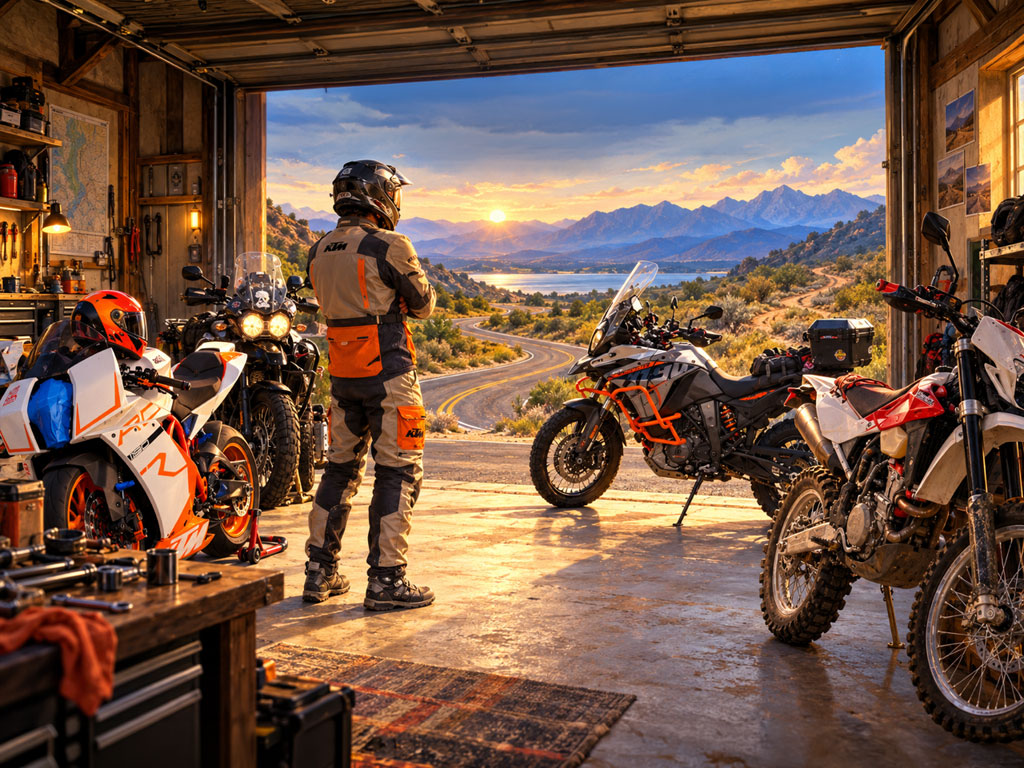
Today, my garage includes a sport street and streetfighter motorcycle for the canyons and the city, a long-distance street motorcycle for those big days covering hundreds of miles between sunrise and sunset, and a track bike for the race track. There is an adventure motorcycle for off-road exploring and long journeys over several days, and an enduro for demanding dirt riding. A dedicated supermoto, with its own tight and playful character, is the next space I hope to fill.
To another rider, this may sound like a carefully considered arrangement. To someone else, it may sound like a man who has developed a very detailed explanation for his garage.
I can appreciate both observations.
Owning these motorcycles has allowed me to keep returning to each discipline until it became part of my weekends and my way of life. Living with them has also made me more aware of the pleasures and temptations that come with ownership.
One thing I notice is how familiar a motorcycle becomes after enough miles. Its responses begin to feel like an extension of my balance and judgement. I recognise the way it delivers power, changes direction and responds to my inputs. Each motorcycle has its own character, and moving between them feels a little like stepping into a different part of myself. The attention I bring to a long adventure changes when I enter a race track or follow a narrow dirt trail. Familiarity helps, but each setting still asks me to pay attention.
Some of that understanding develops in the garage. I take care of routine maintenance and smaller repairs on all my motorcycles, leaving major work to professionals. Looking after a machine with my own hands deepens my connection with it. Those hours with a wrench are also hours spent learning how it was designed to work, what needs attention and where my knowledge ends.
Loading article…
There is satisfaction in completing a job properly. There is also satisfaction in recognising when it belongs in more experienced hands. A motorcycle has little sympathy for my confidence if I have misunderstood what I am doing.
I have had to look just as plainly at the temptations that come with a garage like mine. There is the pull to keep a motorcycle because of what I have already put into it, even when it no longer serves the riding I actually do. There is the way another motorcycle can shine brighter in the imagination than the ones waiting at home. And there is the old riders’ joke that the right number to own is always one more than we have today.
I laugh at that one, though perhaps a little less convincingly than I used to.
What helps me is that the ride usually chooses the motorcycle before I do. When friends plan an enduro day on the trails around Big Bear, the choice is clear. A track day calls for the track bike. A long day of open road from sunrise to sunset belongs to the long-distance street motorcycle. When a long adventure loop is being planned, the adventure motorcycle is already packed in my mind before the route is drawn.
Often it is not only the ride that chooses the motorcycle, but the people I am riding with. Some of my friends keep a single motorcycle built for one kind of riding, and our plans reflect that. When I join friends, I consider the terrain, the distance and the kind of day we have planned. Choosing a motorcycle suited to that shared experience helps me enjoy the ride comfortably alongside them. I have come to see that consideration as part of riding well: thinking about how all of us can enjoy the day together.
The choice does not end with the motorcycle. Each discipline also asks for its own protection, and over the years my gear has grown into a second, quieter garage of its own. For the race track, I wear a full-face helmet, an armoured leather suit, a back protector, and race gloves and boots. For enduro, I use an off-road helmet and goggles, body protection and tall boots. Adventure and long-distance rides bring out armoured textile clothing suited to changing conditions. For the canyons and city, my protection includes a full-face helmet, an armoured jacket and riding trousers, gloves and boots.
The weather has its say as well. Heat, cold and rain all influence what I wear and pack. On a long day, I may pass through several conditions between sunrise and sunset, so checking the forecast, carrying water and preparing suitable layers have become as much a part of the ride as choosing the motorcycle.
Every piece of equipment also carries a continuum of its own. The armour in my jacket, the shape of my boots and the standard my helmet is built to meet reflect knowledge gathered through experience, design and testing, then refined and handed forward. When I gear up before a ride, I am wearing something of what others discovered.
Gear has its own version of the riders’ joke, since there is always one more helmet worth considering. But it is the one part of the garage I have never been tempted to compromise on, because the motorcycle can be replaced and the rider cannot.
If the rider cannot be replaced, then the rider deserves the most careful maintenance of all. I feel different demands on my body across these disciplines: the physical effort and concentration of a race track session, the balance and endurance of enduro, and the sustained attention of a long journey. In my older years, I have come to see fitness, flexibility and a clear mind as part of my preparation for riding. They require attention between rides as well as on the day itself. Whatever tiredness, stiffness or distraction I bring with me becomes part of the experience.
Before a ride, I check myself as carefully as I check the motorcycle. On the motorcycle, that means tyres, brakes, chain, fluids, lights and controls. On myself, it means asking whether I have slept well, eaten properly and had enough water, and whether my mind is truly on the ride or still somewhere else. During the day, I make time for water, food and rest. These small habits help me prepare for the day and recognise when it is time to pause or change the plan. They rarely make for exciting stories, but I have come to value them as part of enjoying the ride.
One rider whose story stays with me is T. E. Lawrence, remembered as Lawrence of Arabia. In a September 1926 testimonial to George Brough, he reported covering 100,000 miles since 1922 on five successive Brough Superiors. That is a remarkable distance to contemplate with a weather app in my pocket. What draws me to his account is the pleasure he found in using those motorcycles. I recognise something of my own enjoyment in that.
When I began building this garage in my late forties, I expected the pleasure of riding. Over time, it also gave me more reasons to examine my own behaviour. Why does a particular machine appeal to me? What am I imagining it will add to my life? Does that expectation survive the experience of owning and riding it?
Those questions reach beyond motorcycles. They connect with my curiosity about why we want what we want, why we hold on to things and how readily we recognise when our reasons have changed. In my own life, this is one small expression of the Human Continuum: an idea meets experience, experience reveals something, and I have an opportunity to question, correct and carry that understanding forward.
In practice, I examine what I receive for its intent, factual correctness, integrity and clarity before letting it settle into how I see the world. That examination is especially useful when I turn it towards my own explanations.
In the garage, it means asking whether each motorcycle, and the gear that goes with it, still serves the reason I chose it. Riding is central to that answer for me. Someone else may find their pleasure in restoration, preservation or the memories a machine holds. What matters in my own examination is recognising when my reasons have changed and being honest about them.
A motorcycle may stay with me because I still enjoy its particular kind of riding. It may also stay because it holds something personal that I value. I can acknowledge either reason. The confusion begins when I keep repeating an old explanation simply because I have become comfortable with it.
This is why the question of how many motorcycles I own has become less interesting to me than how they fit into my life. Which ones am I riding? What do I enjoy about them now? Is the motorcycle I imagine wanting suited to the weekends I actually have?
That last question can make an evening of browsing used-bike listings unexpectedly reflective.
Looking back, I realise how much that one motorcycle gave me to discover. For younger riders beginning with a modest machine and imagining the motorcycles they might own one day, that is the experience I would share. There was so much to learn from the motorcycle already beneath me: its responses, my own limits, and when it was time to stop and rest. Good protective gear and preparation deserve a place in that early excitement too. My garage grew as my interests became clearer, and I remain grateful for what I learned before it did.
I offer these observations to readers who may never have sat on a motorcycle, because many of us keep a garage of some kind. It might contain tools, books, equipment or the materials of an interest we once hoped to pursue. Some things remain useful, some hold memories, and some are waiting for a version of ourselves we may no longer wish to become.
Looking at them honestly can reveal something about how our lives have changed. It can also remind us of a pleasure we have neglected and would like to return to. Sometimes the discovery leads to letting something go. Sometimes it leads to making time for it again.
And sometimes, in my case, it simply leads to a ride. Not every enjoyable afternoon has to produce a conclusion about human behaviour. Coming home smiling is a perfectly worthwhile result.
This is the page I would add to the Living Human Manual from my garage: an observation that remains open to correction as my life and riding change. For years, one motorcycle gave me more than enough to discover. Today, different motorcycles allow me to keep exploring different disciplines, and I enjoy caring for each of them along the way. The question is whether the garage still reflects the riding life I actually live.
There is still a space waiting for a supermoto. Apparently, even an honest examination of my attachments can leave room for another set of keys.