By Roshan Jayasinghe
An Observation on Education, Access and the Human Inheritance
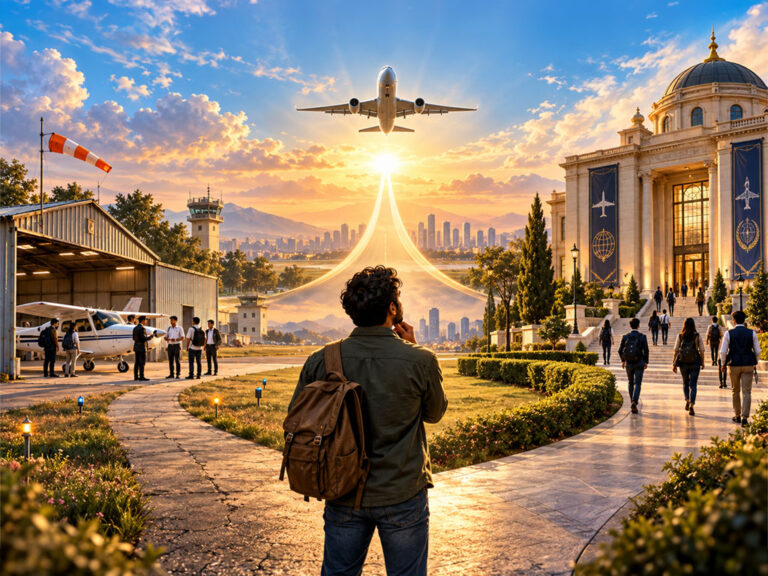
When I was a young man in Sri Lanka, I entered a path toward helicopter pilot training with the Air Force, but after a few months the program itself was cancelled. I later joined Air Lanka as a flight attendant, still carrying that interest in aviation with me, but the work became demanding and life circumstances gradually took me in another direction. Many years later, I have returned to that unfinished interest and set out to complete my private pilot licence, and I am now about halfway through it. What strikes me is that the knowledge I wanted to understand then is the same knowledge I am learning today.
Training as a student pilot has shown me something about how we measure knowledge. A person who wants to become a commercial pilot in the United States can reach the cockpit through more than one doorway. One is a small independent flight school, where the student pays for flight and ground instruction and becomes directly involved with the theory and the flying from the beginning. Another is a university aviation program, where flight training may be combined with a four-year degree and where the cost of that degree is added to the cost of learning to fly, so the total can be considerably greater. The university curriculum is real and much of it is relevant, and the system itself recognizes certain differences, because graduates who meet the requirements of an FAA-authorized aviation degree program may qualify for a restricted airline transport pilot certificate with fewer than the standard fifteen hundred hours, in some qualifying bachelor’s programs at one thousand hours. But no university degree is required simply to earn a commercial pilot certificate, and whichever educational route a pilot follows, the certificates and ratings ultimately have to be earned against the standards established by the same aviation authority.

Years later, those two pilots may sit side by side in the same cockpit, responsible together for an aircraft carrying dozens or even hundreds of people. The passengers boarding behind them do not ask which doorway either pilot came through, because once the aircraft leaves the ground the only thing that matters is what each pilot knows and whether each can apply it when the aircraft needs it. I would ask you to look at your own life in the same way for a moment. Think of the people you have depended on when something truly mattered, perhaps the mechanic who found what others had missed or the nurse who noticed a change before anyone else did. In those moments I doubt you asked where they studied or what their training cost. Then think of a time you were introduced to someone and the name of their school had already shaped what you expected of them before they had said or done anything at all. I have been on both sides of this myself, trusting someone completely without ever asking where they trained, and at other times letting the name of a school shape what I expected of a person I had only just met. It was only when I placed those two experiences side by side that I saw how differently we measure knowledge depending on whether our own safety is at stake.

By Roshan Jayasinghe. An Observation on Money, Measure and a Dignified Human Life. There is a memory I return to often from my younger years travelling through rural Sri Lanka.
Read MoreWhen I follow that difference back, I find that it does not begin in the cockpit or at work. It begins much earlier, at the point where a child first starts receiving knowledge. I have found myself looking back across the people I have known through different parts of my life, and I would ask you to do the same with the people you sat beside at school. Some of them went home to quiet rooms, books, help with their lessons and enough to eat, while others carried far more than schoolbooks into the classroom each morning. Look at where each of them is now, and then consider honestly how much of that distance came from ability and effort, and how much had already been arranged before any of them was old enough to choose. Some societies have tried to close that distance. In Sri Lanka, where I grew up, the move toward free education was a real step forward, but in practice it did not carry every child all the way to higher education, and the intention behind it was never quite as complete as its name suggested. It showed me that removing the fee is an important beginning but not the whole journey. We say education is available to everyone, and in many places that is true in name, yet the outcomes we later describe as merit often began from very different places.
As a student pilot, I study the same principles of flight that are taught in the most expensive aviation programs in the country. Air moves over a wing in exactly the same way whether the explanation comes from a famous university or a small school beside a regional airport, and no amount of tuition changes the physics. What can differ is everything surrounding the knowledge: the instructors, the equipment, the time given to each student, the learning environment and the opportunities that follow. Those differences are real, and they lead me to another question. If better teaching genuinely helps a mind develop, why should that better teaching remain mainly within reach of those who can afford the more expensive doorway? If one institution has developed a stronger laboratory, a better method or a more effective learning environment, human advancement should not require that advantage to remain exclusive in order to retain its value. The higher standard should become something we learn from and gradually extend outward. I do not believe the more expensive doorway adds nothing, because a broader education can deepen a person in ways no checkride measures. My concern is with allowing its price and its name to speak before the person has.
This is where I begin to separate natural human difference from constructed inequality. Human beings are not identical and never will be, and one child is drawn toward medicine while another is drawn toward machinery, music, farming or something no one could have predicted when that child was young. Those differences belong to life, but an arrangement in which one child has a far better chance to discover and develop an ability because the family can afford a more expensive pathway is something we have made ourselves. A child does not choose the country, the family or the economic condition into which that child is born, yet those circumstances can begin deciding access to knowledge long before the child is able to change any of them.
I can also see how easily that advantage begins to reproduce itself. Greater financial means can open the door to a stronger educational environment, the name of that institution can open another door later, and the opportunity behind that door can produce greater income and influence. That advantage can then be passed to the next generation. There is nothing wrong with a parent using what they have to help a child, because I would expect any caring parent to do exactly that, but when I look at the whole pattern I have to ask whether we sometimes begin calling the result merit without sufficiently examining how much of the road had already been cleared before the journey began.
I also think about the abilities that never had their chance. I do not count myself among those losses, because my life has been full in many other ways, but I stood close enough to that kind of doorway as a young man to understand how quietly a path can close. Perhaps you have known someone like that. It might be a friend who was the quickest mind in the class but left school early to help support a family, or a relative whose hands understood machinery better than most engineers but who never had the chance to study it. We usually treat these as private stories, yet every ability that goes undeveloped through preventable circumstance is a loss to all of us who never received what it might have become. My own training shows that some knowledge can still be reached later in life, but the years themselves cannot be returned, and a person at forty cannot be given back the education and the choices that should have been there at ten. Human potential is a resource like land or energy, except that it has a lifetime attached to it, and whatever is not developed within that lifetime leaves with the person who carried it.
I see the same measurement at work in my own job. Much of my day is spent around equipment and the people who run it, and some of the most dependable knowledge I have come across belongs to people who learned by watching what actually happens, morning after morning, rather than from a classroom. I have also worked with people who arrived knowing the science behind every product and still needed time beside the machine before that science became useful, and the best results I have seen came when the two kinds of knowledge met. What stays with me is how differently the world values them before either has been tested. One comes with a title and an institution behind it, and the other has to keep proving itself to every new person. Qualifications matter, and where another person’s safety depends on competence, standards matter a great deal. But qualification, knowledge, judgment, experience and wisdom are not the same thing, and I think we have allowed the label around knowledge to carry more of the measurement than it should.
If you are reading this as a younger person, still at school, deciding where to study or just beginning to work, I would put these observations a little differently for you, because you are standing at a different part of the road than I am. You may not yet be able to choose the path you take, and some of what decides it, such as your family’s means or the place you were born, is not yours to change. What I have learned is that the doorway does not decide what you are able to know, because knowledge does not belong to the institution that teaches it. It belongs to anyone willing to do the work of understanding it.
What I have noticed, looking back, is that some of the most useful things I learned came from places that carried no prestige at all: a conversation with someone older who had done the work, a manual read late at night, a mistake I had to understand before I could correct it. I have also noticed that the people I trust most rarely measure themselves by the name of the place where they learned, and that those who did come through a more expensive doorway carry it best when they do not treat it as making them worth more than the person beside them. One day you may find yourself next to that person in the same cockpit, the same workshop or the same meeting, and by then the only thing that will matter between you is what each of you knows and how you use it. If the way open to you is a harder one, I hope you will notice how quietly the belief that the price of an education measures a mind can close a path, and how much opens once that belief is set down.
No university created mathematics, and no flight school created lift. Human beings discovered these things over a very long time and handed them forward, and institutions, teachers and researchers have done enormous work organizing, testing and extending that knowledge for all of us. Teaching it has a real cost, because teachers need to live and laboratories and aircraft need to be maintained, but the cost of delivering knowledge is not the same as owning it. In the Human Continuum I have tried to hold the arrangements we inherit to a few plain questions: what their intent is, whether they are honest about what they do and who actually benefits from them. I offer those same questions to you, to apply to your own education and to the education available to the children around you, not to blame anyone but to see more clearly what we have arranged and what we might arrange better. A caring parent will always want the best for a child, and I would do the same, yet I keep returning to why another child should receive less because that child’s parents could not, when neither child created the difference.
The more I look at knowledge in this way, the more I see that the quality we have already learned how to create should become a direction rather than a privilege. That does not mean every school must have the same building, every university the same laboratory or every student the same course of study. Different knowledge requires different tools, and specialization will always exist. But poor educational quality should not become the accepted education for poorer people simply because the difference already exists. If we know how to teach something better, if we have developed a method that helps a mind understand more clearly, or if technology allows that knowledge to reach someone who could not reach it before, then I see that as part of the responsibility that comes with knowing better.
I do not know what the final structure of education should look like, and pretending to know would not help this observation. What I have come to believe is that none of us owns the knowledge we carry in any permanent sense. The principles I study now before each lesson are the same ones I hoped to learn as a young man, discovered by people I will never meet and handed forward to anyone able to reach them. We receive knowledge from that long line of people, use it for the short time we are here, add whatever we are able to add and leave it for those who come after. Seen that way, education stops being only a service one person purchases from another and becomes part of how humanity carries itself forward.
There is a difference between accepting the variation that belongs to life and protecting an inequality we arranged ourselves. I do not believe equality means that every person must arrive at the same destination. It means something closer to giving each human being a strong enough foundation that the differences which eventually appear have a fairer chance of coming from the person rather than from the limitations placed around that person before they were able to choose.
If knowledge is among the greatest things we have inherited, then perhaps its value was never in how hard we can make it to reach, how prestigious we can make the institution that carries it or how much someone can afford to pay for it. Its greater value may be found in how completely one generation can place what it has learned into the hands and minds of the next, and in how many of those minds are then given a genuine opportunity to take that knowledge further than we were able to go.