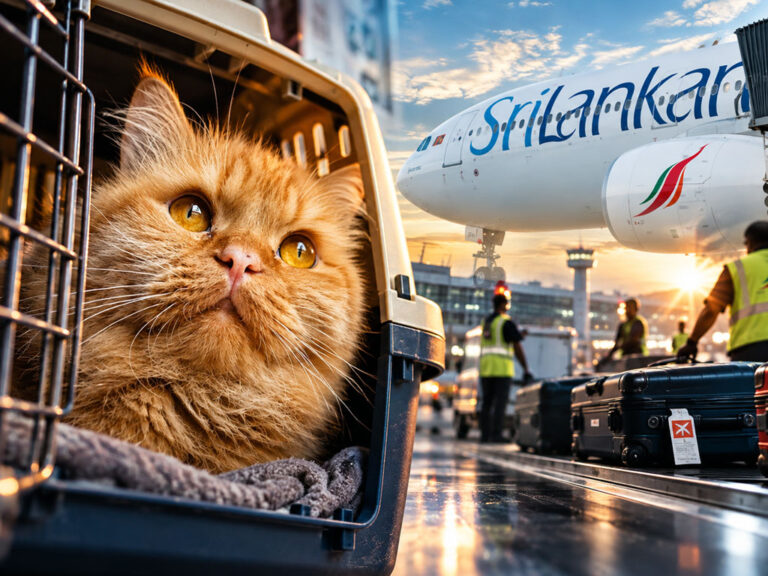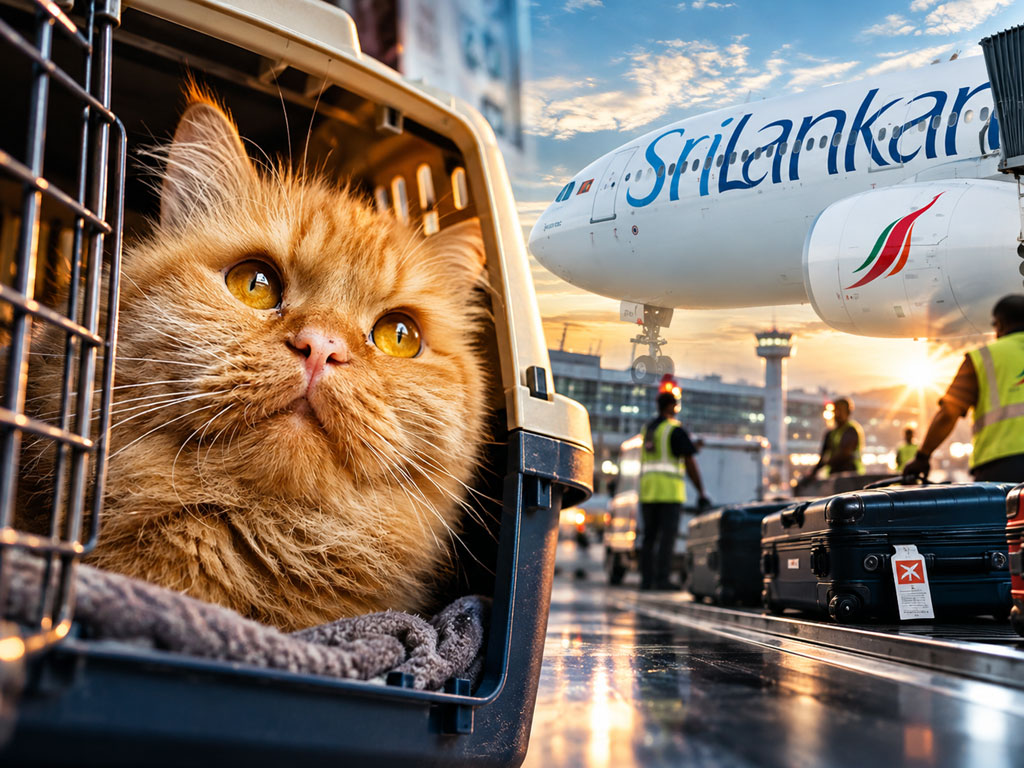
A passenger travelling from Dubai to Colombo alleges that her two-year-old Persian cat disappeared while being handled for a SriLankan Airlines flight, leaving her stranded for approximately 28 hours and seeking answers about the airline’s pet transport procedures.
COLOMBO — A young woman travelling from Dubai to Sri Lanka has lodged formal complaints with SriLankan Airlines after her two-year-old Persian cat, Simba, reportedly disappeared from its transport carrier while being processed at Dubai International Airport on October 11, 2026.
The passenger alleges that the animal was entrusted to airline personnel for transportation on SriLankan Airlines flight UL226 but went missing before being loaded onto the aircraft.
According to the complaint material supplied to The Morning Telegraph, the carrier was subsequently found with its door open and the animal missing, prompting an unsuccessful search and leaving the passenger at the airport for approximately 28 hours.
The woman has questioned whether the carrier was properly secured, whether agreed handling arrangements were followed and what measures SriLankan Airlines and its Dubai ground-handling provider, DNATA, have taken to locate the animal.
Her complaint has reportedly been registered with SriLankan Airlines under customer affairs reference UL179841.
The Morning Telegraph has not independently authenticated the complete correspondence, baggage-handling records or surveillance material relating to the disappearance. The precise circumstances in which Simba escaped, and whether either company breached its handling obligations, therefore remain unestablished.

Passenger Questions How Simba Was Handled at Dubai Airport
The central complaint concerns how Simba’s transport carrier was transferred through Dubai International Airport’s baggage-handling system.
According to the passenger’s account, she paid an additional charge on the understanding that the carrier would be physically transported by an employee to the aircraft’s cargo area rather than placed on a conventional baggage conveyor belt.
She alleges that the arrangement was not followed.
Instead, the carrier was reportedly transferred using the baggage-handling system, after which it was discovered with its door open and Simba missing.
The passenger maintains that the cage had not been broken or otherwise visibly damaged.
She believes its door may have opened because additional plastic cable ties were not secured after the cage passed through the airport’s screening procedures.
The source material alleges that both SriLankan Airlines and DNATA personnel failed to ensure the carrier was adequately secured.
However, the actual handling arrangements, the carrier’s condition before and after transfer, and the steps taken by individual employees have not been independently verified.
Nor has it been established that the charge paid by the passenger specifically purchased a separate hand-carrying service.
SriLankan Airlines’ published baggage rules allow domestic animals, including cats, to travel as checked baggage under applicable restrictions. The airline also states that pets and their transport containers are charged according to excess baggage rates.
The nature of the AED 840 payment and any additional service specifically promised to the passenger must therefore be established from her booking documents and the airline’s acceptance records.
Were the Carrier’s Safety Fastenings Adequate?
One of the most important questions concerns whether Simba’s transport carrier complied with the requirements applicable to live animals.
International air transport of animals is governed by specialised handling and container standards, including the International Air Transport Association’s Live Animals Regulations.
Those standards address container construction, security, handling practices, documentation and animal welfare.
Certain airlines impose additional requirements for securing carrier doors with cable ties or comparable fastenings.
However, the documents presently available do not establish that cable ties were mandatory for this particular carrier under the rules applicable to SriLankan Airlines and DNATA at the time.
The absence of cable ties alone cannot therefore be treated as proof that a mandatory procedure was violated.
The relevant questions are whether the carrier satisfied the applicable acceptance requirements, how its door was secured, whether it was inspected before transfer and what occurred while it was being transported.
If the door opened during ground handling, establishing how and where that happened will be essential to determining whether a procedural failure occurred.
The passenger’s account also requires examination alongside any available handling records, incident reports and airport surveillance footage.
Passenger Says All Veterinary Documents Were in Order
The complaint states that Simba was a two-year-old, orange-coloured Persian cat travelling with the documents required for importation into Sri Lanka.
According to the material supplied, the passenger had obtained prior import authorisation from Sri Lanka’s Department of Animal Production and Health (DAPH).
The documents also reportedly included a veterinary health certificate issued by the United Arab Emirates’ Ministry of Climate Change and Environment.
Simba had been implanted with an identification microchip, the details of which were reportedly included in the transport documentation.
The source identifies the following arrangements:
- Sri Lankan import authorisation: A permit reportedly issued by the Department of Animal Production and Health.
- UAE veterinary documentation: A health certificate reportedly issued by the Ministry of Climate Change and Environment.
- Animal identification: An international microchip implanted in Simba.
- Transport charge: AED 840 reportedly paid to SriLankan Airlines for the animal and its carrier, with the combined weight recorded as seven kilograms.
The source estimates that the payment exceeded Rs. 70,000 in Sri Lankan currency.
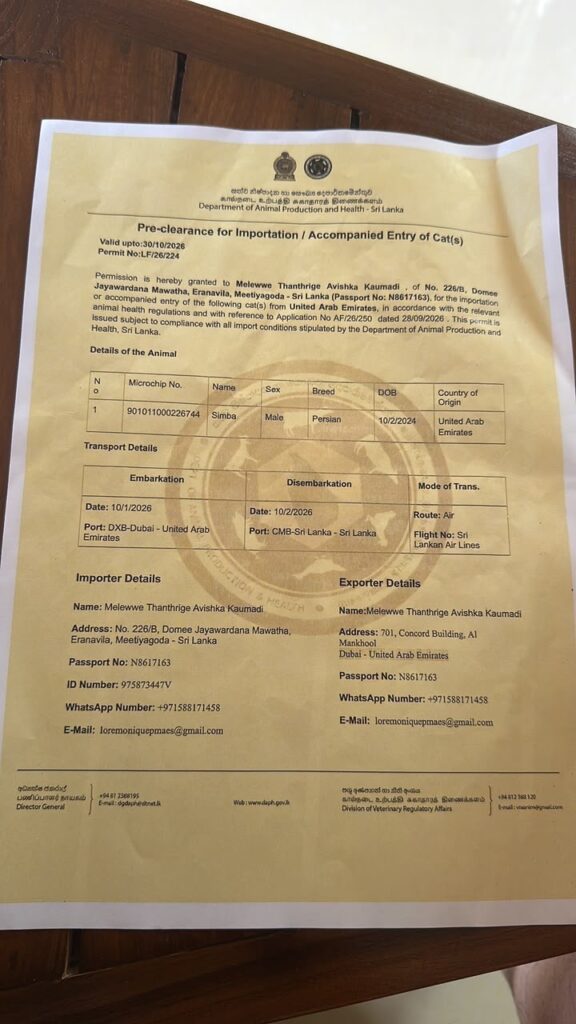
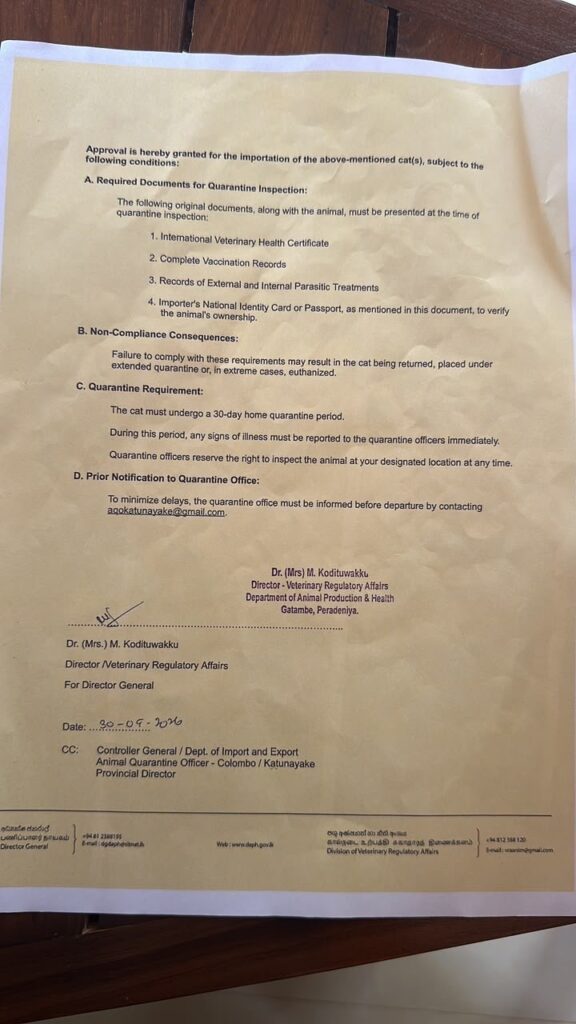
The Morning Telegraph has not independently authenticated the veterinary permits or payment receipt, although the documents are identified in the passenger’s complaint.
The complete permit, booking and microchip reference numbers have been withheld from publication because they may be useful for identity verification and official animal recovery procedures.
They should remain available to authorised airline personnel, airport authorities and investigators seeking to trace Simba.
Passenger Informed of Disappearance Before Flight UL226
According to the complaint, the passenger was contacted by a SriLankan Airlines representative at approximately 10.18 p.m. on October 11 while preparing to travel on flight UL226.
She was reportedly informed that Simba could not be located.
The passenger subsequently sought an explanation for how the animal had disappeared after being accepted for transportation.
She also requested that airport officials examine CCTV recordings covering the baggage-handling area.
In WhatsApp correspondence attributed to a SriLankan Airlines representative, she reportedly received the following response:
“Miss, we treat everyone the same whether in Sri Lanka or any country. You saw yesterday that we looked everywhere. There is no CCTV in the baggage area. We are still looking.”
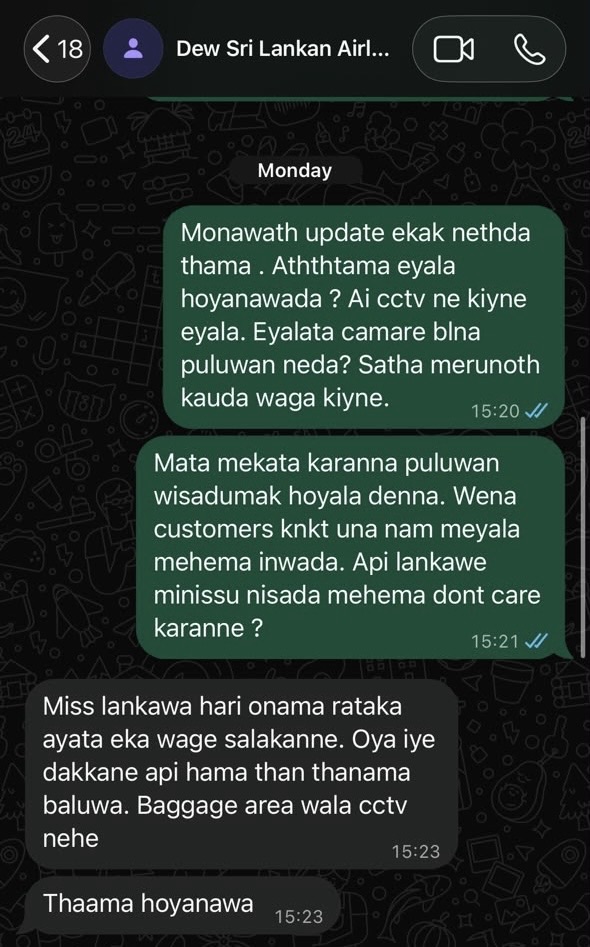
The quotation is reproduced as supplied and has not been independently authenticated against the original electronic conversation.
The assertion concerning CCTV coverage also requires clarification.
It has not been established whether the relevant area lacked cameras, whether cameras existed but did not cover the precise location of the disappearance, or whether any recordings were available for review.
Airport surveillance arrangements are not necessarily uniform across every operational area.
An authoritative response from Dubai International Airport and the companies involved would help establish what footage, if any, could assist in tracing Simba’s movements.
The passenger alleges that she remained at the airport for approximately 28 hours following the incident.
She also says she requested written confirmation that Simba would be transported to Sri Lanka if subsequently found.
According to her account, an airline representative told her that such documentation could not be provided at the Dubai station and that she should obtain it from Colombo Airport.
The circumstances surrounding that request, and whether any subsequent written undertaking was provided, remain unclear.
Passenger Alleges Distressing Response From Airline Representative
One of the most serious complaints concerns an exchange the passenger says took place in the presence of a Dubai airport management representative.
Distressed by Simba’s disappearance, she reportedly asked an airline official what would happen if her cat were found dead.
According to the passenger, she asked:
“What if my cat is dead?”
The official allegedly replied:
“If the cat is dead, madam, you can file a lawsuit against us.”
The alleged exchange has not been independently confirmed through an audio recording, witness statement or response from the official concerned.
Its precise context also remains unknown.
Nevertheless, if accurately reported, the response raises legitimate concerns about the communication and assistance provided to passengers when a live animal disappears during ground handling.
For the passenger, Simba was not simply an item of baggage. He was a companion animal entrusted to the airline under a paid transport arrangement.
The immediate priority in such circumstances would reasonably be an organised search, clear communication and an explanation of the steps being taken to protect the missing animal.
Questions about legal liability are separate from the urgent need to establish Simba’s whereabouts.
Missing Animal Recorded Under a Baggage Irregularity Report
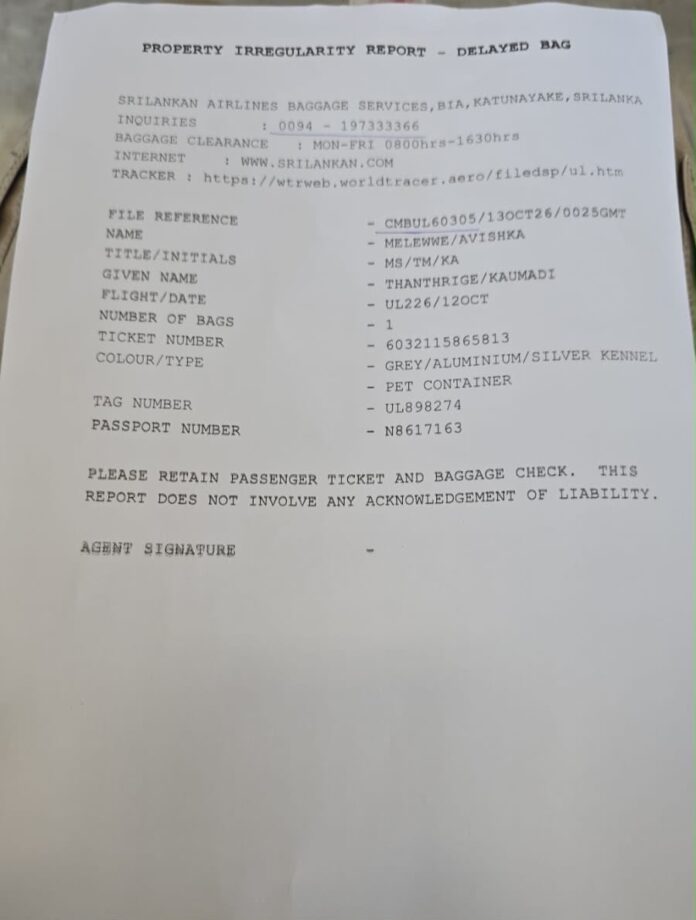
Following her arrival at Bandaranaike International Airport in Katunayake, the passenger reportedly filed a complaint with SriLankan Airlines’ baggage services department.
According to the source, the incident was registered through a Property Irregularity Report (PIR) dated October 13, 2026.
The report allegedly classified the incident as a “Delayed Bag”, despite the subject being a missing live animal.
The passenger has objected to that description, arguing that the disappearance required urgent animal-welfare attention rather than routine baggage tracing.
The PIR reportedly included wording indicating that liability was not accepted solely through issuance of the report.
Such language, if accurately reproduced, does not by itself establish that the airline has legally denied responsibility for the incident.
A PIR is ordinarily an administrative record used to document baggage irregularities. Whether the same reporting system is also used to record incidents involving animals transported as checked baggage requires clarification from SriLankan Airlines.
The significant question is whether registering Simba through a baggage-tracing process was accompanied by appropriate procedures for locating a missing animal.
Those procedures could include notifying relevant airport personnel, preserving handling records, coordinating ground searches and ensuring that the animal’s identifying information is available to authorised teams.
The passenger’s complaint does not establish which of those steps were undertaken or whether they remain active.
Airline Gives 12-Working-Day Response Period
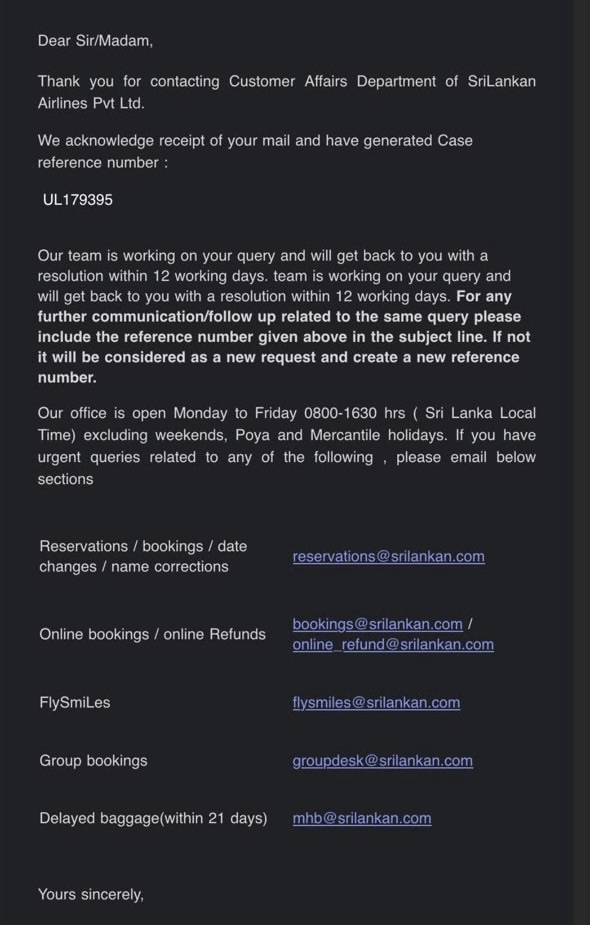
The woman subsequently contacted SriLankan Airlines’ customer affairs department to seek an explanation and assistance.
According to the supplied correspondence, the airline acknowledged her complaint under reference UL179841.
The response reportedly stated:
“Our team is working on your query and will get back to you with a resolution within 12 working days…”
The acknowledgement appears to refer to the airline’s administrative process for handling customer complaints.
It does not necessarily establish that the search for Simba was suspended pending the expiry of that period.
Nevertheless, the passenger has questioned whether a routine customer service response was appropriate when a missing animal might require immediate attention.
A 12-working-day timeframe for resolving a written complaint is materially different from the urgency of searching for a lost pet within an operational airport environment.
SriLankan Airlines should therefore clarify whether the customer affairs process is separate from an active search and, if so, which organisation is coordinating that search.
The passenger also alleges that a Dubai station official acknowledged the animal’s disappearance in email correspondence while referring responsibility for ground handling to DNATA.
That correspondence has not been independently examined in full.
Any division of operational responsibilities between SriLankan Airlines and DNATA must be established from the relevant handling agreement and the records relating to Simba’s acceptance and transfer.
The fact that an external company provides ground-handling services does not, by itself, resolve contractual responsibility towards a passenger.
Questions for SriLankan Airlines and DNATA
The passenger’s complaint identifies several issues requiring documented clarification:
1. Why was Simba’s carrier reportedly placed on the baggage conveyor system when the passenger believed she had paid for it to be transported separately by hand?
2. What services were covered by the AED 840 payment, and was any special handling arrangement agreed upon?
3. Was the carrier properly secured when accepted for transportation, and were additional fastenings required under the applicable regulations?
4. Who was responsible for transferring the carrier between the check-in area and the aircraft?
5. At what point was the carrier discovered with its door open, and what records establish the sequence of events?
6. Were CCTV recordings available from the relevant areas, and were they examined or preserved?
7. What steps were undertaken to locate Simba immediately after the disappearance was reported?
8. Why was the incident registered as a baggage irregularity, and was a separate live-animal incident report prepared?
9. Who is currently responsible for coordinating the search and communicating developments to the passenger?
10. Has the passenger received written confirmation of the arrangements that would apply if Simba is found alive and requires veterinary care or onward transportation?
These questions are directed towards establishing what happened and what remedial action may be necessary.
They do not establish that any individual employee acted negligently or that a criminal offence occurred.
Airline and Ground Handler Responses Required
The disappearance also raises wider questions about how airlines and ground-handling companies manage incidents involving live animals.
Unlike ordinary checked baggage, animals require handling arrangements that account for their welfare, safety and potential distress.
A missing animal presents challenges that may require immediate cooperation among airline staff, baggage handlers, airport operations, security personnel and veterinary authorities.
International standards recognise that transporting live animals involves responsibilities beyond those associated with ordinary baggage.
Determining whether those responsibilities were satisfied in Simba’s case requires evidence from the organisations directly involved.
The Morning Telegraph has not established that SriLankan Airlines or DNATA has issued a comprehensive public explanation addressing each aspect of the passenger’s complaint.
Nor has the newspaper independently confirmed whether Simba has since been recovered.
The airline, DNATA and the relevant Dubai airport authorities should be given an opportunity to provide their accounts, including details of the handling process, search measures and any investigation into the incident.
Search for Simba Remains the Immediate Priority
The passenger’s account describes an upsetting experience involving a pet accepted for international transportation, an allegedly unsecured carrier and unanswered questions about ground-handling procedures.
Her allegations are serious, particularly concerning the handling of the cage, the availability of surveillance footage and the responses attributed to airline personnel.
However, the material supplied does not establish exactly how Simba escaped, which organisation was responsible for the carrier at that moment or whether a breach of established safety requirements occurred.
Those matters require examination of the relevant records and responses from the institutions involved.
In the meantime, the most urgent concern is the animal’s safety.
Simba’s identification details, veterinary documents and transport records could assist authorised personnel in coordinating efforts to locate him.
The passenger is entitled to seek a clear account of what happened, what action was taken following the disappearance and what arrangements exist if her cat is recovered.
Any subsequent investigation should also establish whether the incident exposes gaps in the handling procedures for animals transported through Dubai International Airport.
Until Simba’s whereabouts are confirmed, the immediate public-interest question is not only whether the airline and its ground handler followed the correct procedures, but whether every reasonable effort is being made to find the missing animal safely.
SOURCE:- HARI DESHAYA