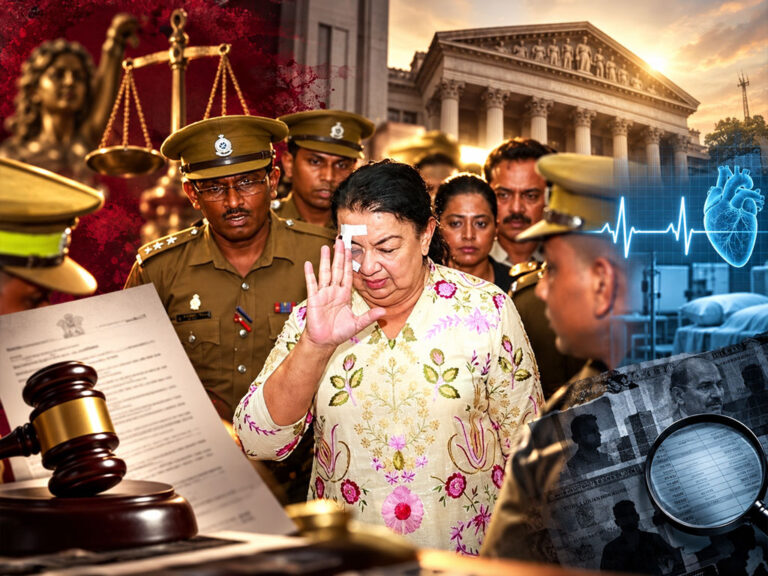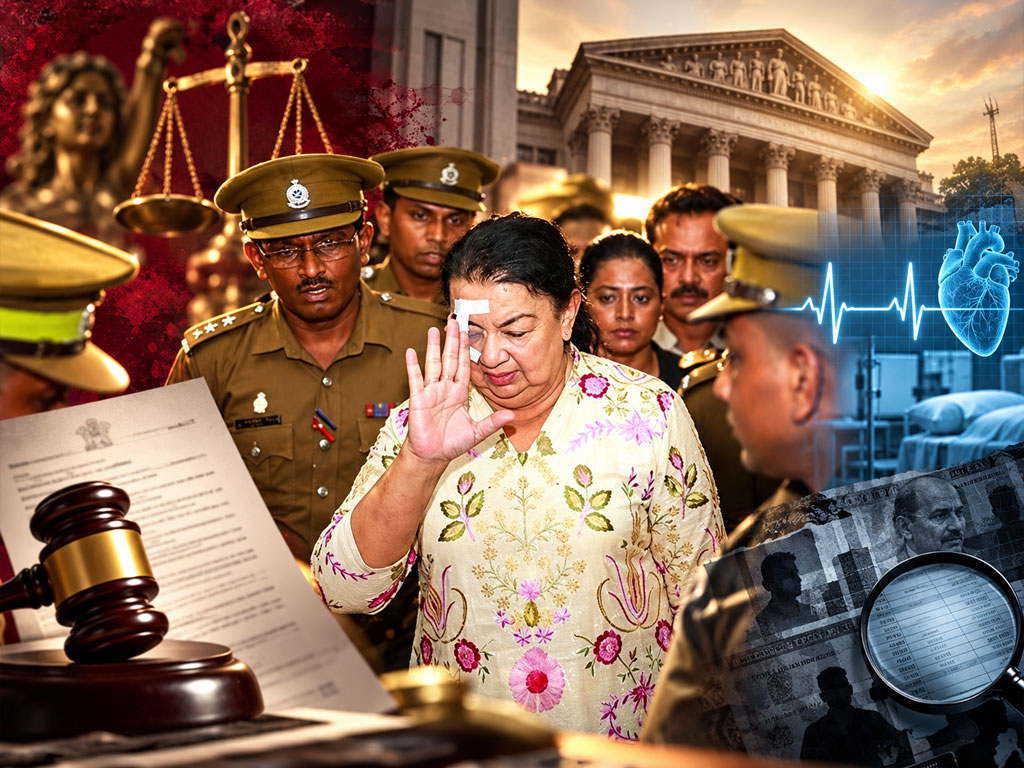
The former First Lady was released on Rs. 100,000 cash bail and two sureties of Rs. 10 million each after doctors reported that she required bypass surgery. Prosecutors continue to investigate allegations concerning National Savings Bank funds and a hospital equipment donation.
COLOMBO, October 16, 2026 — Former First Lady Shiranthi Rajapaksa was granted bail by the Colombo Chief Magistrate’s Court on Friday after medical evidence indicated that she required coronary bypass surgery, ending her period in remand custody while investigations continue into an alleged Rs. 10 million misappropriation involving the Siriliya Saviya organisation.
Colombo Chief Magistrate Asanga S. Bodaragama ordered her release on cash bail of Rs. 100,000 and two personal sureties of Rs. 10 million each. A foreign travel ban was also imposed.
Rajapaksa, the wife of former President Mahinda Rajapaksa, was arrested on October 7 by the Commission to Investigate Allegations of Bribery or Corruption (CIABOC) in connection with funds transferred from the National Savings Bank (NSB) to an account associated with Siriliya Saviya.
Her lawyers sought bail on medical grounds, citing serious coronary artery disease and the need for surgical intervention.

The prosecution, represented by Additional Solicitor General Dileepa Peiris, questioned whether her hospitalisation justified release when she was already receiving treatment at the National Hospital of Sri Lanka.
The decision followed a fresh medical assessment, submitted after an earlier report had failed to establish grounds for bail on October 13.
The granting of bail does not dispose of the investigation or determine whether any offence was committed.
Medical Report Leads to Shiranthi Rajapaksa’s Bail
The court’s decision followed submissions concerning Rajapaksa’s cardiac condition and the treatment recommended by a specialist medical team.
According to the supplied account, defence lawyers maintained that her left coronary artery was between 80% and 90% obstructed and argued that her condition required urgent bypass surgery.
That precise percentage has not been independently confirmed from the medical report.
A subsequent report submitted to court on October 16 indicated that Rajapaksa required coronary artery bypass surgery.
The medical assessment followed a dispute earlier in the week over whether the former First Lady was already undergoing an operation or whether surgery had been formally recommended.
On October 13, the Chief Magistrate examined an earlier report from the National Hospital and observed that it did not contain a recommendation for immediate open-heart surgery. Bail was refused at that stage, and Rajapaksa remained remanded until October 16.
A further assessment was subsequently undertaken by a specialist medical board.
The report presented on Friday addressed the need for bypass surgery, providing medical information that had not been established in the earlier proceedings.
After considering the updated evidence and legal submissions, the Magistrate granted bail subject to financial conditions and a prohibition on overseas travel.
The difference between the October 13 and October 16 decisions is important. The earlier refusal was based on the evidence available at that time, while the later order followed additional medical assessment.
It would therefore be inaccurate to suggest that the court disregarded the medical evidence or granted bail solely because of Rajapaksa’s former political position.
Prosecution Questions Exceptional Circumstances
Additional Solicitor General Dileepa Peiris, appearing on behalf of CIABOC, reportedly questioned whether the former First Lady’s medical condition constituted exceptional circumstances justifying release on bail.
According to the source material, Peiris argued that Rajapaksa was already receiving specialised medical treatment at the National Hospital and was not being denied appropriate care because of her remand status.
The prosecution also referred to the involvement of a medical team comprising 14 specialists.
Its central argument was that release on bail would not necessarily alter the treatment available to Rajapaksa while she remained hospitalised.
The supplied report attributes a lengthy statement to Peiris concerning the distinction between receiving hospital treatment in remand custody and being released on bail.
However, the precise wording of that submission has not been independently established from an official court transcript. Its central argument is therefore paraphrased rather than reproduced as a verified direct quotation.
The question before the Magistrate was whether the evidence and applicable legal requirements justified bail in the circumstances presented.
Friday’s ruling permitted Rajapaksa’s release while retaining conditions intended to secure her participation in the continuing proceedings.
No conclusion about the merits of the underlying financial allegations follows from the decision.
Rs. 10 Million National Savings Bank Transfer Under Investigation
The investigation concerns allegations that Rs. 10 million belonging to the National Savings Bank was transferred to an account associated with Siriliya Saviya in 2010.
According to submissions previously reported from court, the money was obtained following a written request concerning the acquisition of a CT scanner for the Lady Ridgeway Hospital for Children.
Investigators allege that the transfer involved financial irregularities and that the funds were not used for their stated purpose.
Former NSB Chairman Pradeep Kariyawasam has also been identified in reporting on the investigation.
The prosecution has questioned the procedures followed in approving the payment and transferring the funds.
Defence lawyers have disputed allegations of wrongdoing, including claims concerning the use and availability of money in the relevant account.
The prosecution’s case and the defence’s objections remain matters for examination through the judicial process.
Neither the transfer itself nor the allegations made during the investigation establish that Rajapaksa committed an offence.
Chinese MRI Donation Raises Further Questions
The investigation has also drawn attention to submissions concerning medical equipment provided to the Lady Ridgeway Hospital for Children in 2014.
According to information presented to court by the prosecution on October 13, an MRI scanner provided by the Chinese Government was subsequently presented at a ceremony as a donation associated with Siriliya Saviya.
The event reportedly coincided with the birthday of one of Rajapaksa’s children.
The supplied article identifies that child as Yoshitha Rajapaksa, although the reporting examined refers more generally to the birthday of one of her sons.
That identification requires confirmation before being stated as an established fact.
Prosecutors also referred to statements attributed to two Lady Ridgeway Hospital doctors, Ranmanthri and Ratnasiri, concerning the equipment’s original source.
The source material values the scanner at Rs. 200 million, or Rs. 2,000 lakh. That valuation has not been independently confirmed from procurement or donation records.
An important distinction must also be maintained between the equipment and the funds under investigation.
The Rs. 10 million NSB transfer allegedly concerned a CT scanner, while the equipment discussed in the subsequent donation ceremony was identified in other court reporting as an MRI scanner.
These are different medical technologies.
The reported involvement of a Chinese Government donation does not, by itself, establish that the entire value of the medical equipment was misappropriated.
The financial allegation requiring investigation concerns the NSB transfer, the purpose for which it was requested, the account into which it was paid and the subsequent use of the money.
Determining whether any fraud occurred requires documentary evidence, financial records and judicial findings.
Allegations of Preferential Hospital Treatment Remain Unverified
The original source also alleges that Rajapaksa received unusually privileged treatment during her admission to the National Hospital.
However, it provides no independently verifiable details establishing that she received facilities or services unavailable to other remand prisoners requiring comparable medical attention.
Rajapaksa was admitted to the hospital’s cardiology unit on October 12 following recommendations from prison medical officers.
Her hospitalisation was publicly reported, and medical documentation was subsequently submitted to court.
The availability of specialist treatment does not, in itself, establish preferential treatment.
Any allegation that detention or hospital procedures were improperly relaxed would require evidence concerning the facilities provided, applicable prison regulations and arrangements ordinarily available to other prisoners with serious medical conditions.
The wider question of equal treatment before the law is legitimate, but it should be assessed through documented differences in treatment rather than assumptions arising from a suspect’s public profile.
Bail Does Not End the Siriliya Saviya Investigation
Rajapaksa’s release brings the immediate dispute over her continued detention to an end, subject to the bail conditions imposed by the court.
The underlying allegations, however, remain unresolved.
Investigators must establish whether the National Savings Bank transfer complied with applicable procedures, what representations were made to obtain the money and how the funds were subsequently handled.
Questions concerning the Chinese Government’s medical equipment donation and Siriliya Saviya’s involvement in its presentation may also require further examination.
Rajapaksa remains entitled to challenge the prosecution’s allegations and to the presumption of innocence.
Equally, the granting of bail does not prevent investigators from pursuing evidence or the courts from determining the merits of the case.
The next significant developments will concern the continuing financial investigation, compliance with the bail conditions and any further proceedings relating to the allegations against the former First Lady.
The immediate legal question concerning her detention has been resolved. Whether the alleged misuse of public funds can be established remains for the investigation and the courts to determine.
SOURCE:- HARI DESHAYA