
Parliament’s Committee on Public Finance has questioned why the Colombo Port City Economic Commission assigned legal responsibilities to its Commercial Operations Director instead of appointing a separate Legal Affairs Director, amid complaints concerning the recruitment process.
COLOMBO, October 16, 2026 — The Colombo Port City Economic Commission’s decision to assign legal responsibilities to its Director of Commercial Operations, Radika Obeyesekere, has come under parliamentary scrutiny following revelations that the Commission did not appoint a separate Director of Legal Affairs despite previously advertising both positions.
The arrangement was examined at the Committee on Public Finance (COPF) meeting on October 8, chaired by opposition parliamentarian Dr. Harsha de Silva.
Commission Chairman, President’s Counsel Harsha Amarasekera, defended the arrangement, explaining that the institution relied on the Attorney General’s Department for significant legal matters and considered Obeyesekere’s legal background sufficient for coordinating legal work.
However, the explanation prompted questions about whether combining commercial and legal responsibilities within one office provides adequate independent scrutiny of decisions involving investment approvals, licensing, tax concessions and regulatory compliance.

The Morning Telegraph has also received information alleging that qualified applicants who responded to earlier recruitment advertisements were not informed of the outcome of the selection process.
Those complaints have not been independently established through complete recruitment records.
The central concern is whether the Commission has maintained adequate separation between commercial decision-making and the legal review of those decisions.
COPF Questions Dual Commercial and Legal Responsibilities
During the October 8 hearing, de Silva questioned the Commission’s arrangements for handling legal affairs following its decision not to recruit a dedicated Legal Affairs Director.
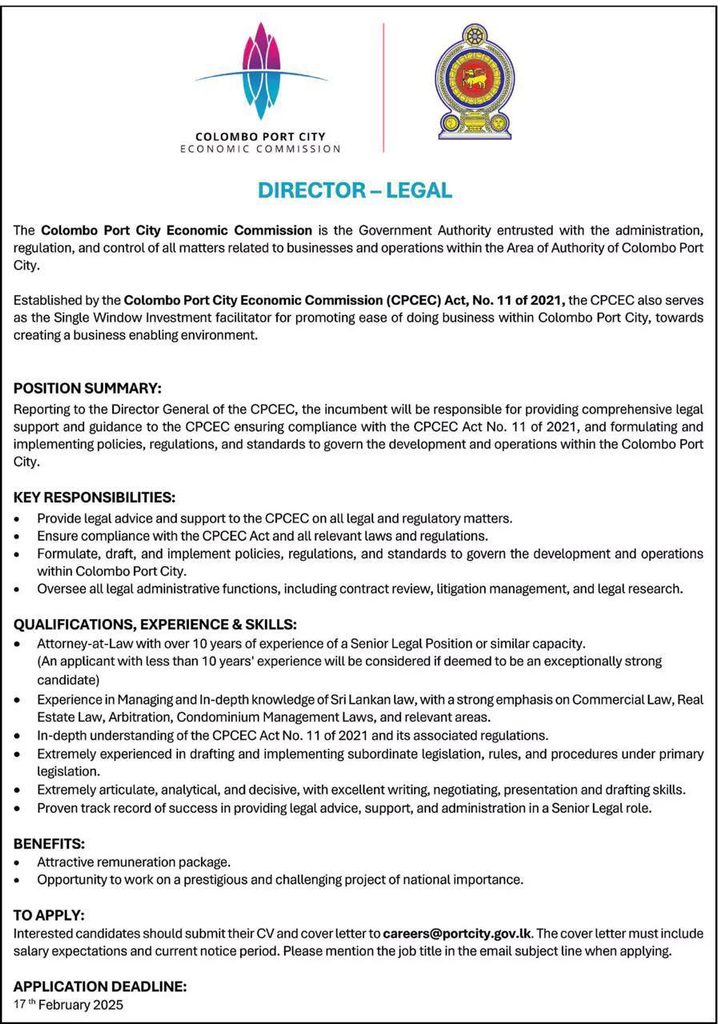
Amarasekera acknowledged that the previous Commission had advertised separately for the Commercial Operations Director and Legal Affairs Director positions.
He explained that the new Commission had reviewed the applications and decided to continue an existing arrangement under which important legal matters were referred to the Attorney General’s Department.
Consequently, the Legal Affairs Director position remained unfilled.
Obeyesekere, who had been selected as Director of Commercial Operations, was subsequently assigned responsibilities for coordinating legal matters.
According to the explanation presented before COPF, the Commission considered her legal background relevant to that arrangement.
Her responsibilities reportedly include liaising with the Attorney General’s Department and the Ministry of Finance, as well as signing certain documents in the capacity of Director of Legal Affairs.
The arrangement creates an important distinction requiring clarification.
Administrative authority to coordinate legal matters or sign documents does not necessarily establish that an officer has unlimited discretion to determine the legality of every commercial decision.
Nor does it prove that the officer personally approves transactions and subsequently conducts their final legal review without independent scrutiny.
The actual extent of Obeyesekere’s authority must be determined from the Commission’s delegation documents, internal procedures and applicable legislation.
Nevertheless, COPF’s examination confirms that the institution’s handling of commercial and legal functions is a legitimate matter for parliamentary oversight.

Port City legal appointment concerns are set for COPF scrutiny as questions persist over recruitment, qualifications and combined commercial and legal duties.
Read MoreCan Commercial Decisions Receive Independent Legal Scrutiny?
The Colombo Port City Economic Commission carries significant responsibilities as the principal regulatory and administrative authority for the Port City special economic zone.
Established under the Colombo Port City Economic Commission Act No. 11 of 2021, the institution oversees matters involving business operations, investment facilitation, licensing and regulatory administration within its designated area.
Its decisions may have substantial commercial and legal implications for investors and the State.
Effective governance consequently requires clear procedures for reviewing whether decisions comply with applicable laws, regulations and delegated powers.
The concern raised in the supplied material is that the same official responsible for commercial operations may also exercise legal signing authority over matters connected to those operations.
Such an arrangement could create an institutional conflict if independent legal review is absent.
However, the mere combination of responsibilities does not, by itself, establish an actual conflict of interest, unlawful appointment or improper certification.
Those conclusions would require evidence that Obeyesekere exercised incompatible powers, approved decisions outside her authority or failed to refer matters requiring independent legal advice.
COPF’s inquiry therefore provides an opportunity to establish which commercial decisions require legal clearance, who provides that clearance and what safeguards prevent inappropriate self-review.
Commission Defends Reliance on Attorney General’s Department
During the parliamentary proceedings, Amarasekera explained that the Commission relied on the Attorney General’s Department for substantive legal advice.
He maintained that the arrangement enabled the institution to address important legal questions without maintaining a separate full-time Legal Affairs Director.
Obeyesekere’s legal background was cited as a reason she could coordinate those responsibilities.
De Silva questioned whether reliance on an external State legal advisory body was sufficient, given the specialised regulatory work undertaken by the Port City Commission.
The Attorney General’s Department serves numerous public institutions and is not dedicated exclusively to Port City.
The Commission must also manage matters requiring timely commercial and regulatory decisions.
These include licensing arrangements, decisions concerning investment incentives and the administration of relevant exemptions.
Opposition MP Shanakiyan Rasamanickam questioned whether seeking advice from the Attorney General’s Department caused delays.
Amarasekera reportedly responded that the Commission had not experienced undue delays that prevented its work.
Rasamanickam observed that other State institutions would welcome similarly prompt access to legal advice.
The response does not establish that the arrangement is inadequate. It does, however, leave open the broader governance question of whether external advice provides sufficient day-to-day legal oversight.
The Commission could clarify that issue by disclosing the circumstances in which legal opinions are mandatory and how commercial decisions are reviewed before implementation.
Recruitment Process Raises Questions Among Applicants
The supplied source reports that several professionals who applied for the Commercial Operations Director and Legal Affairs Director posts have questioned how the recruitment exercises were concluded.
According to those accounts, the Commission publicly invited applications for the two positions through separate recruitment advertisements.
Applicants reportedly included experienced attorneys, corporate law specialists and commercial management professionals who believed they met the advertised educational and professional qualifications.
Some applicants allege that they received no subsequent communication regarding interviews, selection decisions or the discontinuation of recruitment.
They also maintain that they became aware of the decision not to appoint a separate Legal Affairs Director only after media reports concerning the allocation of its responsibilities.
These complaints require further verification.
The Morning Telegraph has not independently examined every relevant application, recruitment advertisement, correspondence record or selection decision.
Nor has it established that all qualified applicants were denied notification or that either recruitment process violated an applicable legal requirement.
The Commission has acknowledged that applications were called for both positions and that the new Commission subsequently decided not to fill the separate legal post.
That sequence makes it reasonable to ask whether applicants were formally notified of the decision and whether the Commission followed its published recruitment procedures.
The distinction is important because an employer’s decision not to fill a vacancy is not necessarily unlawful.
However, public institutions are expected to conduct recruitment and appointment processes through transparent, consistent and appropriately documented procedures.
Were Recruitment Criteria Changed After Applications Closed?
The allegations also concern whether the qualifications and responsibilities originally specified for the Legal Affairs Director position were effectively altered after applications were received.
The supplied material questions whether duties associated with that position were subsequently transferred to Obeyesekere without an equivalent recruitment exercise.
Earlier reporting has similarly questioned whether the combination of responsibilities was compatible with the qualifications originally prescribed for the two posts.
However, no complete comparison of the original job advertisements, approved schemes of recruitment, appointment documents and subsequent delegations has been made available for independent examination.
Consequently, it cannot be established from the available evidence that Obeyesekere was legally ineligible to undertake the additional functions assigned to her.
The appropriate assessment requires consideration of her qualifications, the nature of the delegated duties and the authority under which those responsibilities were assigned.
Whether the Commission formally abolished a position, suspended recruitment or simply decided to leave the post vacant should also be clarified.
Each would carry different administrative implications.
Director General Says Matter Will Be Taken to Commission
The source states that an inquiry was directed to Colombo Port City Economic Commission Director General Revan Wickramasuriya concerning the allocation of legal responsibilities and the complaints surrounding recruitment.
According to the supplied account, Wickramasuriya responded:
“This questionable appointment will be discussed at the upcoming Board of Directors meeting, and an official response will be provided in that regard.”
The exact wording of the reported response has not been independently authenticated against an original written statement or recording.
The Commission’s governing body is established under the Port City legislation, and references to an ordinary corporate board should be understood in that institutional context.
If the matter is scheduled for consideration at an upcoming Commission meeting, that would provide an opportunity to establish whether the arrangement should continue or be revised.
The source further questions why such a matter could take more than a month to be formally considered.
However, the dates of the previous and next governing-body meetings, together with the Commission’s meeting frequency and emergency decision-making procedures, have not been independently established.
A delay between meetings does not automatically establish an administrative failure.
The relevant question is whether the institution has a timely process for addressing governance concerns that could affect commercial or regulatory decisions.
What COPF and the Commission Must Clarify
The October 8 parliamentary hearing and subsequent applicant complaints identify several matters requiring clarification:
- What formal authority permits the Commercial Operations Director to undertake Legal Affairs Director responsibilities?
- Which categories of legal documents can Obeyesekere sign, and what limits apply to that authority?
- Is independent legal clearance required for decisions originating from commercial operations?
- What procedures govern referrals to the Attorney General’s Department?
- Why was the separate Legal Affairs Director vacancy not filled after applications had been invited?
- Were applicants formally informed of the recruitment outcome?
- Did the Commission assess the relevant qualifications before assigning additional legal responsibilities?
- When was the arrangement approved, and where is that decision recorded?
- Has COPF requested further documentation or recommended changes?
- When will the Commission issue an official explanation concerning the governance and recruitment concerns?
Answers supported by appointment records, delegation instruments, recruitment documents and committee proceedings would provide a firmer basis for judging the arrangement.
Port City’s Governance Must Match Its Investment Ambitions
The Colombo Port City project is intended to operate as an internationally competitive investment and services centre.
Its success depends not only on attracting capital but also on maintaining predictable rules, transparent administration and confidence in the institutions responsible for implementing them.
Investors need commercial decisions to be taken efficiently. They also need assurance that those decisions comply with the legal framework governing the special economic zone.
Neither objective should undermine the other.
The Commission’s reliance on the Attorney General’s Department may provide a legitimate mechanism for obtaining independent legal advice.
Whether that mechanism is sufficient depends on how consistently it is applied and whether internal commercial decisions remain subject to appropriate checks.
COPF’s intervention has placed those arrangements under examination, while the complaints from recruitment applicants introduce a separate question concerning administrative transparency.
No evidence examined establishes that Obeyesekere personally certified an unlawful transaction, improperly secured an appointment or deliberately bypassed legal oversight.
What remains necessary is an official explanation of the delegated powers, the reasons for leaving the Legal Affairs Director post vacant and the safeguards governing decisions made under the current structure.
The Commission’s response, together with any further findings from COPF, will determine whether the arrangement can be justified as an effective administrative measure or requires revision to strengthen independent legal oversight.