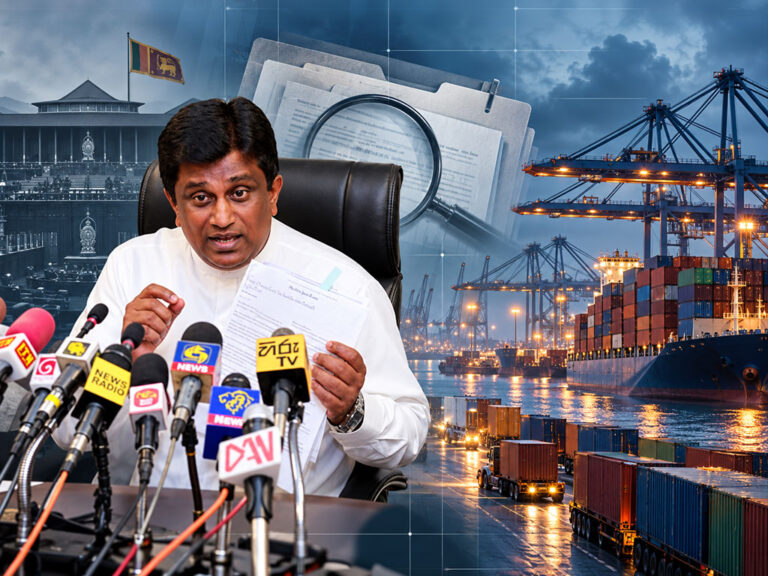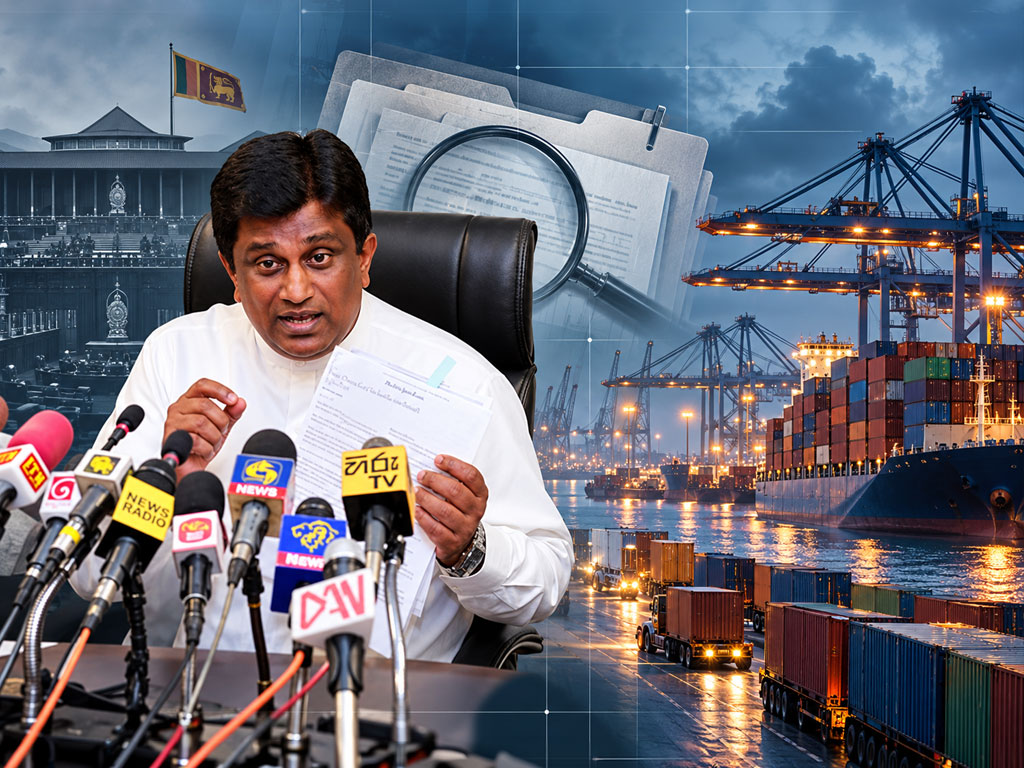
Colombo, October 31, 2026 — Opposition Parliamentarian Ajith P. Perera has accused the government of deliberately delaying the parliamentary report into the controversial release of 323 shipping containers from the Port of Colombo without mandatory physical inspections.
Perera, who serves on the parliamentary select committee investigating the incident, made the allegations during an appearance on Hiru Television’s Salakuna political discussion programme.
He claimed that the committee’s work had been obstructed from the outset, that evidence proposed by opposition members had been rejected and that a draft report containing the committee’s conclusions had still not been presented for discussion.
The allegations come as Parliament has formally extended the committee’s reporting deadline to December 21, 2026.
Parliamentary records confirm the extension but do not establish that the report has disappeared or that the government is deliberately suppressing it.

MP Questions Delay in Circulating Draft Report
Responding to a question about the committee’s progress, Perera alleged that its proceedings had been unfair from the beginning.
He claimed that requests by opposition members to summon particular witnesses and consider additional evidence had been rejected.
According to the MP, the evidence-gathering stage has now concluded, leaving the committee to examine and agree on its findings.
Perera said Justice and National Integration Minister Harshana Nanayakkara, who chairs the committee, was expected to circulate a draft containing the proposed conclusions.
He alleged that more than three months had passed since the committee’s last substantive discussions without such a draft being submitted.
The MP questioned why the report had not progressed despite repeated extensions of the committee’s mandate.
He further claimed that the continuing delay had increased public suspicion about the handling of the investigation.
These are allegations made by Perera. The committee chair’s explanation for the timetable was not included in the supplied account.
Parliament Extends Inquiry Until December 21
Official parliamentary records provide important context for the dispute.
On October 20, Parliament approved a further extension of the select committee’s mandate until December 21, 2026, stating that additional time was required to present its observations and recommendations.
The committee was established under a parliamentary resolution adopted on November 19, 2025, to investigate the release of 323 containers from the Port of Colombo without mandatory physical inspections.
Its remit includes examining:
- The legality and propriety of releasing the containers without physical inspection.
- The accountability of government authorities, officials and private entities involved.
- Whether any of the containers carried illegal, prohibited or harmful goods.
- The roles of Sri Lanka Customs and the Sri Lanka Ports Authority.
- The adequacy of existing legal and administrative safeguards.
- Reforms needed to prevent similar incidents.
Parliament’s official committee listing identifies Minister Nanayakkara as chairman and Perera as one of its members.
The committee has the authority to summon witnesses, obtain documents, receive evidence and make recommendations to Parliament.
The latest extension establishes that the inquiry remains formally active. It does not, however, resolve Perera’s complaints about the handling of evidence or the preparation of the draft report.
Allegations Over High-Risk Container Clearances
Perera described the incident as an exceptionally serious alleged irregularity involving the movement of goods and potential government revenue.
He claimed that containers assigned higher-risk classifications under Customs procedures had been released within hours without the physical examinations normally required.
In his account, the affected containers included shipments classified under red and amber risk categories.
Risk classifications are used to determine the level of scrutiny applied to imports. However, the precise classification of each of the 323 containers, and whether every shipment required the same form of examination, must be established through Customs records and the committee’s findings.
The MP alleged that pressure had been exerted on the Director General of Customs to facilitate the release of the containers.
He further claimed that the instructions originated from senior figures within the executive and relevant ministries.
These are serious allegations of improper political interference. The material supplied does not establish that the President, any minister or any Customs official committed wrongdoing.
Port Congestion Explanation Disputed
The rapid clearance of the containers was reportedly justified at the time by reference to congestion at the Port of Colombo.
Perera challenged that explanation, claiming that evidence presented before the parliamentary committee indicated the congestion had been artificially created.
He suggested that the congestion argument had been used to justify departures from established inspection procedures.
Whether congestion was deliberately manufactured, and whether it influenced the clearance decisions, remains a matter requiring examination of the relevant operational records and witness testimony.
The parliamentary inquiry was established partly because the release of containers without the required inspections raised concerns about Customs procedures, public safety and the protection of state revenue.
The resolution establishing the committee also refers to findings from an earlier Treasury-appointed inquiry that questioned the legality of the clearance process and identified potential risks to national security, public safety and revenue collection.
MP Raises Drug-Seizure Concerns
Perera also referred to recent drug seizures involving shipping containers while questioning assurances allegedly given during the committee’s proceedings about the risk of narcotics entering the country through containerised cargo.
He claimed that drugs valued at billions of rupees had recently been detected in two containers.
The MP further alleged that disciplinary action had been considered against officers involved in those seizures and that intervention by the independent National Police Commission had helped protect them.
The specific incidents, the proposed disciplinary action and the reported commission intervention require independent verification.
Crucially, the discovery of narcotics in other containers does not establish that any of the 323 containers under investigation carried drugs.
The parliamentary committee’s mandate includes determining whether prohibited or harmful goods were present in the shipments concerned. That question remains separate from broader concerns about drug smuggling through ports.
Perera Questions Absence of Senior Officials’ Testimony
The MP also criticised what he described as the failure of senior officials and political leaders to give evidence concerning the controversy.
He specifically referred to President Anura Kumara Dissanayake in his capacity as Minister of Finance, alleging that the President and other principal decision-makers had not appeared before the committee.
The absence of testimony from a particular individual does not, in itself, establish that the individual refused a formal summons or attempted to obstruct an inquiry.
The committee’s official records and witness lists would be needed to determine who was invited, who was formally summoned and what responses were received.
Perera’s allegation nevertheless raises a question about the scope of the investigation and whether committee members believe they have obtained evidence from everyone relevant to the disputed clearance decisions.
Report’s Findings Remain Awaited
The controversy has attracted sustained attention because it concerns fundamental safeguards governing the movement of goods through Sri Lanka’s principal commercial port.
Physical Customs inspections serve several purposes, including detecting prohibited imports, verifying declarations and protecting government revenue.
Any departure from mandatory inspection procedures therefore requires a clear legal and administrative explanation.
The parliamentary committee’s eventual report is expected to address the circumstances surrounding the release of the 323 containers, the officials and institutions involved, and the safeguards needed to prevent similar controversies.
For now, Perera’s allegations remain contested claims rather than established findings.
With the committee’s mandate extended until December 21, attention will turn to whether its draft conclusions are circulated, whether members can agree on a final report and when those findings will be presented to Parliament.