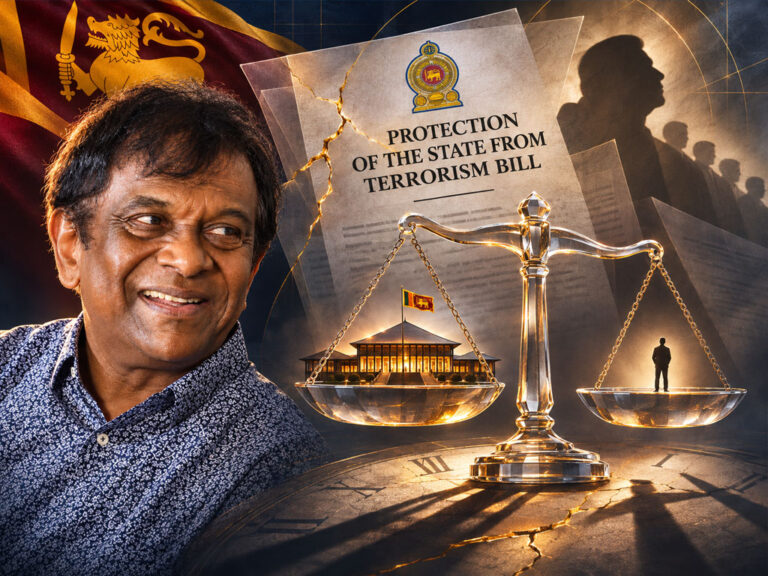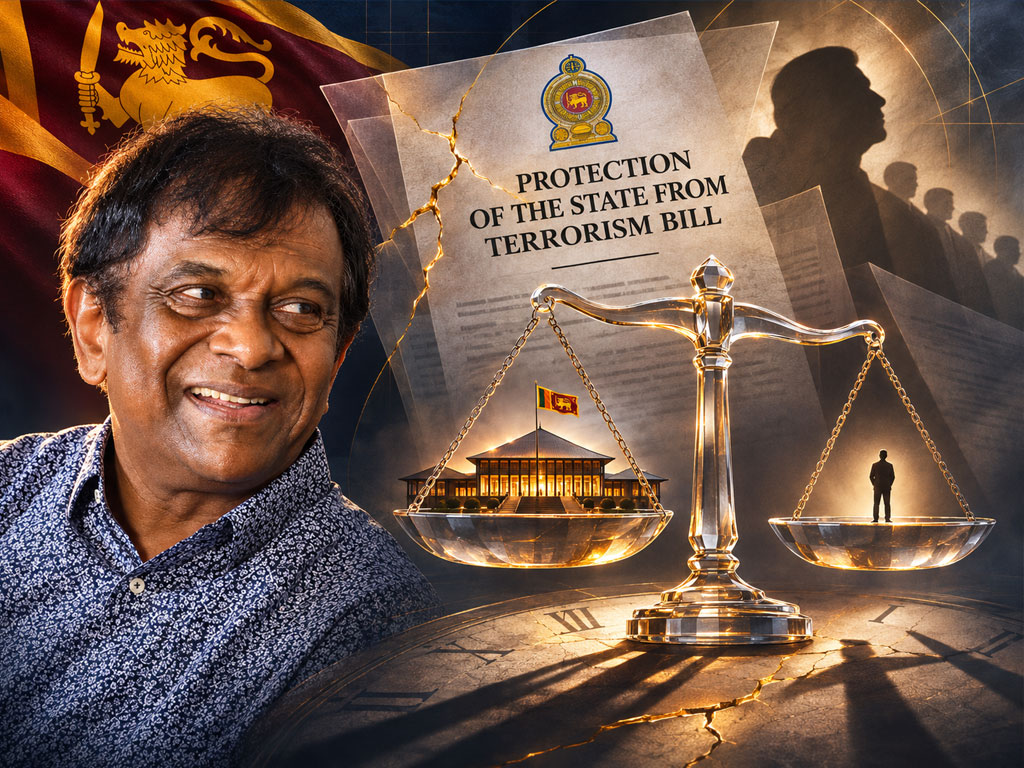
The National People’s Power government must draft its security legislation with its most dangerous possible successor in mind, rather than relying on its own declared intentions.
Name one Sri Lankan government that inherited a repressive law and chose not to use it against its critics.
History offers little reassurance.
The Prevention of Terrorism Act (PTA), introduced in 1979 as a temporary measure, remains in force 47 years later. It has survived successive administrations led by the United National Party (UNP), the Sri Lanka Freedom Party (SLFP), the Rajapaksas, the Good Governance coalition, Ranil Wickremesinghe and now the National People’s Power (NPP).
Throughout those decades, the legislation has been used against Tamil and Muslim communities, political activists, writers, human rights defenders, students and government critics.
Successive political parties condemned the Act while in opposition. Yet, once in government, they repeatedly found reasons to retain the extraordinary powers it conferred.
In 2017, Ranil Wickremesinghe pledged to repeal the PTA as part of Sri Lanka’s efforts to regain European trade concessions.
Five years later, as President, his administration invoked the same legislation against student activists associated with the Aragalaya protest movement.
Janatha Vimukthi Peramuna (JVP) General Secretary Tilvin Silva questioned how a politician who had previously advocated repeal could subsequently use the Act against political opponents.
His criticism was justified.

The Promise and the Practice
The NPP’s position on the PTA was unequivocal while it remained in opposition.
In 2023, its parliamentarians opposed the Wickremesinghe administration’s proposed Anti-Terrorism Bill and challenged the legislation before the Supreme Court.
Its 2024 election manifesto promised to abolish oppressive legislation, including the Prevention of Terrorism Act, while protecting the civil rights of citizens throughout the country.
However, the record since the NPP assumed office has raised difficult questions about its commitment to that promise.
At least 12 people were reportedly arrested under the PTA between September 2024 and May 2025, with further arrests subsequently recorded.
According to figures reported by the Human Rights Commission of Sri Lanka, 46 PTA-related detention cases were recorded during 2025, followed by another 12 in the first three months of 2026.
Those detained reportedly included a man accused of displaying anti-Israel stickers and a 24-year-old Tamil hip-hop artist arrested in June 2026 in connection with a music video.
Such incidents raise questions about whether extraordinary counterterrorism legislation has been invoked in circumstances that could have been addressed through ordinary criminal law.
Within approximately two years of taking office, the government that promised to abolish the PTA has continued to use it.
That contradiction cannot be dismissed merely by restating the administration’s original intentions.
Trust Is Not a Legal Safeguard
The government is now pursuing two significant pieces of legislation.
The Protection of the State from Terrorism Bill, intended to replace the PTA, was presented to Parliament on 6 October 2026.
The Prevention of Organised Crimes Bill was gazetted on the same date and subsequently submitted to Parliament on 20 October.
Both have attracted serious criticism from legal professionals, human rights organisations and independent institutions.
The objections concern the breadth of the proposed offences, the powers available to executive authorities, restrictions on bail and the adequacy of judicial oversight.
These are not merely disagreements about drafting.
They concern the relationship between state authority and individual liberty.
Under the proposed organised crime legislation, detention orders could be issued by the Secretary to the Ministry of Public Security for periods extending, through renewals, to a maximum of one year.
The Bill also restricts access to bail and limits the discretion ordinarily available to judicial officers.
Its provisions concerning membership of organised criminal groups are particularly troubling.
Factors that a court may consider include a person’s clothing, tattoos, hand signs, associations and attendance at particular locations.
Such criteria create the danger that appearance or association may be treated as evidence of criminal involvement, even where there is insufficient proof of participation in an offence.
The Bill’s broad definition of serious crime also extends its reach into areas not ordinarily associated with major organised criminal enterprises.
Its scheduled offences include matters such as bigamy, copyright infringement and unlicensed gambling.
The concern is not that these activities should escape legal scrutiny. It is whether they justify the exceptional enforcement powers designed to confront organised criminal networks.
Another contentious feature is the proposed admissibility of confessions made to police officers of the rank of Assistant Superintendent of Police or above.
Sections 46 and 47 of the proposed legislation would permit such statements to be admitted as evidence, subject to the Bill’s provisions.
The history of the PTA demonstrates why this issue requires exceptional caution.
Human rights organisations have long warned that admitting police-recorded confessions can create incentives for coercion, ill-treatment and torture.
The proposed terrorism legislation moves away from that aspect of the PTA, yet the organised crime legislation would reintroduce a comparable concern through a different legal framework.
Human Rights Institutions Raise the Alarm
The Human Rights Commission of Sri Lanka has called for the Prevention of Organised Crimes Bill to be withdrawn and substantially revised.
It has warned that the proposed legislation could prove even more restrictive than the PTA and has questioned its compatibility with constitutional protections and Sri Lanka’s international human rights obligations.
Amnesty International has separately raised concerns over the proposed replacement terrorism legislation.
According to its analysis, a suspect could face detention for up to one year before being charged, followed by the possibility of a further year in pretrial detention.
The organisation has warned that these provisions threaten the right to liberty, the presumption of innocence and the right to trial within a reasonable period.
Human Rights Watch has similarly criticised provisions in the proposed organised crime legislation that could facilitate prolonged detention, weaken judicial safeguards and permit convictions based on statements obtained by police.
The Bar Association of Sri Lanka and other legal and civil society representatives have also called for substantial reconsideration of the proposed laws.
These objections deserve to be addressed on their legal merits.
Assurances that the present administration will exercise restraint cannot substitute for enforceable safeguards.
A law is not implemented solely by the minister who introduces it.
It is interpreted and enforced by police officers, investigators, administrators and other officials, whose decisions may have immediate consequences for ordinary citizens.
Those most exposed to the risks of excessive state power are often people with limited financial resources, those living far from Colombo and those unable to obtain prompt legal representation.
Crucially, legislation does not expire when the government responsible for drafting it loses power.
The PTA has demonstrated that reality for almost half a century.
The JVP Should Understand This History
The JVP, which forms the political core of the NPP, has particular reasons to appreciate the dangers of extraordinary state powers.
In 1983, the party was proscribed in the aftermath of Black July, during a period in which the government attributed responsibility for the violence to political opponents.
The experience remains an important chapter in Sri Lanka’s political history.
The NPP’s more recent electoral rise also illustrates the unpredictability of political fortunes.
Anura Kumara Dissanayake secured approximately 3% of the vote at the 2019 presidential election.
Five years later, the NPP achieved a two-thirds parliamentary majority in the 2024 general election.
The transformation was extraordinary.
Yet the political circumstances that bring a party to power can change just as dramatically.
No government can assume that its present electoral mandate guarantees permanent control over the institutions of the state.
The legislation enacted today may eventually be administered by political opponents whose intentions, priorities and methods differ fundamentally from those of its authors.
That possibility should determine how the law is written.
Realpolitik, Not Idealism
Democratic constitutions and criminal justice systems are built on the understanding that political power requires limits.
James Madison expressed the principle succinctly:
“If men were angels, no government would be necessary.”
The importance of that observation lies in its recognition of human fallibility.
Independent courts, clearly defined offences, procedural safeguards, effective oversight and limits on detention are necessary precisely because those exercising authority cannot be assumed to act wisely or fairly in every circumstance.
Security legislation should therefore be assessed according to the powers it confers, not the personal qualities or political commitments of the individuals currently entrusted with those powers.
A government may genuinely intend to combat terrorism, organised crime and threats to public safety.
Those objectives are legitimate.
But good intentions do not eliminate the possibility that broadly drafted legislation will later be interpreted expansively, selectively enforced or deliberately abused.
The proper response is to impose meaningful legal constraints from the outset.
The position of some opposition parties is also complicated by their own legislative history.
Political figures associated with previous administrations supported or helped develop the 2018 Counter-Terrorism Bill and the 2023 Anti-Terrorism Bill, both of which encountered substantial opposition.
Their involvement makes it difficult to treat the current controversy as a straightforward contest between a government seeking greater powers and an opposition defending civil liberties.
The responsibility for sustained scrutiny must therefore extend beyond party politics.
The Human Rights Commission, the legal profession, civil society organisations, religious leaders, journalists and concerned citizens all have an essential role to play.
Five Reforms the Government Should Adopt
The President and his administration should not abandon efforts to combat terrorism or organised crime.
Both present genuine challenges to public safety and national security.
The task is to ensure that legislation designed to confront those threats cannot readily be redirected against lawful dissent or innocent citizens.
Five reforms are essential:
1. Narrow the definitions of terrorism and organised crime. Legislation should expressly protect lawful dissent, criticism, peaceful protest, trade union activity and journalism. Appearance-based presumptions should be removed, while extraordinary organised crime powers should be confined to genuinely serious criminal activity.
2. Strengthen judicial control over detention, surveillance and bail. Decisions affecting personal liberty should remain subject to meaningful judicial oversight. Executive detention powers must not displace the authority of independent courts. Intrusive surveillance and access to private digital information should require appropriate judicial authorisation, with narrowly defined exceptions where legally justified.
3. Exclude police-obtained confessions and unreliable hearsay. Criminal proceedings must not create incentives for coercion. Suspects should be guaranteed prompt and confidential access to legal counsel, together with safeguards against torture, intimidation and involuntary statements.
4. Publish the legislative drafting record. The government should make available the expert committee’s draft of the Prevention of Organised Crimes Bill and explain significant departures from its recommendations. Transparency would allow the public and legal profession to assess whether the proposed provisions are proportionate and necessary.
5. Withdraw and substantially revise both Bills. The government should undertake meaningful public consultation and ensure that the organised crime legislation is consistent with the obligations Sri Lanka has accepted under the United Nations Convention against Transnational Organised Crime.
These recommendations would not prevent the state from investigating serious criminal activity.
They would help ensure that investigative powers remain proportionate, accountable and subject to the rule of law.
The Test Is Who Comes Next
The fundamental question facing the NPP is not whether its leaders believe they can be trusted with exceptional powers.
It is whether those powers would remain acceptable if exercised by the political forces they most strongly oppose.
That is the standard against which any responsible government should judge its security legislation.
Sri Lanka’s experience with the PTA has already demonstrated the danger of granting extraordinary authority without sufficient safeguards.
The consequences have continued across decades, changes of government and competing political ideologies.
The President and his administration now have an opportunity to interrupt that cycle.
They should draft legislation that protects the public from genuine threats while preventing the state from treating legitimate disagreement as a security offence.
Above all, they should approach these Bills on the assumption that their powers may one day be exercised by the government’s most determined political adversaries.
Because one day, that may happen.