Proposed US$3.7 billion investment faces renewed scrutiny over domestic-market access, tax concessions and environmental obligations, while a final Cabinet decision remains unconfirmed.
The future of China’s Sinopec oil refinery project in Hambantota has come under renewed scrutiny following claims that a Cabinet-appointed negotiating committee has recommended terminating the existing project arrangement and inviting fresh investment proposals.
The proposed development, generally valued at approximately US$3.7 billion, has been promoted as one of the largest foreign direct investment commitments in Sri Lanka’s history.
According to the account accompanying the reported committee recommendations, concerns over domestic fuel sales, extensive tax concessions and environmental infrastructure obligations contributed to the recommendation against proceeding on the terms sought during negotiations.
However, a recommendation from a Cabinet-appointed committee does not itself constitute a decision by the Cabinet of Ministers.
As of this review, an official Cabinet announcement confirming the cancellation of the Sinopec project has not been independently established.

Committee Reportedly Calls for Fresh Proposals
The Cabinet Appointed Negotiating Committee (CANC) and the Project Committee (PC), which examined the proposed Hambantota refinery arrangements, are reported to have recommended two principal actions.
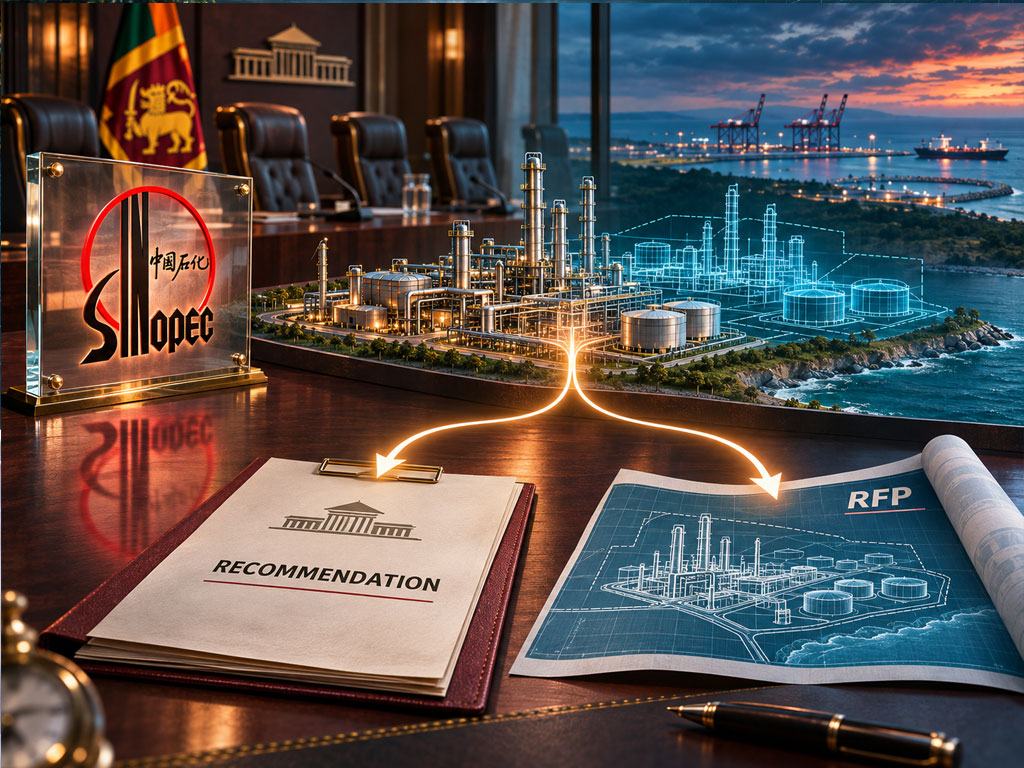
1. Discontinue the existing project approval: The committees reportedly proposed setting aside the decision associated with Cabinet approval granted on 27 November 2023 for China Petroleum & Chemical Corporation, commonly known as Sinopec, to establish an export-oriented petroleum refinery and associated product processing centre in Hambantota.
2. Initiate a new Request for Proposals: The committees reportedly recommended a fresh, competitive procurement process to attract proposals for an export-oriented refinery and related processing facilities in the Hambantota area.
The document described in the supplied account identifies B.K. Prabhath Chandrakeerthi, Professor K.T.M. Udayanga Hemapala and A.K.D.D.D. Arandara as members associated with the recommendation.
The full committee report, its signatures and the precise wording of its recommendations require confirmation against the original official document.
If adopted by the Cabinet, the recommendation could significantly alter the future of a project that has remained under negotiation despite repeated statements expressing confidence in its implementation.
Domestic Fuel Market Access Remains a Key Dispute
One of the principal disagreements surrounding the refinery has concerned the quantity of refined petroleum products Sinopec would be permitted to sell within Sri Lanka.
The project was originally structured primarily as an export-oriented development.
Under the tender framework, local sales were generally limited to 20% of the refinery’s output, with the remaining production intended for export.
Subsequent negotiations reportedly involved requests for greater access to the domestic market.
The supplied account states that Sinopec sought permission to sell as much as 40% of its refined products locally.
Such a change would carry important implications for Sri Lanka’s fuel market.
The planned refinery has been described as having a processing capacity of approximately 200,000 barrels of crude oil per day, substantially exceeding the capacity of the existing state-owned Sapugaskanda refinery.
Greater domestic-market access could intensify competition with the Ceylon Petroleum Corporation (CPC) and other fuel suppliers.
It could also affect the financial assumptions underpinning government plans to modernise domestic refining capacity.
However, competition would not automatically establish that the CPC would become financially unviable. Such a conclusion would require detailed assessment of production costs, market demand, pricing arrangements and the refinery’s proposed sales volumes.
Government officials have previously indicated that disagreements over local-market access were among the factors delaying finalisation of the project.
Reports have also differed on whether those disagreements had subsequently been resolved.
Tax Concessions Raise Fiscal Concerns
Proposed tax concessions represent another important area of negotiation.
The supplied committee account refers to a request for a 35-year corporate income tax exemption and additional tax benefits.
That specific duration has not been independently verified from an official committee document.
Earlier reporting, including statements attributed to government representatives, referred to discussions concerning a 25-year tax holiday.
The distinction matters because the fiscal consequences of a major investment depend on the precise concessions sought, the profitability of the project and the tax revenue the government might otherwise collect.
Sri Lanka’s economic reform programme has placed considerable emphasis on strengthening government revenue and maintaining greater consistency in tax policy.
Exceptional concessions granted to individual investors can therefore raise questions about fiscal fairness, competition and the country’s commitments under its programme with the International Monetary Fund.
At the same time, the economic value of a refinery project cannot be assessed solely by considering potential tax exemptions.
A comprehensive evaluation must also account for investment expenditure, employment, export earnings, technology transfer, infrastructure development and any government obligations associated with the project.
The financial implications of the concessions reportedly requested by Sinopec would require a detailed assessment before any reliable estimate of foregone revenue could be established.
Environmental and Water-Supply Questions
The proposed refinery has also raised questions concerning water availability and environmental infrastructure in Hambantota.
Large petroleum refineries require substantial quantities of water for cooling, processing and other industrial functions.
The supplied account alleges that the project negotiations encountered objections relating to environmental assessment requirements and responsibility for developing desalination infrastructure.
It further claims that Sinopec had not submitted a formal Environmental Impact Assessment (EIA) and had resisted responsibility for constructing a seawater desalination plant.
Those specific allegations require verification against the official regulatory and project records.
The absence of an EIA at a particular stage of negotiations would not, by itself, establish a breach of the law. The applicable approval stage and statutory requirements would need to be examined.
Nevertheless, any final project agreement would need to address environmental safeguards, the sustainable supply of industrial water and the potential effects on surrounding communities.
Responsibility for financing and operating essential supporting infrastructure would also have to be clearly allocated.
Such obligations are central to assessing the long-term costs and benefits of a development of this scale.
Sapugaskanda Refinery Expansion Offers an Alternative Priority
The controversy has renewed attention on the government’s plans to modernise and expand the Sapugaskanda oil refinery.
Unlike the proposed Sinopec project, Sapugaskanda is an existing state-owned facility operated by the Ceylon Petroleum Corporation.
Plans to expand its refining capacity have been presented as a means of reducing dependence on imported refined petroleum products and strengthening domestic energy security.
Greater local refining capacity could allow Sri Lanka to process a larger proportion of its petroleum requirements domestically, subject to the economics of crude oil imports, refinery operations and product demand.
Such expansion could also create opportunities to retain more value within the domestic petroleum supply chain.
However, the Sapugaskanda expansion and the Hambantota project are not necessarily direct substitutes.
Their proposed capacities, ownership structures, markets, financing arrangements and commercial purposes differ considerably.
A refinery designed primarily for export could contribute foreign exchange earnings and industrial investment, while an upgraded domestic refinery could serve different national energy objectives.
The central policy question is therefore how Sri Lanka can develop refining capacity without accepting financial or commercial conditions that undermine the wider public interest.
Does This Signal a Shift Away From China?
Claims that the reported recommendation represents a decision by Sri Lanka to abandon China as an economic partner go beyond the evidence currently available.
The Sinopec project is one proposed investment within a broader economic relationship involving trade, infrastructure and financial cooperation.
A decision to renegotiate or discontinue a particular commercial arrangement would not necessarily represent a change in Sri Lanka’s overall foreign policy.
Governments routinely reconsider major investments when proposed commercial terms, fiscal commitments or project requirements prove unacceptable.
The relevant question is whether the proposed refinery delivers sufficient economic benefit under conditions that protect Sri Lanka’s interests.
Any final decision should be assessed against the commercial and regulatory merits of the project, rather than interpreted automatically as an indication of geopolitical realignment.
Cabinet Decision Will Determine the Project’s Future
The reported committee recommendations bring the longstanding negotiations over the Hambantota refinery into sharper focus.
If the Cabinet accepts a recommendation to discontinue the existing arrangement and seek fresh proposals, the government would need to explain how the revised procurement process would be structured and what safeguards would govern future negotiations.
If discussions with Sinopec continue, clarity will be required on domestic-market access, tax concessions, environmental approvals and infrastructure responsibilities.
Either course would have implications for Sri Lanka’s investment reputation, energy strategy and fiscal position.
The government must balance the potential benefits of a major foreign investment against the need for fair competition, sustainable public finances and credible regulatory oversight.
Until an official Cabinet decision is confirmed, the project should be described as facing a reported recommendation for cancellation, rather than as an agreement that has definitively been terminated.
SOURCE:- SRI LANKA LEADER