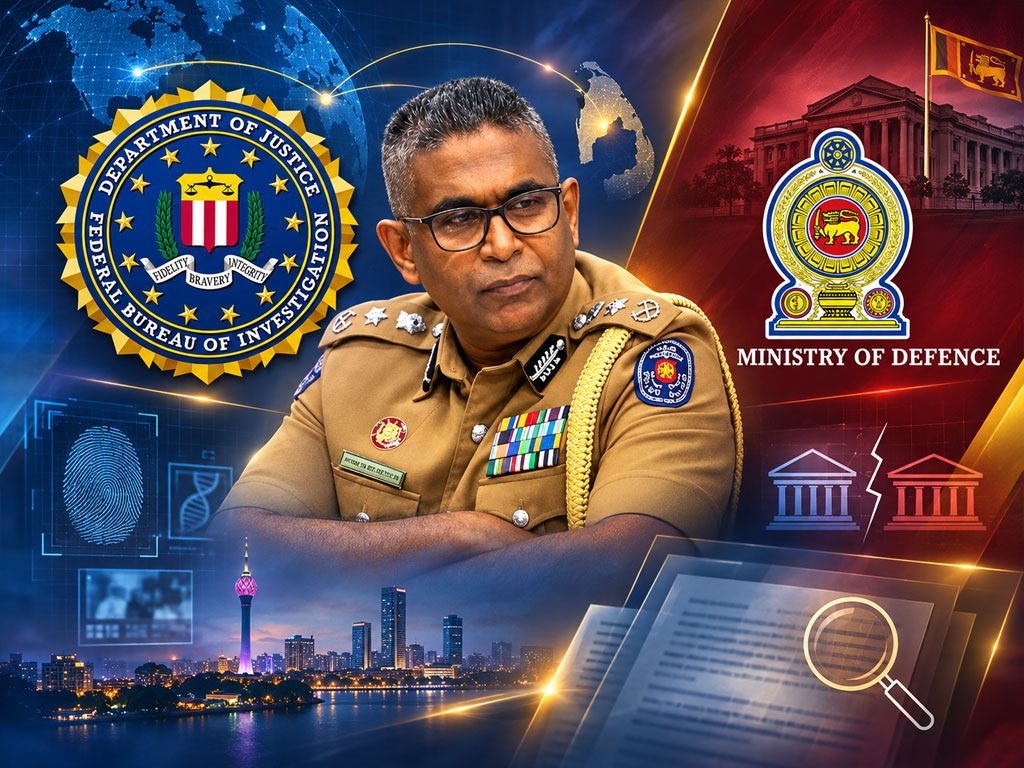
COLOMBO, Sri Lanka, November 22, 2026 — Conflicting statements from Sri Lankan authorities over the arrival of six FBI officials have raised questions about who authorised the visit, whether the required legal procedures were followed, and the extent of foreign involvement in ongoing cybercrime investigations.
FBI Visit to Sri Lanka Exposes Conflicting Official Accounts
COLOMBO — The arrival of six officials from the United States Federal Bureau of Investigation (FBI) to assist Sri Lankan authorities investigating international cybercrime operations has exposed conflicting accounts within the country’s law enforcement and administrative institutions over who requested the visit and whether the necessary authorisation was obtained.
While Sri Lanka Police confirmed that Inspector General of Police (IGP) had requested FBI assistance through the United States Embassy in Colombo, the Ministry of Public Security denied making any such request.
The Attorney General’s Department has also reportedly stated that it was neither consulted nor informed beforehand about the visiting delegation’s involvement.
The differing positions have brought the administrative and legal arrangements governing foreign law enforcement cooperation into focus, particularly as American investigators have participated in examining electronic devices seized during raids on suspected online fraud operations.
According to information released by the US Embassy, FBI personnel have worked alongside Sri Lankan investigators to examine more than 80 electronic devices connected to two active investigations into scam centres targeting American nationals.
The visit, scheduled from November 16 to 22, forms part of a broader initiative supported by the US Department of State to strengthen cooperation against transnational cybercrime.

Public Security Ministry Denies Requesting FBI Assistance
Public Security Ministry Secretary Ravi Seneviratne, responding to inquiries from The Sunday Morning, denied that his ministry had requested assistance from the FBI.
His statement appeared to contrast with information subsequently provided by Police Media Spokesman Assistant Superintendent of Police F.U. Wootler.
Wootler confirmed that the IGP had approached the US Embassy seeking FBI assistance. When specifically asked whether the request originated from the police chief, he answered in the affirmative.
The police spokesperson also confirmed that six FBI officials visited Police Headquarters and conducted a training programme for local investigating officers.
Although Sri Lanka Police operates under the administrative purview of the Ministry of Public Security, the statements reported from the two institutions do not establish whether the ministry was consulted before the request was made.
That distinction is important because requesting foreign technical assistance, authorising foreign personnel to participate in investigations, and granting access to investigative evidence may involve different administrative and legal requirements.
The US Embassy, meanwhile, maintained that the visit had been arranged at the request of Sri Lankan authorities.
Its position establishes that the American delegation was responding to a request attributed to Sri Lanka but does not, by itself, clarify which domestic approvals were obtained or under what legal arrangement the cooperation was conducted.
Attorney General’s Department Says It Was Not Consulted
The visiting FBI officials subsequently paid a courtesy call on Attorney General Parinda Ranasinghe, President’s Counsel, during which discussions reportedly lasted approximately 30 minutes.
A senior official of the Attorney General’s Department, speaking anonymously to The Sunday Morning, stated that the department had not been consulted about the FBI’s involvement before the delegation arrived.
“We were not consulted or informed about FBI involvement. We also got to know after they arrived in the country. They only paid a courtesy call,” the official said.
The official maintained that FBI personnel do not possess independent investigative jurisdiction in Sri Lanka and that their involvement must be limited to providing technical cooperation and expertise to domestic law enforcement authorities.
When questioned about whether electronic devices, digital evidence or other investigative materials would be handed over to the visiting officials, the official answered in the negative, citing jurisdictional restrictions.
Nevertheless, information subsequently released by the US Embassy confirmed that FBI and US Department of Justice (DOJ) personnel had assisted Sri Lankan officers in examining digital evidence recovered during police operations.
These accounts require an important distinction.
Assisting domestic investigators in examining evidence does not necessarily mean that foreign personnel have assumed control of the investigation or that physical custody of the evidence has been transferred to them.
The publicly available statements do not establish precisely how evidence was accessed, whether any digital copies were transferred to foreign authorities, or which arrangements governed the handling and retention of extracted information.
Legal Framework Governing Foreign Investigators in Sri Lanka
Sri Lanka’s Mutual Assistance in Criminal Matters Act No. 25 of 2002, as amended by Act No. 24 of 2018, provides a statutory framework for international cooperation in criminal investigations.
Section 4 identifies the secretary to the ministry responsible for justice as the central authority for mutual legal assistance.
Section 5 establishes procedures governing formal assistance requests, including requirements concerning notification to the central authority where qualifying requests are transmitted directly to competent institutions.
Section 13B also provides for joint investigations involving Sri Lankan and foreign investigators within the applicable statutory framework.
Separately, Section 55(1)(f) of the Proceeds of Crime Act No. 5 of 2025 permits authorised Sri Lankan investigators, subject to the required sanction, to conduct proceeds-of-crime investigations jointly with foreign law enforcement authorities or with their assistance.
These provisions demonstrate that cooperation with foreign investigators is not inherently prohibited under Sri Lankan law.
However, the existence of legal mechanisms does not automatically establish that the necessary procedures were followed in this particular engagement.
It remains unclear whether the FBI’s participation was arranged through formal mutual legal assistance procedures, a police-to-police cooperation mechanism, an authorised joint investigation or an arrangement confined to technical support and training.
The distinction is particularly relevant where investigative cooperation involves access to electronic evidence, extraction of digital information and the exchange of material potentially relevant to criminal prosecutions.
The FBI itself recognises that its personnel do not ordinarily exercise independent law enforcement powers in foreign jurisdictions and must cooperate with the authorities of the host country.
No finding of unlawful conduct by the visiting delegation or Sri Lankan officials has been established in the information presented.
More Than 1,000 Foreign Nationals Arrested in Cybercrime Investigations
The FBI visit comes as Sri Lanka confronts suspected international cybercrime networks operating from locations within the country.
According to figures disclosed by Sri Lanka Police in August 2026, 1,093 foreign nationals had been arrested during the year in connection with suspected cybercrime and financial fraud.
The corresponding figures cited for previous years were 573 arrests in 2024 and 26 in 2025.
Chinese nationals have featured prominently among those arrested, alongside individuals from India, Vietnam and other countries.
The arrest figures relate to suspected offences and should not be interpreted as convictions or evidence of guilt against every person detained.
Investigations into such operations have become increasingly important as organised online fraud networks exploit digital communication platforms, international financial systems and cross-border movements of people and money.
Similar scam-centre operations have been identified in Myanmar and Cambodia, where regional and international law enforcement agencies have pursued investigations into transnational criminal organisations.
The FBI has also cooperated with authorities across the region in efforts to identify criminal networks, trace illicit financial transactions and develop evidence capable of supporting prosecutions.
US Embassy Confirms November 16–22 FBI Mission
On November 16, the US Embassy in Colombo announced that FBI personnel from the bureau’s Charlotte Field Office would visit Sri Lanka between November 16 and 22.
According to the embassy, the delegation would assist local investigators examining suspected scam centres operating in the country.
The cooperation was intended to provide specialised expertise in digital forensics, investigative techniques and criminal case development.
American officials described the visit as the beginning of sustained engagement between the FBI and Sri Lankan law enforcement institutions.
In a statement issued through the US Embassy, US Ambassador Eric Meyer said:
“Criminal networks operating overseas are stealing billions of dollars, and we are committed to stopping them. By bringing FBI investigative expertise and advanced technology together with Sri Lankan law enforcement, we can identify victims, pursue criminals, and prevent more Americans and Sri Lankans from falling prey to these schemes.”
The embassy stated that the initiative was supported by the US Department of State in coordination with the FBI.
The stated objective was to strengthen Sri Lanka’s investigative capacity while improving international cooperation against financial fraud and other forms of cyber-enabled crime.
FBI and US Justice Department Examine Over 80 Electronic Devices
On November 20, FBI and DOJ personnel reviewed two active investigations involving suspected scam centres targeting Americans.
According to an infographic released by the US Embassy in Colombo, more than 80 electronic devices recovered during Sri Lanka Police raids were examined for digital evidence.
Three specialised Sri Lankan police units participated in the engagement:
- Computer Crime Investigation Division (CCID)
- Central Crime Investigation Bureau (CCIB)
- Technical Aid Unit (TAU)
The cooperation focused on investigative strategies, digital forensic techniques, evidence extraction and the development of criminal cases.
FBI and DOJ personnel also provided training on handling electronic evidence and assisted local officers in extracting information from devices seized during police operations.
Such technical assistance can be relevant to investigations involving encrypted communications, digital transaction records, online identities and suspected international financial fraud.
However, the information released does not specify the exact categories of devices examined, the nature of any information extracted or the arrangements governing subsequent access to that material.
Nor does it establish whether the evidence remained exclusively under Sri Lankan custody throughout the examinations.
These distinctions are important because the handling, preservation and admissibility of electronic evidence can influence subsequent criminal proceedings.
Continued FBI Cooperation Planned Beyond the Visit
The US Embassy has indicated that cooperation between the FBI and Sri Lankan law enforcement agencies will continue beyond the weeklong engagement.
According to the embassy, the participating institutions have agreed to share information, pursue investigative leads and strengthen efforts to disrupt international criminal networks.
Such cooperation could improve the ability of Sri Lankan investigators to identify suspects operating across national borders and trace victims, financial transactions and electronic communications connected to suspected online scams.
At the same time, the conflicting accounts provided by the Ministry of Public Security, Sri Lanka Police and the Attorney General’s Department leave important administrative questions unresolved.
The information presently available does not conclusively establish whether the IGP obtained the necessary administrative clearance, whether the Attorney General’s Department was required to be consulted for the particular form of assistance provided, or which legal framework governed the delegation’s access to investigative material.
Clarifying those matters would help distinguish legitimate technical cooperation from any activity requiring additional statutory authorisation.
With the FBI delegation’s scheduled visit concluding on November 22, the central issue is no longer simply why American investigators came to Sri Lanka. It is whether the country’s institutions can clearly account for the authority under which they were invited, the scope of their participation and the safeguards governing evidence obtained during joint investigative work.