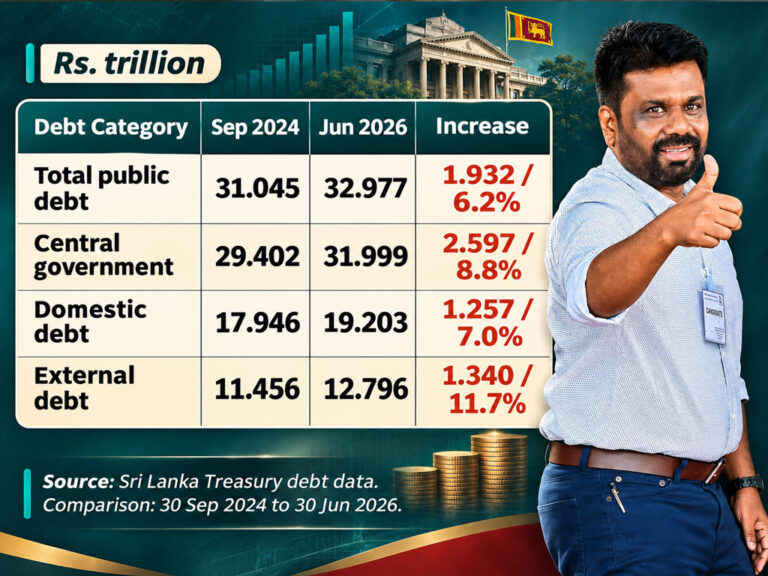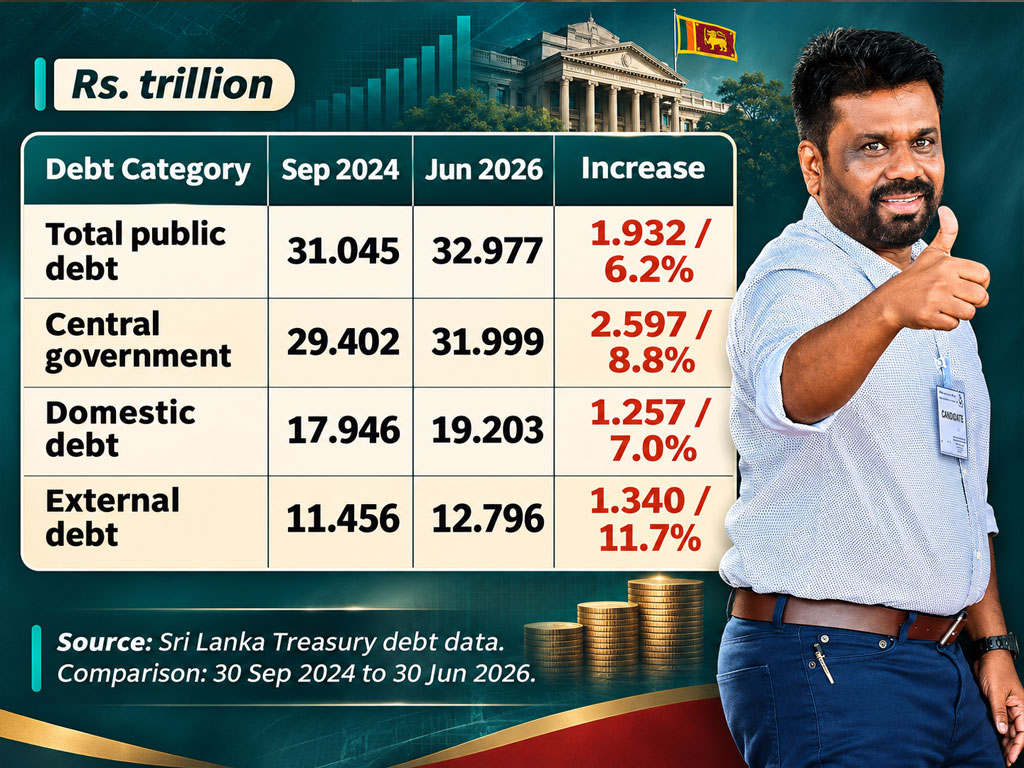
COLOMBO — Sri Lanka’s gross public debt reached Rs. 32.977 trillion by June 30, 2026, bringing renewed attention to President Anura Kumara Dissanayake’s promises of responsible financial management, economic transformation and improved living standards.
When Dissanayake assumed office in September 2024, his administration presented a programme centred on eliminating corruption, improving the management of public resources and developing a stronger production-based economy.
Nearly two years later, the country’s debt figures provide an important opportunity to assess the progress of those commitments.
Economic success cannot be measured by political speeches or favourable fiscal indicators alone. It must also be evaluated through debt sustainability, productive investment, employment opportunities, household incomes and improvements in living standards.
The government’s responsibility is not merely to demonstrate that public finances have stabilised. It must also explain how its policies are creating the conditions for sustainable economic growth.

Public Debt Increases by Rs. 1.932 Trillion
According to the figures presented for comparison, Sri Lanka’s total public debt stood at Rs. 31.045 trillion on September 30, 2024.
By June 30, 2026, gross public debt had reached Rs. 32.977 trillion.
The figures indicate:
- September 2024: Rs. 31.045 trillion
- June 2026: Rs. 32.977 trillion
- Increase: Rs. 1.932 trillion
- Percentage increase: Approximately 6.2%
The June 2026 figure is consistent with statistics published by the Public Debt Management Office of the Ministry of Finance.
However, an increase in outstanding debt does not necessarily represent an equivalent amount of new borrowing. Exchange-rate movements, debt repayments, restructuring and valuation adjustments can also influence the reported debt stock.
This distinction is essential when evaluating government performance.
Nevertheless, the reported increase raises legitimate questions about the country’s continuing debt burden and the strategy being pursued to ensure long-term sustainability.
The government should explain what contributed to the change, how its borrowing programme is being managed and whether public financing decisions are delivering measurable economic benefits.
Central Government Debt Rises by Rs. 2.597 Trillion
The comparison also indicates a substantial increase in central government debt.
Reported figures show:
- September 2024: Rs. 29.402 trillion
- June 2026: Rs. 31.999 trillion
- Increase: Rs. 2.597 trillion
- Percentage increase: Approximately 8.8%
Governments borrow for several reasons, including refinancing existing obligations, financing expenditure and supporting development.
Consequently, the size of the debt stock alone cannot establish whether borrowing has been economically beneficial or wasteful.
The more meaningful question concerns how the government’s fiscal strategy contributes to economic growth and the country’s ability to meet future obligations.
Has Sri Lanka expanded its industrial capacity?
Are exports becoming more competitive?
Is private investment generating sufficient employment?
Are government revenues improving through sustainable economic activity?
These questions require measurable evidence rather than political assurances.
An effective economic strategy should strengthen the country’s productive capacity while managing debt within sustainable limits.
Without that progress, future generations could continue to face substantial repayment obligations without enjoying corresponding improvements in economic opportunity.
Domestic Debt Reaches Rs. 19.203 Trillion
Domestic government borrowing remains an important component of Sri Lanka’s overall debt position.
The supplied comparison indicates:
- September 2024: Rs. 17.946 trillion
- June 2026: Rs. 19.203 trillion
- Increase: Rs. 1.257 trillion
- Percentage increase: Approximately 7.0%
Domestic borrowing allows the government to raise financing through instruments such as Treasury bills and Treasury bonds.
However, excessive reliance on domestic financial markets can create challenges.
Government borrowing requirements may influence interest rates, financial-market liquidity and the availability of credit to private enterprises.
Where government demand for financing is substantial, businesses may face higher borrowing costs or greater difficulty obtaining the funds needed for investment.
This potential effect, commonly known as the crowding-out of private investment, depends on broader financial and monetary conditions.
It is not an automatic consequence of government borrowing.
Nevertheless, policymakers must ensure that public financing requirements do not unnecessarily restrict the private-sector investment essential for industrial growth, employment and innovation.
The government should therefore explain how it intends to balance domestic borrowing with the financing needs of businesses and entrepreneurs.
Foreign Debt Increases to Rs. 12.796 Trillion
Sri Lanka’s foreign debt presents a particularly important challenge because repayment obligations depend heavily on the country’s ability to earn foreign exchange.
The reported figures show:
- September 2024: Rs. 11.456 trillion
- June 2026: Rs. 12.796 trillion
- Increase: Rs. 1.340 trillion
- Percentage increase: Approximately 11.7%
Foreign debt must be assessed carefully when expressed in Sri Lankan rupees.
Currency depreciation can increase the rupee value of outstanding foreign obligations without an equivalent increase in borrowing.
A comprehensive assessment must therefore consider foreign-currency debt values, repayment schedules, interest costs and the adequacy of foreign exchange reserves.
Sri Lanka’s financial crisis in 2022 demonstrated the consequences of inadequate external financing and unsustainable debt obligations.
Avoiding another crisis requires a sustained improvement in export earnings, foreign investment, tourism revenue, remittances and other sources of foreign exchange.
Debt restructuring and repayment extensions can provide temporary relief, but they cannot substitute for a productive economy capable of generating the resources needed to meet future obligations.
The administration must demonstrate how its policies are strengthening that capacity.
Seven Questions the Government Must Answer
The reported debt figures raise several questions that President Dissanayake, the Ministry of Finance and the country’s economic policymakers should address.
1. What caused the increase in public debt? How much resulted from new borrowing, exchange-rate movements, refinancing, repayments and other adjustments?
2. How have borrowed funds been used? What proportion supported productive investment, essential public expenditure or the refinancing of existing obligations?
3. What measurable economic benefits have been achieved? How have fiscal policies contributed to industrial development, exports, employment and private investment?
4. What are the country’s future repayment obligations? How much must be allocated to interest payments and debt repayments over the coming years?
5. How will domestic borrowing be controlled? What measures will protect the availability of financing for private businesses?
6. How will foreign exchange earnings increase? What specific policies and targets have been established to improve exports, investment and other external revenue sources?
7. What is the timetable for debt sustainability? Which measurable indicators will demonstrate progress, and how regularly will the results be published?
These are questions of public accountability.
They do not presume that all borrowing is economically harmful or that rising debt automatically demonstrates government failure.
They seek evidence that public resources are being managed effectively and that financial decisions support the country’s long-term interests.
Economic Stabilisation Is Only the Beginning
President Dissanayake’s administration has emphasised progress in stabilising Sri Lanka’s economy.
However, the foundations of economic stabilisation were established before the present government assumed office.
Following the 2022 economic crisis, Sri Lanka entered an International Monetary Fund-supported reform programme and began restructuring its debt obligations.
The current administration has continued implementing important elements of those reforms.
Improved revenue collection and stronger fiscal performance are meaningful achievements.
Nevertheless, stabilisation should be regarded as the foundation for economic transformation, not its final objective.
The more difficult challenge is to create an economy that produces more, exports more, attracts sustainable investment and generates better employment opportunities.
Maintaining fiscal discipline is essential, but the quality of government expenditure is equally important.
Reducing unnecessary expenditure can strengthen public finances.
However, delays in essential infrastructure development and productive investment can weaken future growth prospects.
An effective government must balance fiscal consolidation with the investments necessary to expand economic capacity.
IMF Findings Highlight the Investment Challenge
The International Monetary Fund’s assessment of Sri Lanka’s 2025 fiscal performance illustrates this challenge.
Sri Lanka recorded a primary fiscal surplus of approximately 5.4% of gross domestic product, substantially exceeding the programme target of 2.3%.
According to the IMF, the stronger-than-expected performance reflected increased revenue collection, including motor vehicle-related receipts and domestic VAT revenue, together with lower-than-planned capital expenditure.
Exceeding fiscal targets is an important achievement.
Nevertheless, the contribution of under-executed capital expenditure raises questions about whether the country’s development programme is being implemented efficiently.
A government cannot rely indefinitely on expenditure restraint to establish the conditions for sustained economic growth.
Productive public investment, carefully selected infrastructure projects and improved implementation capacity are also necessary.
The objective should be to maintain fiscal discipline while ensuring that spending priorities strengthen the country’s long-term economic prospects.
Rising Debt Does Not Automatically Mean Economic Failure
A country’s financial position cannot be assessed solely through the nominal value of its debt.
Debt sustainability depends on several factors, including economic growth, government revenue, interest costs, repayment schedules and access to financing.
A growing economy may be able to sustain a larger nominal debt stock if its capacity to generate income and meet obligations improves sufficiently.
For this reason, the debt-to-GDP ratio is an important indicator alongside the absolute debt stock.
The IMF-supported restructuring framework includes targets intended to reduce Sri Lanka’s debt burden and future financing requirements.
These include bringing public debt below 95% of GDP by 2032 and maintaining specified limits on government financing needs and foreign-currency debt servicing.
The administration’s economic performance should be assessed against those targets and the broader improvements expected in the productive economy.
Fiscal stability and economic development must progress together.
People Need Better Living Standards, Not Just Better Statistics
For ordinary Sri Lankans, economic recovery is ultimately measured through everyday life.
Families need incomes that can withstand the cost of living.
Young people need sustainable employment opportunities.
Entrepreneurs require affordable financing and confidence to invest.
Farmers need fair returns, reliable markets and greater economic security.
Businesses need predictable policies and an environment that supports growth.
These are the practical outcomes against which the government’s economic promises should be judged.
President Dissanayake’s administration must demonstrate not only that fiscal indicators are improving, but also that those improvements are contributing to greater economic opportunity.
The public has a legitimate right to question how borrowed funds are used, whether expenditure priorities are appropriate and what results government policies have achieved.
Such scrutiny is a fundamental part of democratic accountability.
Concerns about future counterterrorism or national security legislation should likewise be addressed through careful legal examination, with particular attention to protecting peaceful political criticism and freedom of expression.
Questioning government economic policy is not inherently anti-government. It is a legitimate exercise of democratic rights.
Where Are the Measurable Results?
Sri Lanka’s public debt figures should encourage a serious examination of economic policy rather than another exchange of political accusations.
The government can reasonably point to improvements in fiscal management and progress under the economic reform programme.
Its critics can equally demand evidence that those achievements are producing stronger industries, better employment opportunities, increased investment and sustainable improvements in household incomes.
Both considerations are necessary for a fair assessment.
President Dissanayake’s promises of responsible financial management and a production-based economy must ultimately be judged against measurable results.
The administration should publish clear explanations of debt movements, disclose its borrowing priorities and establish transparent benchmarks for economic progress.
It should also provide a credible timetable showing how the country’s financial position and the living standards of its people are expected to improve.
Sri Lanka cannot achieve lasting prosperity through fiscal indicators alone.
Financial stability must lead to productive growth and tangible improvements in people’s lives.
The question facing the government is straightforward: how will its promises of responsible debt management and economic transformation become results that ordinary Sri Lankans can see and measure?