The former Health Minister says key procurement records do not match his movements and points to decisions made beyond the Health Ministry. But the CID did question Ranil Wickremesinghe. The crucial issue is now what investigators established about the wider chain of approvals, coordination and accountability.
Defence Arguments Bring the Procurement Process Under Renewed Scrutiny
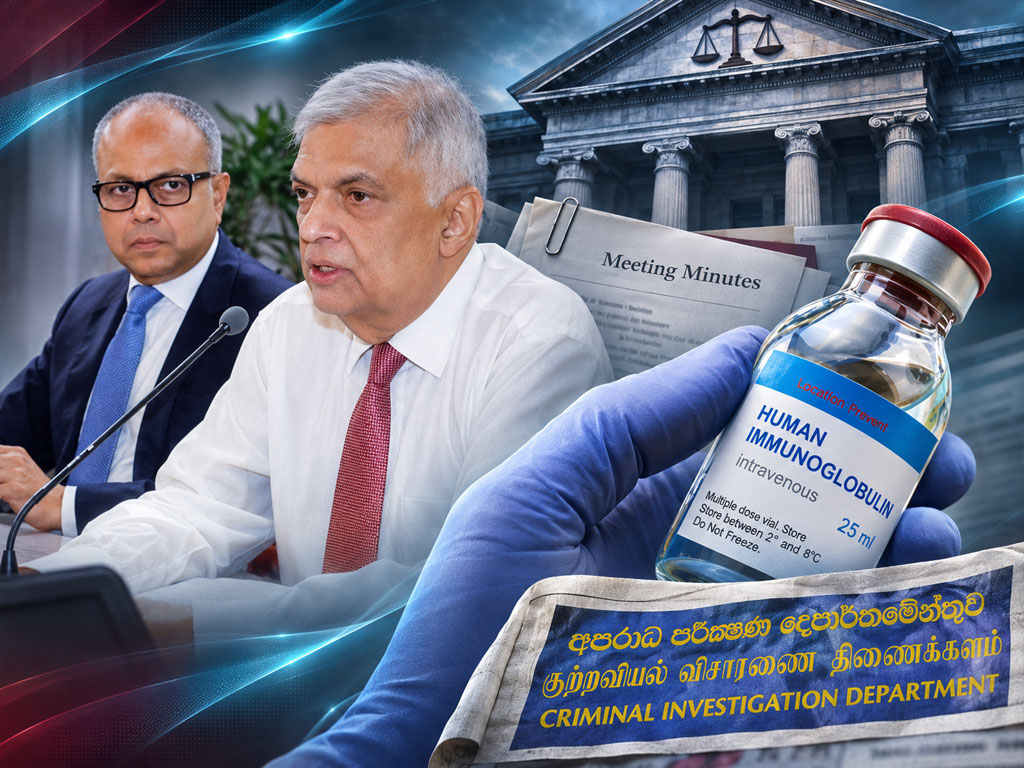
The controversial Human Immunoglobulin procurement case has entered a crucial stage following statements made before the Colombo Permanent Three-Judge High Court by former Health Minister Keheliya Rambukwella, the eighth accused in the proceedings.
His defence has raised questions about disputed Health Ministry meeting records, the origins of emergency procurement guidelines and the roles played by officials outside the ministry.
Particular attention has fallen on decisions involving the Ministry of Finance and alleged coordination through the Presidential Secretariat during the period when Ranil Wickremesinghe held the Finance portfolio.
The proceedings concern allegations of fraudulent procurement and the supply of substances that were not the medicines they were represented to be.
According to reporting on the prosecution, the case involves 12 accused facing charges connected to the alleged misappropriation of approximately Rs. 144.4 million in state funds.
Rambukwella’s statements constitute arguments advanced in his defence. They are not findings by the court, and their evidentiary significance remains subject to judicial assessment.

Disputed Meeting Minutes and Questions About the Minister’s Whereabouts
One of the central arguments presented in the defence concerns records of Health Ministry meetings allegedly conducted under Rambukwella’s chairmanship during 2022.
He has challenged the accuracy of those records, maintaining that his whereabouts on the relevant dates were inconsistent with his purported attendance.
Two dates have attracted particular attention.
September 5, 2022: The Bhutan Conference
The defence maintains that Rambukwella was attending the World Health Organization’s 75th South-East Asia Regional Committee meeting in Bhutan when one of the disputed meetings was reportedly held.
WHO records confirm that the regional meeting took place in Paro, Bhutan, from September 5 to 9, 2022.
The defence refers to passport records, immigration stamps, photographs and official conference documentation in support of its position.
However, the court must determine what those materials establish about Rambukwella’s precise whereabouts and whether the disputed minutes accurately record the meeting and its participants.
October 10, 2022: The Katunayake Pharmaceutical Plant Opening
A second disputed meeting is said to have been recorded on October 10, 2022.
On that date, President Ranil Wickremesinghe attended the opening of a pharmaceutical manufacturing facility operated by Yaden Laboratories in Katunayake.
Contemporaneous reporting also places Rambukwella at the ceremony.
The defence has reportedly referred to photographic evidence, official records and mobile phone location information when challenging the meeting minutes.
Those circumstances raise a legitimate evidentiary question: do the records accurately reflect who attended the relevant Health Ministry discussions, and at what time?
An inconsistency between a recorded meeting and an official’s whereabouts does not automatically establish deliberate fabrication. That conclusion would require further evidence concerning the preparation, circulation and authentication of the documents.
Who Prepared the Procurement Records?
The disputed minutes matter because meeting records can help establish how procurement decisions were initiated, discussed and approved.
If their accuracy is challenged, investigators and the court must consider the original documents, their authorship, the circumstances of their preparation and any subsequent amendments.
The defence has questioned whether sufficient attention was given to identifying those responsible for creating the disputed records.
A proper examination would distinguish between administrative errors, inaccurate recording of attendance and any deliberate falsification.
These are materially different possibilities, carrying different implications for the individuals concerned.
Until the court has assessed the evidence, describing the records as definitively fabricated would be premature.
The Cabinet Paper and Ranil Wickremesinghe’s Role
The defence has also challenged the account of how the emergency procurement process received Cabinet approval.
Rambukwella reportedly maintained that the Health Ministry initially sought an extension of procurement arrangements introduced during the COVID-19 period.
According to the defence’s account, that approach was not accepted, and new emergency procurement guidelines were subsequently proposed following observations from the Ministry of Finance.
He has further asserted that the Cabinet paper associated with the controversial procurement process was submitted by Wickremesinghe, who was serving as Finance Minister and Prime Minister during the relevant period.
This claim was reported following Rambukwella’s statement to the High Court in early November 2026.
It must be considered alongside earlier investigative accounts describing Cabinet memoranda submitted by the then Health Minister.
The court will need to evaluate the relevant documents and distinguish responsibility for proposing guidelines, submitting particular Cabinet papers and implementing individual procurement decisions.
These administrative functions are related but are not necessarily interchangeable.
Sagala Ratnayake’s Alleged Coordination Role
Another aspect raised in the supplied account concerns Sagala Ratnayake, who served as Chief of Presidential Staff.
The defence reportedly referred to correspondence and administrative notes suggesting his involvement in coordinating or following up on progress reviews connected to emergency procurement.
It also referred to communications allegedly forwarded to senior officials within the Presidential Secretariat.
Those claims require examination of the underlying correspondence, including the dates, recipients and subjects of the documents.
Administrative involvement in monitoring a procurement programme does not, by itself, establish responsibility for an unlawful purchase.
The relevant question is what decisions, if any, individual officials made and whether those decisions had a demonstrable connection to the transactions under prosecution.
No finding of criminal wrongdoing against Wickremesinghe or Ratnayake arises merely from their being mentioned in an accused person’s defence.
Did the CID Examine the Wider Decision-Making Process?
The argument that investigators failed to consider the role of Wickremesinghe requires an important qualification.
The Criminal Investigation Department questioned the former President in June 2025 in connection with Cabinet papers relating to Human Immunoglobulin procurement.
That questioning demonstrates that investigators did not entirely exclude him from their inquiries.
Nevertheless, his questioning does not necessarily resolve every issue concerning the wider administrative process.
It remains reasonable to ask whether investigators examined all relevant correspondence between the Health Ministry, Finance Ministry and Presidential Secretariat, and whether the resulting evidence adequately established the responsibilities of individual decision-makers.
The defence’s questions therefore concern the scope and conclusions of the investigation, rather than the unsupported suggestion that no inquiry involving Wickremesinghe took place.
Accountability Must Follow the Evidence
The High Court proceedings have reached the submissions stage following the conclusion of evidence in early November.
Written submissions are scheduled for November 25, with oral submissions expected on November 30.
The defendants remain entitled to the presumption of innocence in the criminal proceedings, and the court must determine the case according to admissible evidence and the applicable law.
The public interest extends beyond the reputations of individual politicians.
The procurement of medicines involves public money, administrative accountability and the safety of patients who rely on the national health system.
It is therefore essential that disputed records are examined carefully and that responsibility is established through evidence rather than political assumptions.
If official documents reveal genuine gaps in the investigation, those questions deserve proper consideration.
Equally, if the prosecution’s evidence satisfactorily explains the disputed meetings and procurement decisions, the court must assess that explanation on its merits.
The integrity of the process depends on following the documentary and financial trail wherever it leads, without presuming either guilt or innocence from a person’s political position.
Only a complete and impartial assessment can establish how the emergency procurement decisions were made, who exercised the relevant authority and where legal responsibility ultimately rests.