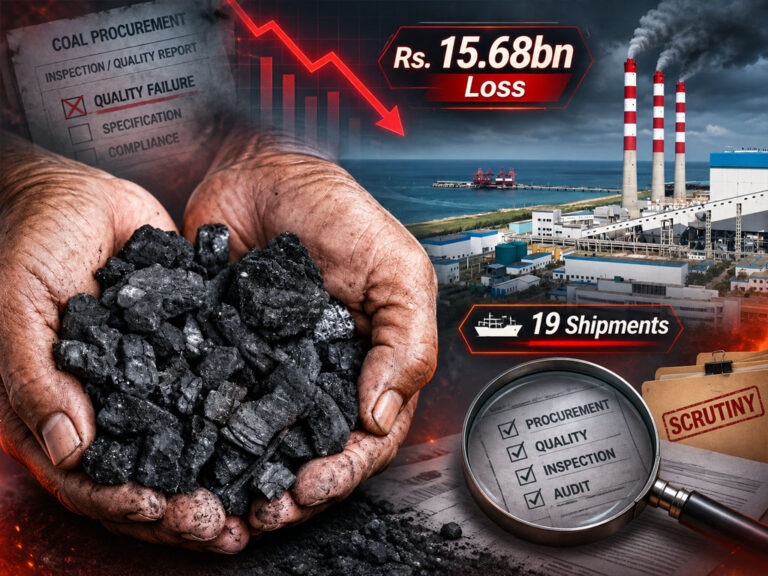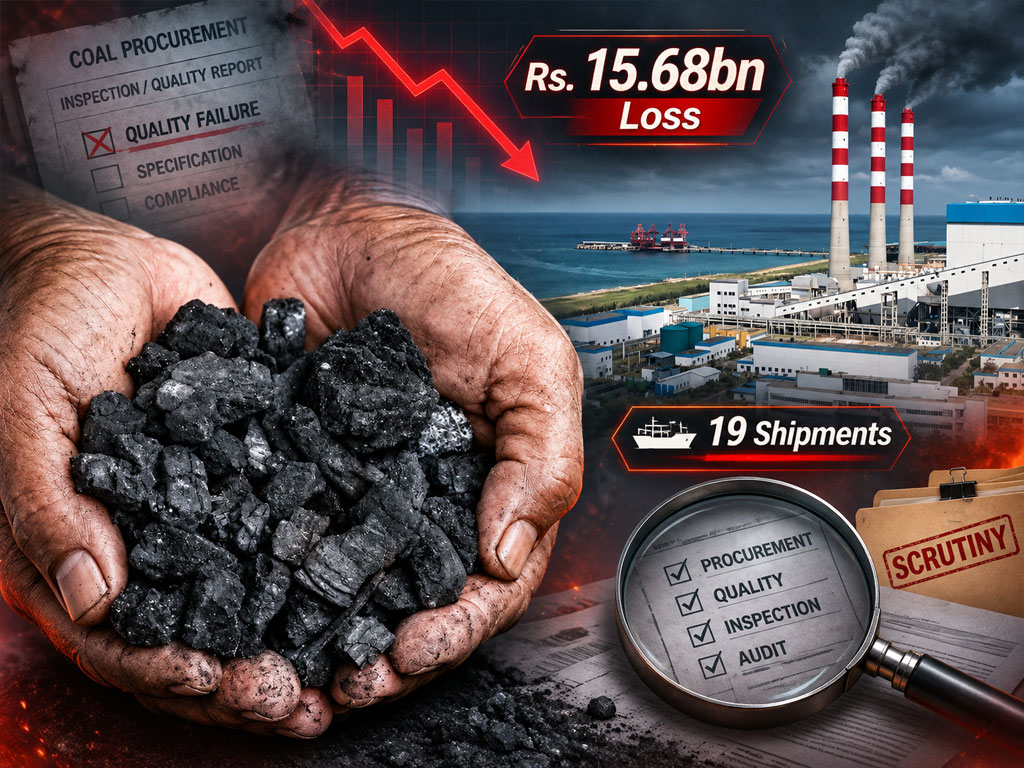
COLOMBO, November 13, 2026 – Sri Lanka’s controversial coal imports have been linked to an estimated Rs. 15.68 billion in financial losses, with 19 substandard shipments, disputed tender decisions and costly emergency power purchases exposing serious weaknesses in the country’s energy procurement system.
A financial assessment of substandard coal supplied to the Lakvijaya Power Plant in Norochcholai has placed the reported direct economic impact at Rs. 15.681 billion, intensifying scrutiny of the procurement decisions, contractual safeguards and quality controls governing Sri Lanka’s electricity generation.
The assessment, described in the information supplied as having been prepared with input from the Ministry of Energy, the Public Utilities Commission of Sri Lanka (PUCSL), Lanka Coal Company and senior officials at the Lakvijaya Power Plant, identifies losses associated with additional coal consumption, reduced generating capacity and the purchase of replacement electricity.
The financial impact is linked to 19 shipments supplied under the controversial 2025/2026 coal procurement arrangement awarded to Trident Chemphar Ltd.
Separate findings by the Auditor General and independent laboratory testing have documented significant deficiencies in procurement and coal quality, although the precise total financial loss remains subject to reconciliation.
Allegations concerning the conduct of officials, the involvement of intermediaries and possible deliberate manipulation of the procurement process require further investigation. The existence of irregularities does not, by itself, establish criminal wrongdoing by any individual or company.

Rs. 15.681 Billion in Reported Financial Losses
According to the financial figures contained in the assessment cited in the original report, the reported losses include emergency electricity purchases, increased coal consumption, additional maintenance expenditure and excess ash disposal.
The principal amounts are presented as follows:
- Emergency electricity purchases – Rs. 8.572 billion (Rs. 8,572,510,000): Additional expenditure attributed to purchasing electricity from other sources when the Lakvijaya Power Plant could not generate its expected output using the coal supplied.
- Additional coal consumption – Rs. 7.099 billion (Rs. 7,099,432,713.45): The estimated cost of burning greater quantities of coal to produce an equivalent amount of electricity because the delivered fuel had a lower calorific value than required.
- Additional maintenance and ash disposal – Rs. 93.5 million: The assessment identifies Rs. 80.4 million in additional maintenance costs associated with equipment affected by coal quality, together with Rs. 13.1 million for handling and disposing of excess ash.
- Reduced electricity generation – 197,673.21 megawatt-hours: The assessment attributes this quantity of lost generation to the plant’s reduced operational performance during the period described as January to September 15, 2026.
The supplied report gives a headline financial loss of Rs. 15,681,292,713.
However, the figures require clarification before being treated as a final audited total. Adding the emergency electricity purchases, additional coal consumption and separately stated maintenance and ash-disposal costs produces a different aggregate.
The report also identifies an operational-cost subtotal of approximately Rs. 7.108 billion, which requires reconciliation with the individual amounts.
The discrepancy does not invalidate the documented concerns over substandard coal, but it makes the precise loss calculation an important matter for further examination.
Procurement Delays and Tender Irregularities
The controversy originated in the procurement programme for coal required during the 2025/2026 operating season.
The original account identifies several decisions that, taken together, allegedly delayed purchases, weakened procurement safeguards and exposed the country to higher costs.
Procurement Plan Rejected in March 2025
According to the allegations, the subject Minister rejected a procurement plan submitted by Lanka Coal Company in March 2025.
The rejection is alleged to have delayed the commencement of the tender process and contributed to difficulties obtaining coal within the required delivery period.
Whether the decision was justified by legitimate procurement concerns or unnecessarily restricted the available purchasing window remains a matter requiring documentary examination.
Tender Period Reduced from 42 Days
In August 2025, Lanka Coal Company proceeded with tender LCC/25/TT/1 for approximately 1.5 million metric tonnes of coal.
The original report alleges that the stipulated bidding period was reduced from 42 days to 21 days before being extended to 28 days following questions raised in Parliament.
Such changes warrant examination because the length of a bidding period can influence supplier participation, preparation of technical documents and the ability of competing companies to submit qualifying offers.
The shortened timetable is alleged to have disadvantaged the procurement process.
A complete assessment would need to establish who authorised the changes, the reasons recorded for doing so and whether applicable procurement requirements were satisfied.
Tender Awarded to Trident Chemphar Despite Registration Concerns
The contract was subsequently awarded to Trident Chemphar Ltd.
The Auditor General’s special audit of the 2025/2026 coal procurement process identified shortcomings concerning the supplier’s registration status and compliance with procurement requirements.
The audit reported that the company had been selected despite not completing the required registration procedures by the relevant stage of procurement.
The original allegations also question whether the supplier had paid the necessary deposits and possessed sufficient previous experience supplying coal meeting the specified calorific standards.
These concerns are significant because supplier qualification requirements are intended to protect public institutions against delivery failures, financial exposure and non-compliance with contractual specifications.
The audit separately identified shortcomings in the process surrounding the contract’s legal clearance.
According to parliamentary reporting of the audit, the agreement was signed on November 19, 2025, before the Attorney General’s approval was due on November 20.
These findings establish grounds for examining the procurement process. Determining whether particular decisions were deliberate misconduct, negligence or administrative failures requires further evidence.
Russian Visit and Cancellation of Additional Coal Supply
The original investigation also identifies a series of events during October 2025 involving alternative coal supply arrangements.
It alleges that the Energy Minister travelled to Russia and met representatives of SUEK on October 15 without obtaining the necessary prior approval.
The account further states that an additional supply option under an existing arrangement with Potencia LLC-FZ was suspended on October 24.
That arrangement reportedly allowed for an additional 10% of coal supplies under the existing agreement.
The decision to discontinue or suspend the additional supply option is alleged to have further restricted the country’s available procurement alternatives.
Whether the Russian discussions influenced the decision, or whether the decisions were connected, has not been independently established from the material reviewed.
The circumstances nevertheless warrant examination against the procurement records, contractual conditions and correspondence between the relevant institutions.
Questions Over Financial Intermediaries
The original account also alleges that Letters of Credit were arranged without adequate financial due diligence.
Two individuals are identified in the allegations as intermediaries:
- Saratchandra Reddy, described as a foreign intermediary.
- Sanath Bandara Jayasundara, described as a local intermediary.
The source accuses the two individuals of fraudulent conduct.
Those accusations have not been independently substantiated by the records reviewed for this article and must not be treated as findings of wrongdoing.
The relevant issue for investigators is whether the financial arrangements complied with applicable banking, procurement and contractual requirements, and whether the parties involved had been appropriately verified.
First Shipment Arrived Late as Coal Quality Concerns Emerged
The original procurement schedule anticipated coal deliveries beginning in the final months of 2025.
However, the first Trident shipment arrived on December 31, 2025, later than originally planned.
Quality concerns emerged from the initial consignments.
The agreement provided mechanisms for testing coal and imposing contractual remedies where shipments failed to meet the specified standards.
According to the original allegations, authorities had an opportunity to terminate the supply arrangement after two consecutive shipments failed the relevant quality requirements.
The contract nevertheless continued.
A total of 19 shipments, amounting to approximately 1.14 million metric tonnes, were ultimately received under the arrangement.
The reasons for continuing to accept deliveries despite concerns over quality and performance are central to the controversy.
The government and procurement authorities were also required to consider the operational consequences of cancelling supplies without securing adequate replacement coal.
A determination of whether the agreement should have been terminated therefore requires examination of the actual contract provisions, laboratory results, delivery schedules and decisions recorded by the responsible officials.
Independent Laboratory Tests Found Coal Below Required Standards
One of the strongest elements of the controversy concerns independent testing undertaken by Bureau Veritas.
The original procurement specifications identified coal with a gross calorific value within a defined range, including a minimum rejection threshold of 5,900 kilocalories per kilogram.
Independent test results reported by Bureau Veritas indicated that the coal supplied under the 19 consignments fell below that threshold.
The reported calorific values ranged from 4,762 to 5,426 kcal/kg.
The original account identifies two examples:
- MV Conan: 4,762 kcal/kg.
- MV Ultra Confidence: 4,858 kcal/kg.
These results indicate substantially lower energy content than the minimum specified in the procurement conditions.
Lower-calorific-value coal generally requires a greater quantity of fuel to generate the same electrical output.
It can also affect boiler performance, ash production and the efficiency of other plant systems, depending on the coal’s composition and the operating conditions.
The significance of the Bureau Veritas results is strengthened by the fact that they were obtained independently of the supplier’s original testing arrangements.
Earlier reporting documented discrepancies between laboratory results provided through different testing arrangements, prompting parliamentary scrutiny and demands for additional independent verification.
Lakvijaya Machinery Breakdowns Add to Financial Concerns
The original report links the use of inferior coal to operational difficulties at the Lakvijaya Power Plant.
It states that the first generating unit suffered a breakdown on October 17, 2026, followed by problems affecting the second unit.
The report attributes these failures to the use of substandard coal.
However, the material reviewed does not establish a definitive engineering finding that the coal directly caused either breakdown.
A conclusive assessment would require technical reports examining equipment condition, boiler performance, operating records, maintenance history and the quality of fuel consumed before the failures.
The original investigation states that the economic consequences of the October breakdowns have not yet been fully quantified.
If additional generation was lost because of equipment damage associated with the coal supplied, the resulting costs could extend beyond those already included in the financial assessment.
Emergency Coal Purchases Created Further Exposure
The government also sought additional coal through emergency procurement arrangements.
According to the original account, five supplementary shipments amounting to approximately 300,000 metric tonnes were arranged at US$142 per tonne.
That price was substantially higher than the US$98.50 per tonne stated for the original contract.
The difference amounted to US$43.50 per metric tonne before accounting for other contractual conditions or costs.
The source further alleges that the emergency coal supplies also encountered quality problems, with one shipment rejected entirely.
Contemporary reporting confirms that emergency procurement faced disputes over coal specifications and that officials examined legal and technical options concerning cargoes with excessive ash content.
The precise financial consequences of the emergency purchases remain dependent on the final quantities delivered, accepted, rejected and paid for.
Those costs must also be distinguished from the operational losses resulting from the original Trident contract to avoid double-counting.
Additional Costs Beyond the Direct Financial Assessment
The report argues that the direct financial calculation does not capture every economic consequence of the procurement failures.
It identifies a further estimated opportunity cost of Rs. 2.2 billion associated with increased use of hydroelectric water resources to compensate for reduced coal-fired generation.
Greater reliance on hydroelectric generation during periods of coal shortages can affect the water resources available for later electricity production.
The source also refers to additional costs arising from emergency diesel-based power generation.
Those costs would depend on the quantity of replacement electricity generated, fuel prices, plant operating costs and any subsidies applied during the period.
The report therefore suggests that the wider economic impact could exceed the headline direct loss.
However, the additional estimates require verification and must be assessed carefully to prevent the same expenditure from being counted under multiple categories.
Attempts to Recover More Than US$54 Million
The original investigation states that authorities are seeking to recover approximately US$54.686 million, described as equivalent to Rs. 18.116 billion, through penalties and contractual financial safeguards.
The individual amounts provided are:
- Penalties: US$36,496,000.
- Security deposits: US$14,446,000.
- Deposits proposed to be retained in the future: US$3,440,000.
These three figures total US$54.382 million, rather than US$54.686 million.
The difference requires reconciliation with the official recovery schedule.
The report also states that US$39,911,101, comprising penalties and outstanding payments, has been withheld or suspended.
That amount is described as 35.90% of a total contract value payable to the supplier of US$111,155,576.
The stated percentage is broadly consistent with those two figures.
Nevertheless, withheld payments, security deposits, penalties assessed and money actually recovered are not interchangeable.
Each category has different financial and legal implications.
Confirmation is therefore required of the sums formally imposed, amounts already secured, any disputed penalties and the funds ultimately recovered by the state.
Who Will Be Held Accountable?
The procurement controversy has exposed weaknesses extending beyond the quality of individual coal shipments.
The available audit findings and reported technical assessments identify concerns involving supplier eligibility, tender administration, delivery schedules, independent testing and the operational consequences of accepting fuel below contractual requirements.
The source also raises allegations concerning ministerial decisions, intermediaries and financial oversight.
Those allegations require evidence-based investigation, including examination of official records and the opportunity for all parties concerned to respond.
Trident Chemphar’s contractual obligations, the decisions taken by Lanka Coal Company, the responsibilities of officials overseeing procurement and the adequacy of safeguards against further financial losses all warrant scrutiny.
The immediate priority is to establish an accurate and independently verified account of the total financial impact, recover any amounts lawfully due and determine whether procurement rules were breached through negligence, misconduct or decisions made under genuine supply constraints.
Sri Lanka’s electricity consumers ultimately bear the financial consequences when essential fuel procurement fails.
The findings already documented by the Auditor General and independent testing laboratories provide substantial grounds for further investigation.
What remains unresolved is whether the authorities will establish responsibility for the decisions that allowed the controversy to develop, recover the losses that can be legally recovered and introduce safeguards capable of preventing similar failures in future coal procurement.