COLOMBO, November 20, 2026 — Sri Lanka’s Budget 2027 promises investment, tax relief and economic growth, but rising living costs, slow capital spending and uncertainty over future IMF support reveal deeper challenges beneath the headline figures.
Sri Lanka’s 2027 Budget presents an ambitious programme of public investment, tax relief and economic growth, but beneath its headline figures lies a more troubling question: has the country’s economic recovery genuinely improved the lives of ordinary people, or has financial stability merely concealed a gradual deterioration in household living standards?
President Anura Kumara Dissanayake presented the Budget to Parliament on November 12, setting out the government’s economic priorities for the coming year. With the parliamentary debate now underway, this week’s Kivinda Dakma examines what the figures reveal about the direction of the economy.
This is the administration’s third Budget. Having already presented two, it has reached a point at which its economic performance must increasingly be judged against its own policies, decisions and results.
The presidential and parliamentary electoral cycles are expected to bring the government before voters again in 2029. In practical political terms, the current Budget therefore provides an important opportunity to assess the administration’s progress.
The first two Budgets offered the government an opportunity to demonstrate how its election promises would be translated into policy. By the third, however, explanations based primarily on the failures of previous administrations become less convincing.
Responsibility for revenue collection, public expenditure, investment decisions, administrative efficiency and economic policy now rests substantially with the present leadership.
The appropriate measure of success is no longer simply what the government intends to accomplish, but what it has achieved after two years in office.

A Budget Attempting to Balance Competing Priorities
In my assessment, the 2027 Budget is a mixed exercise.
On one side, the government is attempting to remain within the fiscal discipline established under Sri Lanka’s agreement with the International Monetary Fund. On another, it seeks to demonstrate that relief is being provided to households facing persistent financial difficulties.
At the same time, it promises increased public investment intended to stimulate production and accelerate economic growth.
These objectives are not necessarily incompatible, but achieving them simultaneously requires considerable financial and administrative discipline.
The Budget estimates revenue and grants of approximately Rs. 6,180 billion against expenditure of Rs. 7,673 billion, producing a projected deficit of Rs. 1,493 billion.
Additional proposed expenditure for disaster reconstruction would increase total spending to Rs. 7,933 billion and widen the deficit to approximately Rs. 1,753 billion.
Public investment, including supplementary reconstruction expenditure, is expected to approach Rs. 2 trillion.
These are substantial financial commitments. Whether they produce meaningful economic benefits will depend on the quality of the projects selected and the government’s ability to implement them.
Public Investment Must Deliver Measurable Returns
There are positive elements in the Budget that deserve recognition.
Investment in roads, railways, rural connectivity, transport infrastructure and other productive assets can strengthen the economy if projects are properly selected and efficiently executed.
Provisions for healthcare, education, social protection and public-sector remuneration may also provide relief to households and improve essential services.
The government has proposed revisions to personal income tax, including an increase in the annual tax-free threshold from Rs. 1.8 million to Rs. 1.95 million, effective from April 2027.
Such measures can improve disposable income for qualifying taxpayers, although their benefits must be considered alongside inflation and the broader cost of living.
Public investment, however, cannot be assessed merely by the amount allocated.
Projects must be evaluated according to their economic justification, expected returns, implementation costs and long-term benefits.
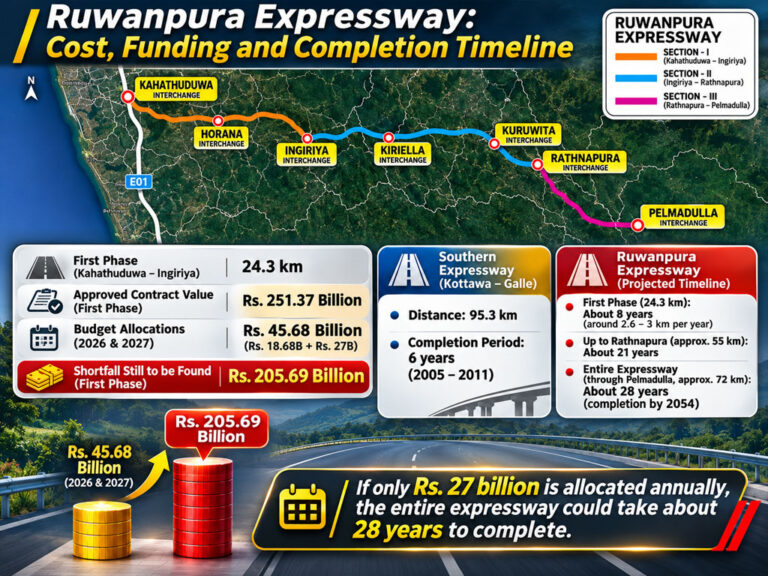
The Ruwanpura Expressway offers an example of the questions that should accompany major infrastructure spending.
Concerns have previously been raised over aspects of its original planning and economic viability. Those concerns deserve renewed examination before substantial additional public resources are committed.
In my view, any feasibility studies and technical assessments available within the President’s Office and Ministry of Finance concerning this and other previously proposed projects should be reviewed.
An infrastructure project should proceed because it offers demonstrable economic value, not simply because successive governments have repeatedly included it in their development programmes.
There is also a serious difference between allocating money and spending it effectively.
Sri Lanka has a history of announcing ambitious capital expenditure programmes only to record considerably lower implementation rates by the end of the financial year.
Reports indicate that less than 30% of the capital expenditure allocated for 2026 had been utilised during the first nine months.
If this pattern continues, the government’s proposed investment programme for 2027 may encounter similar difficulties.
An impressive capital expenditure figure in a Budget speech offers little economic value if the projects remain trapped in procurement delays, administrative procedures and incomplete implementation.
The Economic Challenge Beyond the IMF Programme
Perhaps the most important question concerns Sri Lanka’s economic direction after March 2027.
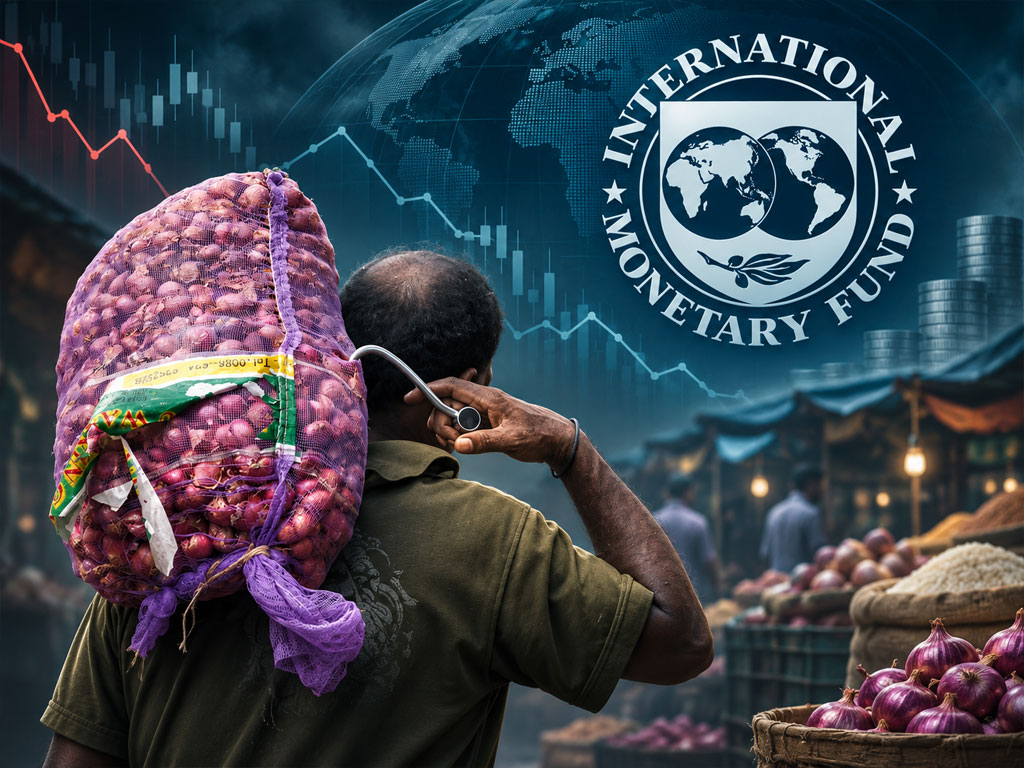
The country’s Extended Fund Facility arrangement with the International Monetary Fund was approved on March 20, 2023, for a 48-month period scheduled to conclude on March 19, 2027.
The programme played an important role in restoring a measure of confidence following Sri Lanka’s financial collapse.
Fiscal consolidation, stronger revenue collection, limits on monetary financing, cost-reflective energy pricing, debt restructuring and reforms to state-owned enterprises formed part of the stabilisation process.
Yet the social cost of adjustment cannot be overlooked.
Higher taxes, increases in administered prices and reduced household purchasing power placed considerable pressure on ordinary citizens, many of whom were already struggling with the consequences of the economic crisis.
An IMF arrangement provides a framework for stabilisation. It cannot substitute indefinitely for a coherent national economic development strategy.
The government must therefore explain how it intends to manage the transition when the present arrangement reaches its scheduled conclusion.
Will Sri Lanka seek another IMF-supported programme, pursue an extension of the existing arrangement if available, or proceed under a domestically developed economic framework?
Each option carries implications for investor confidence, fiscal policy, access to external financing and the country’s ability to meet its debt obligations.
With foreign debt servicing pressures expected to increase in subsequent years, the conclusion of the existing programme will not bring an end to Sri Lanka’s financial responsibilities.
The public deserves a clear explanation of how foreign exchange requirements, debt repayments and future budget deficits will be managed.
If continued IMF assistance becomes necessary, that possibility should be discussed openly rather than presented as a failure or concealed behind political assurances.
Four Sectors Reveal the True State of the Economy
A meaningful assessment of Sri Lanka’s economic condition requires an examination of four interconnected sectors.
- The monetary sector: This includes money supply, interest rates, banking stability, credit availability and inflation control. The Central Bank plays the principal role in maintaining monetary and financial stability.
- The fiscal sector: Government revenue, taxation, expenditure, public borrowing, debt and budget deficits fall within this area. The annual Budget is a central instrument of fiscal policy.
- The external sector: Foreign exchange reserves, the rupee’s value, exports, imports, tourism earnings, workers’ remittances and external debt payments determine the country’s international financial position. Gross official reserves reached approximately US$6.9 billion by the end of August 2026, while the rupee had depreciated by about 6.3% against the US dollar during the first nine months of the year.
- The real sector: Agriculture, industry, construction, transport, fisheries, services and other productive activities determine employment, output and household incomes. This is where the practical consequences of economic policy become most visible.
The fourth sector is particularly important.
An economy may demonstrate improved reserves, greater banking stability and stronger fiscal indicators while substantial sections of the population continue to experience financial hardship.
If farmers receive inadequate returns, industrial enterprises struggle to remain operational, small businesses face declining demand and young people cannot find suitable employment, macroeconomic stability has not yet produced a sufficiently broad-based recovery.
In my assessment, this remains one of the principal weaknesses in the country’s economic performance.
The government has maintained a degree of monetary and fiscal stability, but the benefits have not yet translated sufficiently into improved incomes and opportunities across society.
Stability Is Not the Same as Growth
The government is entitled to recognise the progress made since the economic crisis of 2022.
The severe fuel queues, prolonged electricity interruptions and widespread shortages that characterised that period are no longer features of everyday life.
The banking system has remained operational, foreign exchange reserves have improved and the country has regained some confidence among international financial institutions.
These achievements should not be dismissed.
Nevertheless, economic stability and sustainable economic growth are fundamentally different objectives.
Preventing a vehicle from falling into an abyss is an achievement. Making that vehicle move forward again at the speed required to reach its destination is another challenge entirely.
Sri Lanka has made progress in preventing a return to the worst conditions of its financial collapse.
The more difficult task is generating sufficiently strong and inclusive economic growth to restore household incomes, expand employment and improve living standards.
That requires more than controlling expenditure and meeting fiscal targets.
It demands productive investment, competitive industries, stronger exports, reliable access to credit and an environment in which businesses can expand with confidence.
Inflation and Rupee Depreciation Threaten Household Budgets
Inflation has once again become a significant concern.
Central Bank data show that annual inflation, measured by the Colombo Consumer Price Index, increased to 8% in August 2026 and reached 8.3% in October.
The rise reflects renewed price pressures following a period of substantially lower inflation, with food prices and energy-related costs contributing to the broader economic burden.
For ordinary households, the distinction between inflation and the price level is crucial.
An annual inflation rate of 8% does not mean that goods have become 8% cheaper. It means that average consumer prices are approximately 8% higher than a year earlier.
Even when the inflation rate subsequently falls, the prices households pay do not necessarily return to their previous levels.
Families experience these pressures through the cost of groceries, electricity, transport, education and healthcare.
If wages fail to increase sufficiently to compensate for higher prices, purchasing power declines even when economic statistics indicate that inflation is moderating.
The value of the rupee presents an additional concern.
On November 18, 2026, the Central Bank’s average telegraphic transfer selling rate for the US dollar stood at approximately Rs. 337.24.
A weaker rupee increases the domestic currency cost of imported fuel, medicines, machinery, industrial inputs and other essential products, unless the impact is offset by other factors.
These pressures can increase production costs and eventually affect consumer prices.
For an economy that remains dependent on imported energy and numerous intermediate goods, exchange-rate stability is important not only for financial markets but also for household welfare and business competitiveness.
The Silent Economic Tsunami
I describe these accumulating pressures as a silent economic tsunami.
A physical tsunami is preceded by visible changes and, where warning systems are effective, public alerts.
An economic crisis can develop far less dramatically.
Household expenses gradually increase. Families begin purchasing smaller quantities of food. Parents reduce spending on children’s supplementary education. Patients may struggle to afford prescribed medicines.
Young people consider leaving the country in search of better employment opportunities.
Small businesses reduce their workforce or postpone expansion. Farmers scale back cultivation because their expected returns no longer justify the financial risks.
These changes do not necessarily occur simultaneously, nor do they immediately appear as a dramatic collapse in national economic indicators.
They accumulate quietly across households, communities and industries.
The government may present improving reserves, fiscal discipline and other positive economic indicators, while sections of the lower- and middle-income population experience a gradual erosion of their living standards.
This does not mean that every household is becoming poorer or that the recovery has produced no benefits.
It means that headline indicators alone cannot establish whether those benefits are reaching society broadly enough.
If the pressures continue without an adequate policy response, their social and political consequences could become increasingly serious.
That is the warning behind the metaphor of a silent tsunami.
What Budget 2027 Must Deliver
The government’s immediate responsibility extends beyond preserving the stability achieved since the crisis.
That stability must now be translated into higher production, stronger investment, expanded exports, sustainable employment and improvements in real household incomes.
Capital expenditure allocated in the Budget should be implemented according to realistic schedules and independently assessed economic priorities.
Small and medium-sized enterprises require reliable access to finance, efficient public services and opportunities to enter larger markets.
Agriculture, industry and services must become more closely connected through investment in productivity, transport, processing, technology and export development.
The government must also provide a credible explanation of its economic strategy beyond the scheduled conclusion of the current IMF programme.
Neither fiscal discipline nor public investment should be treated as an end in itself.
Both are instruments intended to strengthen economic resilience and improve the lives of citizens.
Ultimately, a Budget’s success is not determined by the applause it receives in Parliament or the scale of the figures announced by the Finance Minister.
Its value is measured at the household dining table, in the village shop, on the factory floor, across agricultural fields and throughout the labour market.
Those are the places where economic policy becomes everyday reality.
If the warning signs emerging from households and businesses are overlooked, the financial pressures accumulating quietly beneath the Budget’s headline figures may eventually produce consequences far more difficult to manage.