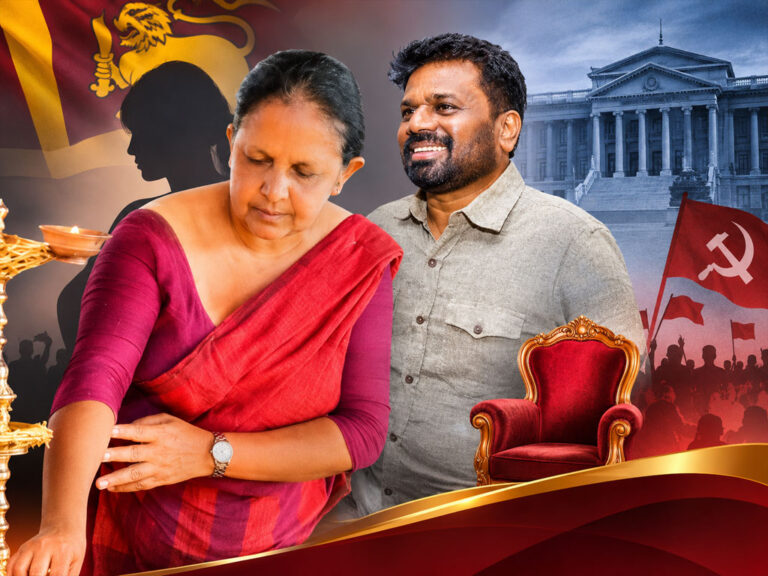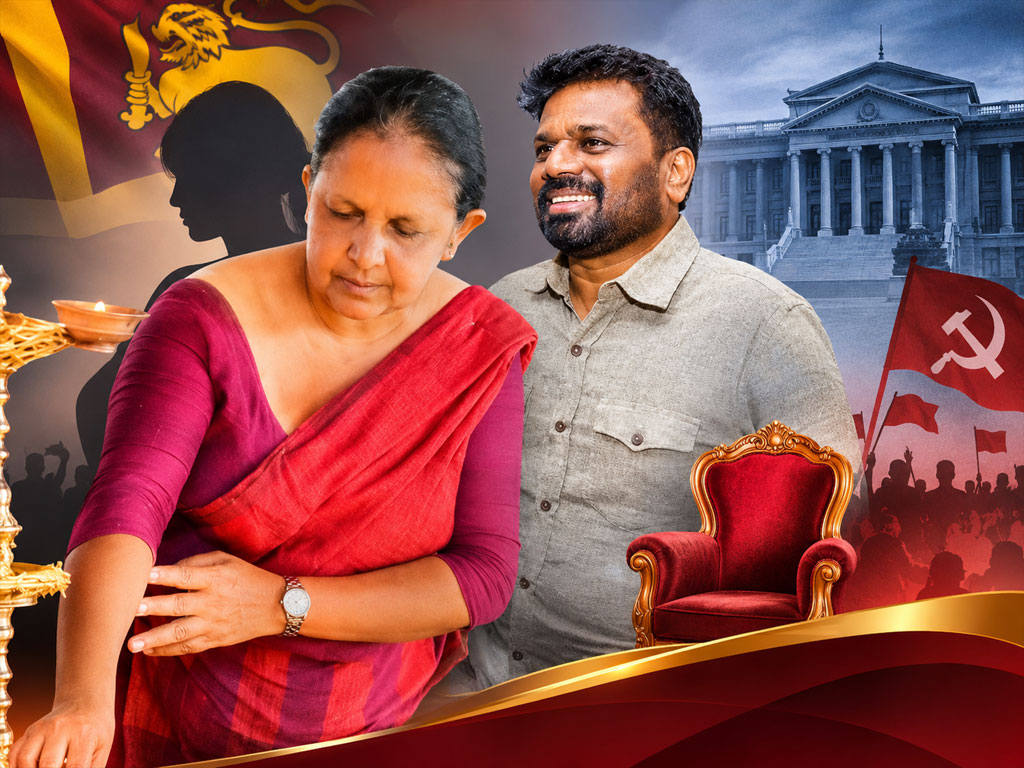
COLOMBO, Sri Lanka, November 29, 2026 — The debate over President Anura Kumara Dissanayake’s wife’s absence from official functions raises a wider question about the First Lady and left-wing politics: can a movement committed to collective leadership reject inherited political privileges while continuing to use traditional imagery to defend its public reputation?
Public discussion surrounding President Anura Kumara Dissanayake’s decision not to involve his wife prominently in official state ceremonies has largely focused on personal circumstances and political speculation. Yet the controversy also offers an opportunity to examine a deeper ideological conflict between liberal democratic traditions and the collective political philosophy historically associated with Sri Lanka’s left.
At the centre of that debate is the concept of the First Lady, a symbolic position traditionally associated with the spouse of a president. Although commonly treated as an established feature of democratic government, the designation raises questions about political privilege, individual achievement, family relationships and inherited social status.
For a political movement such as the Janatha Vimukthi Peramuna (JVP), whose historical identity is rooted in collective organisation and class-based political struggle, the question is particularly relevant.
The argument examined here is not whether a president’s spouse should participate in public life. Rather, it concerns whether political recognition should arise from individual involvement and public responsibility or be acquired through marriage to a political leader.

The First Lady and the Traditions of Liberal Democracy
In the United States, presidential spouses frequently participate in official ceremonies, diplomatic engagements and public initiatives. President Donald Trump’s wife, Melania Trump, has occupied the position of First Lady, reflecting a longstanding American political convention.
Similar forms of spousal participation exist in several other democracies, although their constitutional arrangements and ceremonial practices differ.
Within liberal democratic political thought, leadership is generally understood to emerge through individual political rights, electoral competition and the exercise of popular sovereignty.
A person may rise to the presidency or another position of authority through political participation, leadership abilities and electoral success.
Titles such as “His Excellency” also reflect longstanding conventions surrounding political office. From a critical ideological perspective, such forms of address can be interpreted as expressions of distinction and hierarchy within institutions that otherwise uphold political equality.
Nevertheless, these conventions cannot simply be regarded as the inevitable products of liberal democracy. Some are inherited from older diplomatic, monarchical and social traditions that have continued within modern political institutions.
The title of First Lady presents a particularly interesting contradiction.
Unlike the presidency, it is not ordinarily acquired through an electoral mandate. Its public significance arises from the office held by another individual, usually the person’s spouse.
Consequently, a democratic system that places considerable emphasis on individual rights and political achievement may simultaneously recognise a ceremonial position based primarily on a family relationship.
Collective Leadership and the Political Philosophy of the Left
The historical foundations of left-wing politics differ from political traditions centred on individual leadership and personal prestige.
Marxist and other socialist movements have traditionally emphasised collective organisation, class struggle, shared political objectives and the participation of organised groups in social transformation.
Within this framework, a political leader’s position is understood not merely as the product of individual talent but also as the outcome of collective political activity.
The JVP’s historical political identity has been closely associated with this understanding of leadership.
From that perspective, the argument against automatically granting the president’s spouse a prominent political or ceremonial position becomes clearer.
Marriage to a president does not, by itself, establish an independent political mandate or a role within the party organisation.
If the president’s spouse were actively involved in JVP politics, the collective leadership principle would suggest that her responsibilities should arise through the party’s organisational processes rather than automatically through her husband’s office.
The distinction is important because it separates personal relationships from political legitimacy.
A spouse may independently choose to participate in public affairs, undertake charitable activities or pursue a political career. Such participation, however, need not depend upon the assumption that marriage automatically confers political authority.
Does Liberal Democracy Deliver Genuine Political Equality?
A critical interpretation of liberal democracy argues that formal political equality does not necessarily produce equality in economic resources, social influence or access to political power.
Several examples illustrate this distinction:
- All citizens may be equal before the law, but they do not possess equal economic or social influence.
- Every citizen may enjoy the legal freedom to participate in politics, but the resources required to enter political life are not distributed equally.
- Each voter generally possesses one vote, yet wealthy individuals, corporations and influential media organisations may exercise political influence extending beyond the ballot.
These differences form part of a longstanding debate about the relationship between political democracy and economic inequality.
From a Marxist perspective, individual freedom and formal equality can coexist with social structures that reproduce unequal power relationships.
Within that interpretation, the First Lady’s status may be viewed as another example of how inherited privilege and family connections continue to operate within institutions founded on democratic legitimacy.
It is therefore possible to question whether a ceremonial position acquired through marriage is consistent with the principle that public recognition should arise from independent political participation or achievement.
Such criticism does not establish that liberal democracy rejects genuine individual freedom. Rather, it challenges the extent to which democratic institutions successfully separate public authority from established social hierarchies.
Why President Dissanayake’s Approach Matters
President Anura Kumara Dissanayake’s comparatively limited public presentation of his wife at official political engagements has attracted criticism and speculation among political opponents.
Some have interpreted that absence through conventional expectations about presidential families, while others have raised questions about his personal circumstances.
Those personal allegations should not be treated as established facts without credible supporting evidence.
A more substantive political discussion concerns whether the president’s approach reflects the JVP’s historical commitment to collective political identity.
Under that interpretation, declining to create a prominent ceremonial role for his wife could be consistent with the argument that political recognition should not automatically extend to the families of elected officials.
Whether this is the president’s stated motivation cannot be established merely from her absence at particular events.
Nevertheless, the distinction between personal political legitimacy and family-derived ceremonial status remains relevant to understanding the ideological debate.
The question becomes more significant when considered alongside Sri Lanka’s longstanding traditions of political families and dynastic succession.
Political influence has repeatedly passed between relatives, including spouses and children, throughout the country’s history.
Recent speculation concerning the possible political future of Limini Rajapaksa, the wife of Namal Rajapaksa, illustrates how family relationships continue to feature prominently in discussions about political leadership.
Such speculation, however, does not establish that she intends to pursue elected office, including the presidency in 2029.
The JVP’s Response and Its Ideological Contradiction
The central criticism directed at the JVP concerns not the president’s decision to keep his wife outside the traditional public role of First Lady, but the party’s alleged response to political criticism surrounding that decision.
According to the argument advanced in the original commentary, photographs showing the president’s wife participating in Buddhist religious observances, including Bodhi Pooja ceremonies, have circulated on social media in ways that appear intended to answer questions about her public role.
The commentary specifically refers to photographs reportedly involving Public Security Deputy Minister Ananda Wijepala.
The extent to which those images were officially promoted or coordinated by the JVP, rather than circulated independently by supporters and social media users, requires verification.
The ideological criticism nevertheless deserves examination.
If a political movement rejects the assumption that a president’s spouse must perform a traditional ceremonial role, responding to criticism by presenting conventional images of marital devotion and religious observance may reinforce the expectations it seeks to challenge.
Such a response risks shifting the debate away from political principles and towards the public presentation of the president’s family.
The contradiction is not religious participation itself. A president’s spouse retains the same freedom as any other citizen to practise religion and participate in private or public religious activities.
Rather, the question concerns the political use of those activities as evidence of personal respectability or as a response to criticism.
If traditional imagery is deliberately used to satisfy conventional expectations, a movement that claims to reject those expectations may find itself reproducing them.
Political Tactics Can Reinforce the Ideologies They Oppose
The distinction between ideological beliefs and political behaviour is central to this argument.
A political organisation may publicly reject particular social conventions while continuing to use them strategically when attempting to secure public approval.
Such behaviour can create a contradiction between its declared philosophy and its everyday political practices.
From a critical materialist perspective, ideology operates not only through explicit beliefs and political statements but also through the social activities, institutions and routines that people reproduce.
A movement may therefore reinforce an established political convention even while insisting that it does not accept the principle behind it.
This creates a particular challenge for the JVP.
If its ideological position is that presidential spouses should not automatically receive political recognition, the more consistent response would be to explain that principle directly.
Attempting to defend the president through traditional representations of family life may instead validate the very assumptions the movement should be questioning.
Political communication designed to achieve an immediate advantage can consequently weaken the credibility of a longer-term ideological position.
Beyond Personal Gossip: A Test of Political Consistency
The debate over Sri Lanka’s First Lady should not be reduced to speculation about the president’s marriage or the personal decisions of his family.
Neither should it be used to suggest that spouses of political leaders must remain invisible or be denied the freedom to participate in public life.
The more important distinction concerns the difference between voluntary public participation and ceremonial privilege acquired automatically through marriage.
A president’s spouse can exercise independent political rights without necessarily occupying an institutional position derived from the presidency.
Equally, a political party committed to collective leadership must decide whether its public conduct reflects the principles it advocates.
For the JVP, this presents a wider question about the relationship between ideology and political strategy.
Can the party preserve its historical commitment to collective political organisation while operating within a democratic system shaped by longstanding traditions of personal leadership, family symbolism and ceremonial status?
The answer will depend less on how the president’s wife appears in public and more on how consistently the governing movement applies its stated political principles.
Ultimately, the ideological contradiction arises when a political organisation rejects a convention in theory but relies upon that same convention when seeking public acceptance.
If the JVP considers the traditional First Lady role inconsistent with its political philosophy, explaining that position openly would provide a stronger foundation than attempting to defend itself through the very social expectations it questions.
The wider issue is therefore not the conduct of the president’s wife but the ability of a governing political movement to reconcile its declared ideology with the political practices it chooses to maintain.